How many times a light bulb blinks in 60 Hz AC

Thread Starter

Alchemy One

Joined Oct 5, 2019
217
There are two voltage peaks in each cycle, one positive and the other negative. Incandescent light bulbs don't care about polarity, and so will reach a peak of brightness on each of the voltage peaks. This repeats 60 times a second, therefore there will be 120 brightness peaks per second.

You can confirm this by taking a light sensor (photodiode or phototransistor) and hooking it up to your oscilloscope, and shining an incandescent light on it.
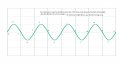
In my graph below my attempt was to represent 4 HZ of AC. If you find the graph acceptable, at what of those points the current change direction. I have labeled certain points in the graph. If you think none of them points represent change in direction of current you may attach another sine wave 4 HZ diagram and show the points you think represent change in current direction. I really like to keep the light flickers out of this as I feel that maybe argued to no end. It is because AC is not pulsed DC and pulsed DC is not change in direction of current. With my fidget gadget I flicker its led bulb all day due to little magnets sitting top of it passing a hall sensor. I can increase the speed until the light flickers no more or I think it doesn't anyway. So light flickers is not really the subject of my concern at all. I only meant as a quick pointer but that seem to open a can of worms and not just here. :)
Thank you so much.
 

Attachments

OBW0549

Joined Mar 2, 2015
3,565
I know somewhere around here I have some photo diodes (transistors) that were spares for my ballistic chronograph. I guess if I could find them I could look at a scope and see what we have.
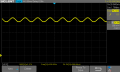
I took a photodiode and a 1 kΩ series resistor and biased them with 5.0VDC, and monitored the voltage across the resistor with my Siglent scope and a DVM. With a 50W desk spot shining on the diode, I got a peak-to-peak variation in diode output of 300 mV riding on an average value of 2.4 V. So about 12.5% ripple at 120 Hz.

PNG0001.png
 

ErnieM

Joined Apr 24, 2011
8,415
Next week we can move along to the direction of current flow, that's always fun to have a deja vu experience. :)
That's my favorite because the only correct answer is current flows in the opposite direction as the electrons do, and that just makes people's heads aspload.


In my graph below my attempt was to represent 4 HZ of AC. If you find the graph acceptable, at what of those points the current change direction. I have labeled certain points in the graph. If you think none of them points represent change in direction of current you may attach another sine wave 4 HZ diagram and show the points you think represent change in current direction.
Graph is not labeled. It indicates no quantities, only a wavy line.

It indicates this is an "AC" something, so it is marked as "alternating CURRENT." Thus the current alternates between + and - which means by definition than the direction also changes.
 

Reloadron

Joined Jan 15, 2015
7,914
I took a photodiode and a 1 kΩ series resistor and biased them with 5.0VDC, and monitored the voltage across the resistor with my Siglent scope and a DVM. With a 50W desk spot shining on the diode, I got a peak-to-peak variation in diode output of 300 mV riding on an average value of 2.4 V. So about 12.5% ripple at 120 Hz.

View attachment 202003
Thanks a bunch for doing that and I seriously my eye would pick up on that. This also spares me looking for photo diodes when I haven't a clue where I last saw them. :) So I think we can say (well you can say) with some authority, depending on how we define "blink" there is no blink.

Ron

Ron
 

Analog Ground

Joined Apr 24, 2019
460
I took a photodiode and a 1 kΩ series resistor and biased them with 5.0VDC, and monitored the voltage across the resistor with my Siglent scope and a DVM. With a 50W desk spot shining on the diode, I got a peak-to-peak variation in diode output of 300 mV riding on an average value of 2.4 V. So about 12.5% ripple at 120 Hz.

View attachment 202003
Do you have a fluorescent lamp? The signal is quite different.
 

OBW0549

Joined Mar 2, 2015
3,565
Thanks a bunch for doing that and I seriously my eye would pick up on that. This also spares me looking for photo diodes when I haven't a clue where I last saw them. :) So I think we can say (well you can say) with some authority, depending on how we define "blink" there is no blink.
Even if the light level were to drop to zero between peaks I doubt you would end up seeing any flicker, as the frequency is much higher than the 25-30 Hz flicker fusion rate for the human eye.
 

Reloadron

Joined Jan 15, 2015
7,914
Even if the light level were to drop to zero between peaks I doubt you would end up seeing any flicker, as the frequency is much higher than the 25-30 Hz flicker fusion rate for the human eye.
I have seen people claim that in a LED they can see 60 Hz. I never could. Not anymore than my eyes can perceive it in a fluorescent tube.

Ron
 

nsaspook

Joined Aug 27, 2009
16,459
I have seen people claim that in a LED they can see 60 Hz. I never could. Not anymore than my eyes can perceive it in a fluorescent tube.

Ron
The thing about 60Hz flicker is that some people (I can't see it usually) can easily detect it on a fast LCD monitor. The upper limit on light code change detection in the eye is higher than 60Hz in many people using bright, fast, high contrast displays.

https://en.wikipedia.org/wiki/Flicker_fusion_threshold
 

wayneh

Joined Sep 9, 2010
18,135
I have seen people claim that in a LED they can see 60 Hz. I never could. Not anymore than my eyes can perceive it in a fluorescent tube.

Ron
Your eyes and brain detect it even if you’re not conscious of it. That’s why computer monitors are rarely set as low as 60Hz anymore - it’s very fatiguing.

I once cut myself at work and was close to passing out before I got outside (which immediately stopped the fainting feeling). As the world was collapsing into tunnel vision, I could see every flicker of the fluorescent lighting that I was normally unaware of. Quite disturbing.
 

Thread Starter

Alchemy One

Joined Oct 5, 2019
217
I took a photodiode and a 1 kΩ series resistor and biased them with 5.0VDC, and monitored the voltage across the resistor with my Siglent scope and a DVM. With a 50W desk spot shining on the diode, I got a peak-to-peak variation in diode output of 300 mV riding on an average value of 2.4 V. So about 12.5% ripple at 120 Hz.

View attachment 202003

If I build a power generator, more like power alternator motor with the following rather unusual configuration, not sure if it can or has been done. Instead of say a rotor go 60 times around a pair of stator magnet each second 3600 times a minute, that is a lot of spinning and wear and tear on everything. How about the other extreme, not covering three phase supply.
The rotor is made of 60 pair of conductors and the stator 60 pair poles magnets, single phase. Actually make that more like one pair pole rotor and 60 pair pole stator electromagnets. Although I have a motor with 8 pair magnet rotor and heaven knows how many poles on the stator winding, although it is a three phase and with 3 hall sensors.
Would I get 60 cycles if the rotor rotated full circle just once at whatever speed?
 
Last edited:

wayneh

Joined Sep 9, 2010
18,135
The EMF developed in any coil depends on how quickly the magnetic field moves past it. It will always be true that more speed equals more power. You design to go fast, to minimize magnets and copper wire, which are both expensive.
 

Thread Starter

Alchemy One

Joined Oct 5, 2019
217
Thanks a bunch for doing that and I seriously my eye would pick up on that. This also spares me looking for photo diodes when I haven't a clue where I last saw them. :) So I think we can say (well you can say) with some authority, depending on how we define "blink" there is no blink.

Ron

Ron
Ron, Do you remember me? Do you remember us fight tooth and nail more or less how many times current changed direction. I said 120 and you had every evidence that it was 60 and your scope and what have and the internet also backed you up you said.
So what is going to be? Are you holding your position now here in the same site, same me, same you... well more or less same. Are you going to fight tooth and nail here now that it is 60 times after I was squeezed in the grinder and chewed up by not just one but the entire gang of most intelligent folks. You were not the only one and you know it. If you didn't catch it, Well it was a clan again just me. And here you can still smell their presence, calling me a troll or whatever other names they savor
If you think what I say now is false and that you never said and maintained the 60 figure. guess what. here Is you in your bold response
Here is me:
"
How many times the direction of current change in one second in our so-called 60 Hz AC system?
Everybody seems to say it is 60 times a second.
I think it is false. What am I missing?"

Here is you: "
My scope says that my 60 Hz house current (when there is a load) changes direction 60 times per second, my frequency counter seems to agree with that so I have to agree with the consensus.
I also read this on the Internet:
"An alternating current will flip the direction of charge flow (60 times a second in North America (60 Hz) and 50 times a second in Europe (50 Hz)). This is usually caused by a sinusoidally varying current and voltage that reverses directions, creating a periodic back and forth motion for the current".
It's pretty common knowledge that they can't put stuff on the Internet unless it is true so it must be true. I also read that on the Internet. "

By the way while you go along with the herd...going with consensus. I despise consensus. To not stand alone, to not be in the presence of one's own being, to not be one's own true timelessness, authenticity is to not be alive. To follow along is dead of the graveyard. It has no fragrance, no beauty. It is to be a copy cat, it is to be a coward. it is to be a fake. It is to go through life with your face borrowed. I RATHER BE DEAD NOW THAN TO LIVE THAT WAY.

And that was just the tip of iceburg. I was and am the troll. right?
So for old times sake. How many times current change direction in our 60 HZ power system?
Go head. Remember I was just starting to learn. I am the type of person that I absolutely can not conform or accept anything until I am fully convinced and not because everyone else understands it. I consider the collective and the majority absolutely appalling and dangerous copy cats who make noise when beat on the outside and hallow on the inside. like a drum. And the name callings, like cowards their strength come from numbers. It makes me sick to my stomach how sick people are inside. And I mean right here. and right now. Those troll calling imabaciles are even here in this thread throwing their foul odor at me so callous and with thick skin they can't smell their foul stench.
What says in the internet you said:
This internet?

Or one that you can put here?

Or this one below?
Find it in your own typing here. Plus aren't you going to argue with ObW0509? Why not?
.https://forum.allaboutcircuits.com/threads/60-hz-ac-system-change-in-direction-of-current.163811/
 
Last edited:

Thread Starter

Alchemy One

Joined Oct 5, 2019
217
Here's another thing you can try: Connect an incandescent bulb to an AC source. I'd recommend a 12 volt transformer and an automobile bulb. Notice it's full (apparent) brightness. Then add a single diode into the circuit. The bulb will be half as bright. (assuming you're using a powerful enough transformer)

I'm not entirely sure on this but I think hair dryer fans are half wave or full wave rectified. During half wave rectification the motor runs on Low. During FULL rectification the motor runs on High. As for the heat elements - I'm not sure at all how they change the heat, so I'll leave that part alone.
Perhaps this could be considered a reasonable animation.
 

Reloadron

Joined Jan 15, 2015
7,914
Ron, Do you remember me? Do you remember us fight tooth and nail more or less how many times current changed direction. I said 120 and you had every evidence that it was 60 and your scope and what have and the internet also backed you up you said.
So what is going to be? Are you holding your position now here in the same site, same me, same you... well more or less same. Are you going to fight tooth and nail here now that it is 60 times after I was squeezed in the grinder and chewed up by not just one but the entire gang of most intelligent folks. You were not the only one and you know it. If you didn't catch it, Well it was a clan again just me. And here you can still smell their presence, calling me a troll or whatever other names they savor
If you think what I say now is false and that you never said and maintained the 60 figure. guess what. here Is you in your bold response
Here is me:
"
How many times the direction of current change in one second in our so-called 60 Hz AC system?
Everybody seems to say it is 60 times a second.
I think it is false. What am I missing?"

Here is you: "
My scope says that my 60 Hz house current (when there is a load) changes direction 60 times per second, my frequency counter seems to agree with that so I have to agree with the consensus.
I also read this on the Internet:
"An alternating current will flip the direction of charge flow (60 times a second in North America (60 Hz) and 50 times a second in Europe (50 Hz)). This is usually caused by a sinusoidally varying current and voltage that reverses directions, creating a periodic back and forth motion for the current".
It's pretty common knowledge that they can't put stuff on the Internet unless it is true so it must be true. I also read that on the Internet. "

By the way while you go along with the herd...going with consensus. I despise consensus. To not stand alone, to not be in the presence of one's own being, to not be one's own true timelessness, authenticity is to not be alive. To follow along is dead of the graveyard. It has no fragrance, no beauty. It is to be a copy cat, it is to be a coward. it is to be a fake. It is to go through life with your face borrowed. I RATHER BE DEAD NOW THAN TO LIVE THAT WAY.

And that was just the tip of iceburg. I was and am the troll. right?
So for old times sake. How many times current change direction in our 60 HZ power system?
Go head. Remember I was just starting to learn. I am the type of person that I absolutely can not conform or accept anything until I am fully convinced and not because everyone else understands it. I consider the collective and the majority absolutely appalling and dangerous copy cats who make noise when beat on the outside and hallow on the inside. like a drum. And the name callings, like cowards their strength come from numbers. It makes me sick to my stomach how sick people are inside. And I mean right here. and right now. Those troll calling imabaciles are even here in this thread throwing their foul odor at me so callous and with thick skin they can't smell their foul stench.
What says in the internet you said:
This internet?

Or one that you can put here?

Or this one below?
Find it in your own typing here. Plus aren't you going to argue with ObW0509? Why not?
.https://forum.allaboutcircuits.com/threads/60-hz-ac-system-change-in-direction-of-current.163811/
Yeah, I remember, matter of fact I remember I decided I would not bother with your post, only other forum members. Yes, I see you as a troll or hopeless pedantic.

Thank YOu & Have a Nice Day
Ron
 

Tonyr1084

Joined Sep 24, 2015
9,744
Will say this one last time - then bow out of this conversation: 1Hz has a positive going wave form at the start. It hasn't changed direction yet, but it's going positive. Then it peaks. Then it changes direction for the first time as it starts going toward the negative side. It then peaks at its negative peak, then changes direction again for the second time, returning to the zero point where we started counting this whole thing. That's 1Hz.

How will a scope name it? "One Hertz!" It hasn't changed direction once, it has changed twice. To say your scope says it's 1Hz is accurate because it is exactly that - "One Hertz". The question is "how many times does current change direction in 60Hz?" While it is 60Hz, current changes direction 120 times. As seen in the 1Hz example changing direction twice, so too does 60Hz change direction 120 times.

Have a good day ladies and gentlemen.
 

MaxHeadRoom

Joined Jul 18, 2013
30,771
I believe there is some confusion differentiating between one cycle (Hz) which is the repetition rate of a COMPLETE cycle.
And the result that occurs when answering the question mentioned in title of the original post. ;)
Max.
 
Top