How many times a light bulb blinks in 60 Hz AC

gyrgrls

Joined Apr 20, 2021
2
I recall in the UK when florescent fittings became popular, they emitted an almost imperceptible flicker (50Hz supply).
This led to accidents in machine shops due to the strobe effect on spindles etc appearing stationary..
The answer was to place the fittings in the shop across 3phases with each fitting on a separate phase.
Max.

Now, older fluorescent fixtures with magnetic ballasts had this power line flicker problem. Modern electronic ballasts have their predominant flicker at maybe 40 kHz. However, there may still be some 120 Hz modulation on the 40 kHz carrier, due to less-than-perfect filtering of the mains voltage within the fixture. Infiltered three-phase full-wave-rectified mains current has about 11% ripple, so the total ripple of light mixed intensity from three fixtures could be reduced by 85% or more. Phase shift in each ballast is irrelevant since the ripple of the light OUTPUT of the three lamps will be 120 degrees out of phase as everything is relative at this point... So, multiplying the ripple output in light intensity from each lamp by 0.11 should, in theory, render the MINIMUM average ripple from an area more or less evenly illuminated from all three lamps. In practice, the multiplier might be more on the order of 0.15, due to the variance in distance, thus intensity, between each lamp and the workspace. The predominant flicker rate would be the sixth harmonic of the mains frequency (two zero-crossings per phase multiplied by three phases).

However, a 40 kHz flicker from an electronically ballasted fixture can be even more problematic. I once had a desk lamp on an end table by my couch, and it interfered with the TV remote. The remote would not work at all while the lamp was on. The lamp had a CFL installed, and the 40 kHz flicker from its output was jamming the infrared receiver in the TV set. Switching to an incandescent bulb solved the problem.
 

MrAl

Joined Jun 17, 2014
13,852
Hi,

This is kind of an ancient thread ha ha , but still interesting.

Back in post #13 i described using a scope to view the fluctuations in bulb intensity with a light sensor. The output from the sensor shows a 120Hz modulation with a 60Hz driven bulb.
But there was a little typo i should clear up. That is, when you connect a diode in series with the bulb it will only blink once per cycle (60Hz) and i typed "once per second" which was a typo.

Many years ago i made a simple remote control with a receiver made from a simple light detector, it might have been a LDR or a pin diode, cant remember, but the overhead incandescent bulb flicker interfered with the sensor to a very large extent, as the sensor had to detect a very small light output form a small LED maybe 15 feet away while the 60 watt bulb might have been 8 feet away and much brighter, by a huge factor. I had to use a filter with several capacitors and resistors, maybe 8th order, to filter out the bulb and let the higher frequency light fluctuations from the LED through. IT worked but the filter had to be of high order.

Today however, you can buy ready made sensor/detectors that are actually made for whatever frequency you want to operate with, and microcontrollers that you can use to generate the LED pulses so you can make a really good remote today with a ton of different codes. Things have progressed a lot in this area over the decades past.

Oh for a little bit of a laugh, "Tony" back in post #14 described the line current (60Hz) as some sort of sentient being. It was funny, thanks Tony. I think i like comedy as much as electronics ... well, almost :)
 

BillB3857

Joined Feb 28, 2009
2,573
I have read this thread with some enjoyment, and it reminded me of the "Dark Sucker Theory", which I will post only the meat of the three page discussion.
The Dark Sucker Theory states that any given source of light “[doesn’t] emit light; [it] sucks dark. Thus we call these [sources] dark suckers.” This theory focuses on three main points: darkness is existent, darkness has a mass heavier than that of light, and that dark is faster than light.
 

MrAl

Joined Jun 17, 2014
13,852
Blinks twice per cycle.
So in 60 Hz, it blinks 120 times.
Hello again,

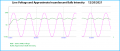
I dont know if i can call it 'blinking' i think i would call it more like 'modulated' because it does not really turn on and off 120 times per second with a 60Hz line frequency, it more or less just undulates up and down about some constant level as the graph below shows.
As we can see, the intensity builds up at first, then once it gets up to a certain level it stays within some smaller range. It increases slightly then decreases slightly, then back up then back down again, but never reaching zero, at least until the power is cut entirely.

This is approximately what you see with a scope when you use the scope to monitor the bulb intensity with some kind of light sensor that provides a voltage output that corresponds to light intensity.
The reason it does not always go to zero is because the filament stays hot and so still provides some light even though the voltage has decreased significantly.

The graph below shows the intensity for a normal 120v bulb such as 60 watts, but the up and down amplitude will depend highly on the mass of the filament. The start up time also depends on the mass of the filament and the cool down time will too, and with some larger bulbs like 300 watts you can actually see it dim over maybe a 1 second period because the filament takes time to cool down.

RoughBulbIntensity60Hz-01.png
 

MisterBill2

Joined Jan 23, 2018
28,485
For an entertaining example of "blinking", observe the rear red lights of some cars that use the same LEDs for stop and tail lights, Quickly move your field of view and observe that the light seems to be off and on across the path generated by visual persistence. LEDs are much faster than incandescent lights.
AND I do not like trolls!!!
 

MaxHeadRoom

Joined Jul 18, 2013
30,868
For an entertaining example of "blinking", observe the rear red lights of some cars that use the same LEDs for stop and tail lights, Quickly move your field of view and observe that the light seems to be off and on across the path generated by visual persistence. LEDs are much faster than incandescent lights.
AND I do not like trolls!!!
Someone put together a Xmas novelty a few years back, it was a Picmicro that fed a row of 8 LED's when you switch on they are all flashing at a high rate.
But if you wave the LED strip back and forth rapidly, they can be seen to spell out Merry Christmas. :cool:
 

Audioguru again

Joined Oct 21, 2019
6,826
Someone put together a Xmas novelty a few years back, it was a Picmicro that fed a row of 8 LED's when you switch on they are all flashing at a high rate.
But if you wave the LED strip back and forth rapidly, they can be seen to spell out Merry Christmas. :cool:
I have a portable fan that has a row of 7 LEDs on one blade. When spinning the LEDs spell out slowly adding one letter, "Recall Empowering You". Recall was the name of the company.
A label on it says Made In China. Do not eat. For longer battery life turn off when not in use.
 

MrAl

Joined Jun 17, 2014
13,852
Yes persistence of vision plays a part in how us humans see things that change but our eyes and brain tend to average everything out (integration over time is like an averaging).
If you still have an LED calculator or clock, you can do the movement experiment what that too. Move the calculator back and forth while staring at the display and you will be able to see part of the multiplexing scanning of the LED segments. It's also a sort of visual analogy for how we as humans see quantum effects, than average out into what we perceive as a solid object.

I believe that some coatings on fluorescent bulbs have some persistence also because of the way the phosphors react to the exciting photons.
 

MisterBill2

Joined Jan 23, 2018
28,485
Yes persistence of vision plays a part in how us humans see things that change but our eyes and brain tend to average everything out (integration over time is like an averaging).
If you still have an LED calculator or clock, you can do the movement experiment what that too. Move the calculator back and forth while staring at the display and you will be able to see part of the multiplexing scanning of the LED segments. It's also a sort of visual analogy for how we as humans see quantum effects, than average out into what we perceive as a solid object.

I believe that some coatings on fluorescent bulbs have some persistence also because of the way the phosphors react to the exciting photons.
Certainly the coating on at least quite a few florescent tubes has a fair amount of persistence. I dicovered that in 1964 trying to make them flash. They do not flash very well, the coating takes time to glow and it takes time to decay. It was slow enough to see.
 

MrAl

Joined Jun 17, 2014
13,852
Certainly the coating on at least quite a few florescent tubes has a fair amount of persistence. I dicovered that in 1964 trying to make them flash. They do not flash very well, the coating takes time to glow and it takes time to decay. It was slow enough to see.
Hi there,

Would you happen to know the chemical composition of the phosphor used on the bulbs you tested?
There are quite a few different ones which can also vary the color temperature.
I usually prefer cool white, but i also like a slightly less cool now as the color rendition of objects viewed under the light look more realistic, such as resistor color codes. I used these lights a lot in the past and certainly preferred them over incandescent bulbs, but now i use LED bulbs exclusively. I may have one of those curly bulbs left though.
 

Thread Starter

Alchemy One

Joined Oct 5, 2019
217
I have a portable fan that has a row of 7 LEDs on one blade. When spinning the LEDs spell out slowly adding one letter, "Recall Empowering You". Recall was the name of the company.
A label on it says Made In China. Do not eat. For longer battery life turn off when not in use.
======================================================
At last an answer worth reading. Just when I thought you didn't have it in you. Surprise... :)
 

MisterBill2

Joined Jan 23, 2018
28,485
I have no hint as to the chemical makeup of the phosphor coating of those tubes. AND 1964 was a long time back. They were probably F40CW because that was the color we always chose. And the choices at the time were WW and CW, warm white and cool white, although colored tubes were also available.
 

Reloadron

Joined Jan 15, 2015
7,975
There was a discussion sometime back about a neon bulb, a small neon bulb. The thread starter claimed after power was removed the lamp continued to glow. Finally after many post and image of this magic neon bulb was posted. The bulb had a phosphorescent coating. Go figure. When power is removed the bulb in question would glow for a min or two.

As to a incandescent bulb "blinking"? They don't, not at 50 or 60 Hz anyway. Post #46 covers that well.

Ron
 

MisterBill2

Joined Jan 23, 2018
28,485
There was a discussion sometime back about a neon bulb, a small neon bulb. The thread starter claimed after power was removed the lamp continued to glow. Finally after many post and image of this magic neon bulb was posted. The bulb had a phosphorescent coating. Go figure. When power is removed the bulb in question would glow for a min or two.

As to a incandescent bulb "blinking"? They don't, not at 50 or 60 Hz anyway. Post #46 covers that well.

Ron
I recall that post and our amazement when we saw that it was NOT a regular neon bulb. Misleading questions usually lead to inadequate answers.
And while an hot filament bulb does not blink, some of them do have a bit of ripple on the light output. Does it matter?? I don't think so.
 
Top