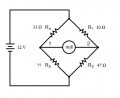
Yes, as it is in that diagram. The two points do not have to be the two ends of one resistor.Can't voltage only be measured between two points?
Yes, the two points are node 1 and node 2.Can't voltage only be measured between two points?
There is a voltage drop at node 1 due to Ra and Rb.How is the null measuring the volt drops when the wire connecting it to the resistors only makes contact with one end of each resistor?
The null detector, as the name implies, is only concerned with detecting when there is NO voltage across it. Thus it can be a very sensitive device that can tell you when current is flowing to the left through it or through the right through it, but there is no concern about accuracy or calibration, just that when NO current is flowing through it, you can tell that that is the case.How is the null measuring the drops across any of these resistors?
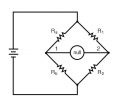
View attachment 302004
Can't voltage only be measured between two points? How is the null measuring the volt drops when the wire connecting it to the resistors only makes contact with one end of each resistor?
Isn't it not possible to have volt drops along wires due to the low resistance?There is a voltage drop at node 1 due to Ra and Rb.
There is also a volage at node 2 due to R1 and R2.
The null voltage being measured is the voltage difference between those two voltages.
Remove the null meter from the circuit. You have two paths from top to bottom, one through Ra and Rb and the other through R1 and R2.Isn't it not possible to have volt drops along wires due to the low resistance?
Of course.Isn't it not possible to have volt drops along wires due to the low resistance?
Your explanation helps, thank you.But what if Va is the same as V1. If we were to insert a conductor, bit it a wire, a resistor, or a current meter, between the two points, would you agree that no current would flow at all?
That's what the purpose of a null detector is -- to detect when the voltage on one side of it is exactly the same as the voltage on the other.
A node is essentially any point where we can connect components together. It's also called a junction sometimes. We assume that the node consists of ideal wires (i.e., zero resistance and no parasitic values such as inductance) so that the voltage on any point of a node is exactly the same as every other point on that same node.Your explanation helps, thank you.
However I have to ask, how are the resistors making both sides of the null have equal voltage? Also, is a node not just wire, is it actually a component in the circuit?

The null detector in this circuit isn't being used to detect the voltage drop across ANY individual resistor. A volt meter (of which a null detector is merely a very simple version) can ONLY provide information about the voltage drop ACROSS the METER.I thought that in order for the null to detect the volt drop across each individual resistor it would have to be connected across them like how a voltmeter measures voltage. The null measuring voltage by contacting two different points of two resistors as opposed to the two ends of each resistor didn't make sense to me. It also confused me how the null can detect when the two sides of it have the same voltage when the wires on both of it's sides have no voltage to begin with.
It does not have to detect the voltage drop across any of the resistors. When you start with a false premise anything you conclude is invalid.I thought that in order for the null to detect the volt drop across each individual resistor it would have to be connected across them like how a voltmeter measures voltage.
You are looking at this from a purely theoretical point of view which is making it so difficult to understand. I suggest that you read about the "Wheatstone Bridge", which uses null detection in a very practical way to accurately measure the resistence of unknown components:Your explanation helps, thank you.
However I have to ask, how are the resistors making both sides of the null have equal voltage? Also, is a node not just wire, is it actually a component in the circuit?
Could you explain the meaning of each part in that formula and how it gives the voltages of the nodes in reference to the bottom node?The voltage from Node 2 to the bottom node is given by:
V2 = 12 V * ( 47 Ω / ( 10 Ω + 47 Ω ) ) = 9.895 V
Now let's say that we adjust Rb until the meter is nulled, meaning that it has zero volts across it and, hence, no current flowing in it.
That means that V1 must also be 9.895 V with respect to the bottom node, too. But V1 is given by:
V1 = 12 V ( Rb / ( 33 Ω + Rb ) )
From this, we can determine what the value of Rb is 155.12 Ω.
It is the equation for a voltage divider, essential to understanding the circuit.Could you explain the meaning of each part in that formula and how it gives the voltages of the nodes in reference to the bottom node?
Oh, you're right, I just read it wrong.It is the equation for a voltage divider, essential to understanding the circuit.
I could, but I really don't think that will do you any good -- in fact, it would likely be to your detriment because you would be at severe risk of thinking you have learned something when you really haven't. The fact that this isn't second nature to you is yet further evidence that you are trying to work beyond your current level of comprehension. The result is that you are actually digging a hole that is just getting deeper and deeper, so you need to stop digging and start filling in the hole.Could you explain the meaning of each part in that formula and how it gives the voltages of the nodes in reference to the bottom node?