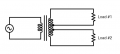
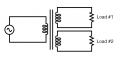
The voltage on the primary winding can either be stepped up or down depending on the number of turns in the coil of the secondary winding. Less turns means the voltage induced will be less and vice versa. The primary and secondary winding are both wound around a iron core. The alternating EMF from the primary winding is what induced a voltage on the secondary winding, which is intensified by the iron core.
with a transformer with 4 secondary windings are the windings all on the same core? Does this change the way the voltage is induced?
Example:
Lets say the primary has 120V on it and there are 120 turns. That is 1 volt/turn.
The secondary(s) will also have 1 volt/turn. It does not matter if the secondary is loaded or not.
Slick, a overhead wire electric train motor driver. Each main transformer secondary is an isolated energy source that is rectified, combined and filtered to DC for the 3-phase motor converter modules and the ACM. You could model (or use) the single main transformers as 4 separate transformers.
Oh WOW!! This is not a simple question at all. This is a whole system composed of a lot of individual blocks with different purposes. Besides that, it has a lot of duplicated redundant sections to allow continuesd operation even in the event of multiple failures. A detailed explanation will take up quite a bit of space.
Imagine that you have a step-up transformer that doubles 120VAC to 240VAC. The turns ratio from primary to secondary is 1:2.
Now split the secondary winding into two sections. The turns ratio from the primary to each secondary is 1:1.
Hence each secondary winding will deliver 120VAC.
Now there are two different approaches here. An accurate description of how a four secondary single primary transformer works would be a straight-forward few sentences.
But I see here is a whole system that not only provides multiple functions, but also is multiply redundant in many aspects, including redundant load sharing as well as a few brilliant approaches to reliability. A full description of that will require quite a few pages to provide useful details, because it is all bound so closely in addition to being so redundant.
So is the explanation desired for only the transformer, or for the system??
I assume you know how an electromagnet works?
Wrap a bunch of wire around an iron rod, send current through the wire, and the rod becomes a powerful magnet.
If that current is DC, the north pole will be on one end and the south pole on the other, all the time.
If that current is AC, then the north and south poles will be trading places many times per second.
Run current back and forth through that wire (alternate the current), and you create an alternating magnetic field in the rod.
Electromagnetism works forwards and backwards.
Create an alternating magnetic field in the rod (maybe by spinning a magnet rear the rod) and you will generate an alternating electric current in the wire.
If you wrap two identical coils of wire on the same rod (same number of turns) and then you spin your magnet near the rod, you will get identical AC voltage waves on both coils.
If one coil has twice as many turns as the first, then it will generate twice as much voltage. Or if it has 10% more turns it will have 10% more voltage. (It's proportional).
If you wrap 3 identical coils, then you get 3 identical AC outputs.
4 coils, 4 outputs.
Say you've got an iron rod with identical 4 coils and you're tired of spinning a magnet, you can take advantage of:
Electromagnetism works forwards and backwards.
Put a 5th coil on the rod, and feed this coil with an AC source.
The alternating current in the 5th (primary) coil induces an alternating magnetic field in the rod, and the alternating magnetic field in the rod induces an identical alternating current in each of the 4 identical secondary coils.
You've just created a crappy transformer with 4 secondaries.
To make it better, bend the iron rod into a circle.
Now you have a toroidal transformer.
But if you want it to look "normal," ditch the rod, do it right, get some silicon steel E-I laminations and wrap your 5 coils around them in the normal, proper way.
Also, voltage is proportional to current. So does the current induced on secondary windings go up and down during either step up or step down transformer
For X amount the power, the current needed for X load in Watts will change as the secondary output voltage changes per turns ratio. It's really about the transformation of electrical energy ratios of electric and magnetics fields in space required for X power transfer to the transformer load.
For a multi-secondary transformer, consider first that the current in the primary delivers a certain amount of energy into the magnetization of the core. THAT is what the primary is doing. Now each secondary feels the magnetic flux changing and the generated voltage is a product of the number of turns experiencing that change in magnetic flux . LV= L dI/dT ) where L is related to the number of turns being affected by the changing magnetic flux.
So if there are four identical secondaries then each will be able to capture a similar amount of the magnetic flux variation, and deliver energy as V x I.
Also, voltage is proportional to current. So does the current induced on secondary windings go up and down during either step up or step down transformer
In simple terms, total power out of a transformer equals total power in times the transformer efficiency (which is usually over 90%).
The total power out is just the sums of V*I for all windings.

 Facebook
 Google
 GitHub
 Linkedin