E&L Instruments Elite 2 breadboard repair, does anyone recognise this type of power transformer?

Thread Starter

LV-456_42

Joined Dec 21, 2024
45
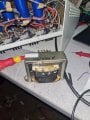
this is the only picture i have of this type its an American style transformer, it has NO part numbers on it at all. the primary was completely shot when i purchased the E&L elite 2. i did have it another one rewound supposedly it was a x2 12v on the secondaries but i had this strange incline that it wasn't. anyway. the secondaries had a earth point on it too I'm not sure what the professional word is for when a earth strap is wound in too the secondaries ??
20240728_211707.jpg


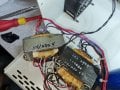
below its the one on the left the smaller one
20240727_125913.jpg


thanks in advance and marry Christmas
 

Tonyr1084

Joined Sep 24, 2015
9,744
Yup! Those are transformers. Multi-tapped or multi-core.
115 / 230 means you can wire the primary for either of those voltages. The secondaries - that we can't tell just from the picture. Without knowing what's inside - it's nobody's guess. You can power the transformer if you like. BE DAMNED CAREFUL! 115 CAN BITE. 230 CAN KILL. 115 CAN KILL IF THE CONNECTION TO THE BODY IS RIGHT.
Start with a continuity meter. Determine which lugs are internally connected. Make a sketch. One side of the transformer is high voltage. The other side is likely low voltage - but we can't say for sure until you take some measurements. Rubber gloves are a decent start at protecting yourself from contacting potentially dangerous voltages. Once we have a picture of how the cores are wound we can begin to come up with an answer.

Oh - and Ho-Ho-Ho to you too. Merry Christmas. To all those who don't observe the Christian faith, Happy Holidays in accordance with your faith.
 

Thread Starter

LV-456_42

Joined Dec 21, 2024
45
Yup! Those are transformers. Multi-tapped or multi-core.
115 / 230 means you can wire the primary for either of those voltages. The secondaries - that we can't tell just from the picture. Without knowing what's inside - it's nobody's guess. You can power the transformer if you like. BE DAMNED CAREFUL! 115 CAN BITE. 230 CAN KILL. 115 CAN KILL IF THE CONNECTION TO THE BODY IS RIGHT.
Start with a continuity meter. Determine which lugs are internally connected. Make a sketch. One side of the transformer is high voltage. The other side is likely low voltage - but we can't say for sure until you take some measurements. Rubber gloves are a decent start at protecting yourself from contacting potentially dangerous voltages. Once we have a picture of how the cores are wound we can begin to come up with an answer.

Oh - and Ho-Ho-Ho to you too. Merry Christmas. To all those who don't observe the Christian faith, Happy Holidays in accordance with your faith.
thanks for the info , i forgot to mention in the original post that these pics are quite old ( mid year) and when i had another rewound they had to destroy this one. so i don't have it anymore. i was hoping to find another one of the same type somewhere i can't imagine that these where custom made for E&L made way back when... well i say that anything is possible...
 

Thread Starter

LV-456_42

Joined Dec 21, 2024
45
I have another question the previous wiring arrangement on this elite 2 was for the USA so was configured for 115v the transformer what capable of being made to work for the 230v , it had a 115v fan inside wired directly to the mains via the transformers primary connection, nothing fancy. now my question if i where to say get another transformer which is dual voltage but configure it for UK power 240v but it can go to 115v could i connect the fan across the 115v section or would that cause some unknown affect ? like open a gateway to death hell or somthing?

happy Christmas too !
 

Tonyr1084

Joined Sep 24, 2015
9,744
Good Christmas Morning to you.

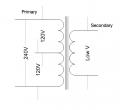
There are many different configurations of transformers out there. Here's just the basics:
The first transformer is a power transformer. It's center tapped on the primary side. You can use either half of the transformer and power it with 120 VAC. Or you can power the whole transformer with 240 VAC. The result either way is the same on the secondary side. Whatever voltage that is. And it doesn't have to be "LOW" voltage, it can be ANY Voltage depending on how it's built.

The second transformer is 2 Core on the primary side. Each core is separate one from the other. This has a different advantage from the center tapped transformer. Notice on the CT Transformer there are three wires coming out whereas on the 2C Transformer has four. The 2C transformer can be wired together and still run on 120VAC. The difference is in the amount of POWER the transformer can deliver.

In a few minutes I'll show how these transformers can be wired. In the process I hope it answers your question about connecting it to 240VAC and using it to power a 120VAC fan.
Screenshot 2024-12-25 at 7.37.25 AM.pngScreenshot 2024-12-25 at 7.56.05 AM.png
 
Last edited:

Tonyr1084

Joined Sep 24, 2015
9,744
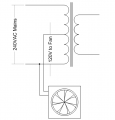
I have another question • • • if i where to • • • get another transformer which is dual voltage but configure it for UK power 240v but it can go to 115v could i connect the fan across the 115v section or would that cause some unknown affect?
You CAN wire it as shown below. Satan will remain a non-threat and the universe will stay safe.
Screenshot 2024-12-25 at 7.50.46 AM.png
 

Tonyr1084

Joined Sep 24, 2015
9,744
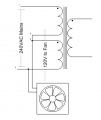
IF you have a 2C transformer (4 wires on the primary side) you can wire it like this:
Screenshot 2024-12-25 at 8.09.22 AM.png
Pins 2 & 3 are jumpered so that you have the transformer working on 240VAC. Pin 2 or 3 are wired to the fan. The fan is wired back to pin 1 or 4. In this drawing I happened to wire it to pin 4. Either will work.

An IMPORTANT detail; notice the black dot on each core. It indicates a phasing. If you were to wire 240 to pins 1 & 3 and jumper pins 2 & 4 you will have a "Do Nothing" transformer. One core will be working in opposition to the other and will cancel each other out.

In my first drawings I didn't bother to draw the dot in. It's just the basics of the anatomy of a transformer. But where multi-core transformers are concerned and how you use them, it's important to get the phasing right.

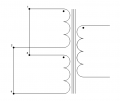
Finally, there's one more example of how you can use a 2C transformer:
Screenshot 2024-12-25 at 8.18.57 AM.png
In this configuration the upper core is wired in parallel to the lower core. Again, keep in mind the phasing dots. Pins 1 & 3 are jumpered together and pins 2 & 4 are jumpered together. This doesn't change the input voltage but it doubles the amount of power. The secondary will still provide its ratio voltage. What's a ratio voltage? A transformer that is a 10:1 will reduce the voltage by that much. 120VAC in on the primary will have 12VAC on the secondary. A 1:10 transformer will have 120VAC on the primary and 1200VAC on the secondary. And no, I didn't accidentally hit an extra zero or two. 1:10 is 10 times the input voltage. 10:1 is 1/10th the input voltage.

That's the basics. And there is a TON and a half more that goes into transformer design. Hopefully this has taught you a little about transformers and how you can wire it to run your fan from the center of the transformer primary side.
 
Last edited:

Tonyr1084

Joined Sep 24, 2015
9,744
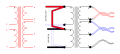
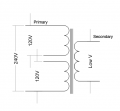
Regarding the below transformer, this is about as wild a guess as it can be. The output voltages are just the sort of thing I've typically seen. It doesn't mean these are the values of the transformers you pictured. The left transformer is just what I make of your picture. The right transformer with the wires, black, red, white and blue, is yet another guess. But it might be a pretty good guess based on the fact that the red wires are twisted. Likely low voltage and low amperage. The blue wires (and that barely visible black wire) probably goes to a (+) (-) (+) part of some circuit. But again, this is just a wild guess.
Screenshot 2024-12-25 at 1.24.07 PM.png
Grandkids are just pulling up. They've been at their father's parents house all morning.
 

Thread Starter

LV-456_42

Joined Dec 21, 2024
45
Regarding the below transformer, this is about as wild a guess as it can be. The output voltages are just the sort of thing I've typically seen. It doesn't mean these are the values of the transformers you pictured. The left transformer is just what I make of your picture. The right transformer with the wires, black, red, white and blue, is yet another guess. But it might be a pretty good guess based on the fact that the red wires are twisted. Likely low voltage and low amperage. The blue wires (and that barely visible black wire) probably goes to a (+) (-) (+) part of some circuit. But again, this is just a wild guess.
View attachment 338935
Grandkids are just pulling up. They've been at their father's parents house all morning.

thanks a bunch wire 5 ( from your picture ) on the secondaries goes straight to GND its attached too the chassis, i wasn't really sure what it was for as pretty much all more modern transformers i have seen do not seem to have a GND terminal on the secondaries, much like the one in the picture i have provided.

no problem about family , my kids are in bed now its been alot of fun, there mum is shattered in fact so a, i its been a full on house of fun.
enjoy your Christmas geez
 

schmitt trigger

Joined Jul 12, 2010
2,027
What is an E&L Elite 2? An audio amp?

Schematics for most consumer electronics can be found on the web. Sometimes free, sometimes you have to pay for them.

But if you are really wanting to repair the unit, it is an enormous help to have one.
They will certainly include schematics and information about the voltages.
 

Thread Starter

LV-456_42

Joined Dec 21, 2024
45
What is an E&L Elite 2? An audio amp?

Schematics for most consumer electronics can be found on the web. Sometimes free, sometimes you have to pay for them.

But if you are really wanting to repair the unit, it is an enormous help to have one.
They will certainly include schematics and information about the voltages.
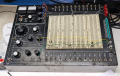
its a analog / digital electronics trainer from the late 60's early 70s , believe the one i a slightly updated versions i have seen before.

in regards too a schematic i have searched high and low for one and there is not one available for that particular version from what i can tell.
 

MaxHeadRoom

Joined Jul 18, 2013
30,557
Regarding the below transformer, this is about as wild a guess as it can be.
The two Primaries normally connected either in parallel, 120v, or 240 in series.

Normally if two primaries are supplied and each is rated, for example, 120vac you connect them in parallel if your supply is 120v and series if your supply is 240v. In either case the secondary output voltage is the same.
 
Last edited:

Tonyr1084

Joined Sep 24, 2015
9,744
The two Primaries normally connected either in parallel, 120v, or 240 in series.

Normally if two primaries are supplied and each is rated, for example, 120vac you connect them in parallel if your supply is 120v and series if your supply is 240v. In either case the secondary output voltage is the same.
Think I said that before.

The reason for my suspicion there are two separate primaries is because there are four wires on one side. That doesn't specifically mean there are two isolated primaries, it could be multi-tapped primary. 100 - 120 - 240. My presentation is only a basic overview of transformers. What is baffling me is why pin 5 is chassis grounded. It's possible pin 5 may be the center tap and chassis ground.
thanks a bunch wire 5 ( from your picture ) on the secondaries goes straight to GND its attached to the chassis, i wasn't really sure what it was for as pretty much all more modern transformers i have seen do not seem to have a GND terminal on the secondaries, much like the one in the picture i have provided.
Transformers have two basic purposes - first is most obvious - to change one voltage to another. The second is to isolate a circuit from mains power. There are isolation transformers that are 1:1. That means there's no change in voltage but the secondary output is isolated from the mains voltage. No chance of getting shocked by accidentally touching secondary voltage and ground.

In cases where a transformer secondary is chassis grounded is that the other two leads provide positive 12 volts above chassis ground and negative 12 volts below chassis ground. VERY common in amplification applications. Speakers work best when they have alternating positive and negative signals. Push & Pull. Push the speaker cone forward, pull it backward.
 
its a analog / digital electronics trainer from the late 60's early 70s , believe the one i a slightly updated versions i have seen before.

in regards too a schematic i have searched high and low for one and there is not one available for that particular version from what i can tell.
Have you seen this video where Marc and Ken repair an EL Instruments Inc Elite 2, they discuss the power supply about 4.30 in and the summary says they sort out a power supply problem although I haven't watched all 3 videos to see if they help with your problem?


Chris
 

Thread Starter

LV-456_42

Joined Dec 21, 2024
45
Have you seen this video where Marc and Ken repair an EL Instruments Inc Elite 2, they discuss the power supply about 4.30 in and the summary says they sort out a power supply problem although I haven't watched all 3 videos to see if they help with your problem?


Chris
hi yes i thought i had mentioned Marc in this thread and it turned out i mentioned him and his crack team in my introduction / welcome message. but forgot to mention it in this one. he was the inspiration for me to search high and low for an elite 2 when that video was first released i was recovering from a lengthy back surgery and being on a number of questionable meds from the doctors, combine that with alot of bad decisions then it came around and i found one. but me finding one which is worse for wear. i then most recently have found another one which is allegedly working,( time will tell if it turns up Christmas back log) ill be taking measurements off. the reason for that is although Marc's video is amazing and i use it regularly as a reference as well as Ken's amazing reverse engineered view of the board but its not fully complete from what i can tell.
 
Top