How does a 555 IC timer works and how can I implement it by having a 30s timer

Thread Starter

Nani Kore

Joined Sep 23, 2017
21
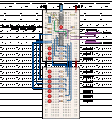
So basically my idea is that I have 10 LEDs and assuming each two is equivalent to 1 minute. The idea is that all of those LEDs would be on, and when I press probably a tactile push button the timer counts down. If 30 seconds passes by then the first LED would turn off. Can anyone tip me on how I would be putting 30s on each led and how they would be counting down. All I know is I think I'll be using a D Flip Flop. What I have right now are: 555 IC, Speaker/Buzzer, LEDs, resistors-capacitors, tactile push button, breadboard, and jumper wires.
 

Attachments

ro169

Joined Oct 10, 2014
62
Are you trying to create 5 minute timer which notifies you visually in 30 second intervals?

You could use your 555 timer to trigger counters which will keep track of the time elapsed
 

Colin55

Joined Aug 27, 2015
519
You can use 10 555's as they cost only 5 cents
Or you can use a LED bar graph chip in bar mode or you can use a micro.
Or you can use a staircase of transistors. It just depends how accurate you want the display and how simple you want the circuit.
 

Thread Starter

Nani Kore

Joined Sep 23, 2017
21
Yes, I'm trying to create a 5 minute timer which reminds me every 30s when each LEDs are turned off, so from the start ( 0:00 ) All LEDs are turned on. Then when 30s passes by the first LED turns off
 

ro169

Joined Oct 10, 2014
62
okay if you'd like to avoid programming and reduce costs you could go with a simple digital circuit.

There are a number of ways you could achieve this depending on how long you set the period on the 555 timer to.
For example:
You could set the 555 timer in astable mode to generate a 1 second pulse, so every second that passes, the timer will output a pulse. Then use BCD counters to keep track of the amount of pulses. Use 2 cascaded counters like the CD4510 (1 for seconds and for for tens of seconds).

Then you can use combination logic gates to detect when the tens of seconds counter has reached 3. The gates could then reset the tens of seconds counter as well as well as turn off one of the LEDs.

OR you could increase/decrease the period on the timer and use more/less counters.

Personally I'd prefer using a single AVR microcontroller with simple C code. Would get the job done much quicker!
 

Thread Starter

Nani Kore

Joined Sep 23, 2017
21
Hahaha I have microcontrollers but since i have buzzers/speakers and 555 ICs Ive been wanting to try them out. Thanks for the help I'll ask if theres any!
 

dl324

Joined Mar 30, 2015
18,220
Would this do the trick?
No. CD4017 only has one output active at a time.

I'm with @absf.

Chain some shift registers to get 10 bits, use LOW outputs to drive the LEDs, and use a CMOS 555 to shift in a HIGH that will turn them off one by one at 30 second intervals.
 

dl324

Joined Mar 30, 2015
18,220
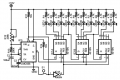
You could try something like this:
upload_2017-10-19_10-51-41.png
Notes:
  1. A CMOS timer should be used.
  2. Timer period is 0.7*(R12+2R13)C1 seconds. Using the nominal values for R13 and C1, setting R2 R12 to 28.6k would give 30 seconds. But cap tolerance could be -20 to +80%.
  3. Switch bounce won't affect operation.
  4. The current in the LEDs must be low enough that the logic level of the shift register outputs isn't affected. If higher current is required, some other driver such as CD4050, darlington/transistor arrays, or discrete transistors, could be used.
  5. The CD4069 inverter could be replaced with a discrete inverter.
EDIT: Corrected typo on R12 in note #2.
 
Last edited:

Thread Starter

Nani Kore

Joined Sep 23, 2017
21
You could try something like this:
View attachment 137591
Notes:
  1. A CMOS timer should be used.
  2. Timer period is 0.7*(R12+2R13)C1 seconds. Using the nominal values for R13 and C1, setting R2 to 28.6k would give 30 seconds. But cap tolerance could be -20 to +80%.
  3. Switch bounce won't affect operation.
  4. The current in the LEDs must be low enough that the logic level of the shift register outputs isn't affected. If higher current is required, some other driver such as CD4050, darlington/transistor arrays, or discrete transistors, could be used.
  5. The CD4069 inverter could be replaced with a discrete inverter.
Thank you so much for this info! I will try to experiment with this now after I buy the materials!
 

dl324

Joined Mar 30, 2015
18,220
Thank you so much for this info! I will try to experiment with this now after I buy the materials!
There are some issues with the circuit. I'll let you decide how problematic they are and how much complexity you're willing to add to overcome them.
 

Bernard

Joined Aug 7, 2008
5,784
I'm using a circuit almost identical to Post # 10 except for 20 LEDs & SN74LS164N shift registers Instead of loading 1s am loading flickering LED.
 

Thread Starter

Nani Kore

Joined Sep 23, 2017
21
There are some issues with the circuit. I'll let you decide how problematic they are and how much complexity you're willing to add to overcome them.
The value of the IC is what exactly? I'm having a hard time finding them. I'm trying to tell the shop owner that its a D flipflop and with the 4015N value
 

dl324

Joined Mar 30, 2015
18,220
The value of the IC is what exactly? I'm having a hard time finding them. I'm trying to tell the shop owner that its a D flipflop and with the 4015N value
The shift register part number is CD4015N; the N suffix indicates dual in line package.

I breadboarded the circuit and found that NE555 can do 30 second intervals, so you can use a bipolar part if you can't get a CMOS veraion.
 

absf

Joined Dec 29, 2010
1,968
You can get them from eBay 10 pieces for USD3.01 including postage.

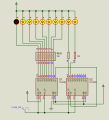
Here's how I did it with 2x 74HC595....

74hc595 cct.PNG
Not sure if the SH_CP and ST_CP are connected correctly but it does work. Add in the 555 and reset button as in Dennis's circuit....

Allen
 

Thread Starter

Nani Kore

Joined Sep 23, 2017
21
You can get them from eBay 10 pieces for USD3.01 including postage.

Here's how I did it with 2x 74HC595....

View attachment 137799
Not sure if the SH_CP and ST_CP are connected correctly but it does work. Add in the 555 and reset button as in Dennis's circuit....

Allen
This worked beautifully! Thank you! I just saw just now but it happened that I have the 74HC595s!
 

dl324

Joined Mar 30, 2015
18,220
This worked beautifully! Thank you! I just saw just now but it happened that I have the 74HC595s!
Have you noticed that when you first apply power, the first interval is longer than the others? Have you noticed any problems when the circuit is reset?
 

Thread Starter

Nani Kore

Joined Sep 23, 2017
21
Have you noticed that when you first apply power, the first interval is longer than the others? Have you noticed any problems when the circuit is reset?
Yes definitely noticed that so I adjusted some parts to to equally distribute the intervals. I've got a fully working 5 minute timer. Although the tactile button messes it all up. It stops the timer but pressing it again wont turn it back on. I have to disable then able the power to make it work again
 
Top