How do you design this LED project?

Thread Starter

austinstudent

Joined Jan 28, 2020
24
If you can talk to your instructor or TA, there's no need to make assumptions. If you couldn't ask questions, then you can simply state your assumptions as part of your solution.
Since the LEDs have different maximum currents, I'd make two variants of the modulate circuitry and do the experiment once for each emitter/detector combination.
What do you intend to do with the detector results? One LED is visible light and the other in infrared.

I did some thinking, and asking around, and came to this understanding.

I see two ways to add a second LED to the circuit. The first would be to place the second LED in series with the first led in the schematic, however, might have to modify the resistors to account for the additional voltage for the LED. (dunno how tbh).
The second option would be to put both LEDs in parallel, and this is the method I think is the right move.

As for separating DC and AC signals, I need to know how to bias the Opamp output by the dc level, and use the AC signal to oscillate. I can prob split the input signal and use a high pass filter on one of the splits and a low pass filter on the other to separate the AC and DC signals.

Thoughts Mr. Dennis/others?
 

dl324

Joined Mar 30, 2015
18,333
I did some thinking, and asking around, and came to this understanding.
If you're not asking a TA or the instructor, you're wasting your time.

I see two ways to add a second LED to the circuit. The first would be to place the second LED in series with the first led in the schematic, however, might have to modify the resistors to account for the additional voltage for the LED. (dunno how tbh).
Think about what you're saying. If the optimal current for each LED is different, putting them in series would be a compromise. Why compromise if you don't have to?

I don't know what anything about your acquisition system, but can it read two optical sources at the same time? If not, why do you think you want to drive both LEDs at the same time.
The second option would be to put both LEDs in parallel, and this is the method I think is the right move.
I don't know where you've been getting your education, but you're not very good at describing circuits, so you should use schematics. Putting LEDs in parallel with ballast resistors is acceptable. Putting LEDs in parallel, as in cathode-to-cathode and anode-to-anode, is generally considered a poor design practice. You can get away with it if you match the forward voltages of the LEDs, but you're using two different types of LEDs.
As for separating DC and AC signals, I need to know how to bias the Opamp output by the dc level, and use the AC signal to oscillate. I can prob split the input signal and use a high pass filter on one of the splits and a low pass filter on the other to separate the AC and DC signals.
Why make the circuit overly complicated? You need to add a DC and an AC signal to modulate the brightness of an LED. You don't need filters.
 
Last edited:

Thread Starter

austinstudent

Joined Jan 28, 2020
24
If you're not asking a TA or the instructor, you're wasting your time.

Think about what you're saying. If the optimal current for each LED is different, putting them in series would be a compromise. Why compromise if you don't have to?

I don't know what anything about your acquisition system, but can it read two optical sources at the same time? If not, why do you think you want to drive both LEDs at the same time.
I don't know where you've been getting your education, but you're not very good at describing circuits, so you should use schematics. Putting LEDs in parallel with ballast resistors is acceptable. Putting LEDs in parallel, as in cathode-to-cathode and anode-to-anode, is generally considered a poor design practice. You can get away with it if you match the forward voltages of the LEDs, but you're using two different types of LEDs.
Why make the circuit overly complicated? You need to add a DC and an AC signal to modulate the brightness of an LED. You don't need filters.
You're not wrong. Do you mind drawing out what you mean/suggest I do with the two LEDs? Again not trying to milk, just don't want to be confused at all by what you mean.

The acquisition system can read both optical sources.

I'm lost there, thought filters was the right choice for that. Is there an easier alternative that you're suggesting Mr. Dennis?
 

dl324

Joined Mar 30, 2015
18,333
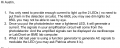
There's nothing in the directions you posted that indicates you need to measure the signal from both LEDs at the same time.
1580427205497.png

I'm lost there, thought filters was the right choice for that.
Your opamp example was an inverting summing amplifier. I questioned why you were AC coupling the AC signal and why you were using an inverting amplifier instead of non-inverting.

If you chose an opamp that had a common mode input range that went to ground, such as the lowly LM358, you wouldn't need a negative supply.
 
Last edited:

Thread Starter

austinstudent

Joined Jan 28, 2020
24
There's nothing in the directions you posted that indicates you need to measure the signal from both LEDs at the same time.
View attachment 197948


Your opamp example was an inverting summing amplifier. I questioned why you were AC coupling the AC signal and why you were using an inverting amplifier instead of non-inverting.

If you chose an opamp that had a common mode input range that went to ground, such as the lowly LM358, you wouldn't need a negative supply.
Screen Shot 2020-01-30 at 5.47.14 PM.png
My tA suggested this if that helps
 

Thread Starter

austinstudent

Joined Jan 28, 2020
24
FullSizeRender.jpeg

Screen Shot 2020-01-31 at 11.19.38 AM.png

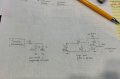
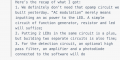
Talked to the TAs today, and this is what was said plus what I think is what we really have to do. You were right it actually isn't that hard, still confused on the calculations though.
 

dl324

Joined Mar 30, 2015
18,333
You only have a couple days left. Making any progress?

There are a couple issues with your proposed circuits. Unless the forward voltages are matched, you shouldn't operate the LEDs as you've shown. Photo detectors need to be biased.

If you're interested in a circuit that does what I interpreted the instructions to mean, come back after you've gotten your grade.

Are you attending a college/university in the US (Austin, TX maybe)?
 

Thread Starter

austinstudent

Joined Jan 28, 2020
24
You only have a couple days left. Making any progress?

There are a couple issues with your proposed circuits. Unless the forward voltages are matched, you shouldn't operate the LEDs as you've shown. Photo detectors need to be biased.

If you're interested in a circuit that does what I interpreted the instructions to mean, come back after you've gotten your grade.

Are you attending a college/university in the US (Austin, TX maybe)?
I got a 96. Thanks Mr. Dennis you're the best! I go to UT yes. Sorry for the late response, been a stressful few months but without your great help I would not have been able to complete the project so thanks again.
 
Top