How do I convert voltage from 0 to 5V into -9 to 9V

Thread Starter

labelman

Joined Jun 3, 2016
6
I'm trying to interface a 5V digital signal to drive an ultrasound transmitter. I've seen several approaches including this thread from a few years back.

http://forum.allaboutcircuits.com/t...rt-voltage-from-0-to-5v-into-10-to-10v.62652/

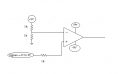
My current circuit will only go from -3V to 8V and I don't understand how to debug it. I'm guessing it has to do with the voltage divider based reference. I don't need to operate in the linear region. Is there a simpler and better way to do this? I've also tried the circuit in the second attachment without success even though my LTSpice simulation gave the results I wanted. As you can tell my analog skills are really weak.
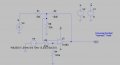
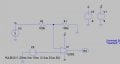
Level converter.jpg Level converter 2.jpg

Any help would be appreciated.
Thanks,
Lane
 

Thread Starter

labelman

Joined Jun 3, 2016
6
Thanks #12,
Except for the resistor on the input signal that's what I did (see my second circuit). Is the input signal resistor required? As I recall my circuit like my second drawing just stuck to one rail no matter the input value. From your circuit the input resistor is the only difference I see. I used 100k vs 1k resistors for the divider if that matters.
Lane
 

WBahn

Joined Mar 31, 2012
32,760
First, note that the TL082 is not a rail-to-rail opamp. The closest you can count of coming to the rail is about 2 V. So if you are powering it from +/- 9 V then you can't count on anything better that about +/- 7V. But that still leaves the question of why you are only seeing -3 V.

In your first circuit, V4 is a pulse source, but V3's output is labeled "in", so which is your input signal?
 

hp1729

Joined Nov 23, 2015
2,304
I'm trying to interface a 5V digital signal to drive an ultrasound transmitter. I've seen several approaches including this thread from a few years back.

http://forum.allaboutcircuits.com/t...rt-voltage-from-0-to-5v-into-10-to-10v.62652/

My current circuit will only go from -3V to 8V and I don't understand how to debug it. I'm guessing it has to do with the voltage divider based reference. I don't need to operate in the linear region. Is there a simpler and better way to do this? I've also tried the circuit in the second attachment without success even though my LTSpice simulation gave the results I wanted. As you can tell my analog skills are really weak.

View attachment 108757 View attachment 108758

Any help would be appreciated.
Thanks,
Lane
Any standard RS232 driver will work. MAX232 even generates the + and - V.
 

Attachments

Last edited:

Thread Starter

labelman

Joined Jun 3, 2016
6
First, note that the TL082 is not a rail-to-rail opamp. The closest you can count of coming to the rail is about 2 V. So if you are powering it from +/- 9 V then you can't count on anything better that about +/- 7V. But that still leaves the question of why you are only seeing -3 V.

In your first circuit, V4 is a pulse source, but V3's output is labeled "in", so which is your input signal?
V4 is the source, V3 is mislabeled and is just for the reference voltage. I just happened to have a TL082 lying around so I thought I'd try it to prototype the idea. I definitely need a better choice.
 

Thread Starter

labelman

Joined Jun 3, 2016
6
True, though it will invert the signal, which may or may not matter.

@labelman; How much current does the ultrasound transmitter need? Be sure the opamp can deliver it.
This is a great idea and I think I'll go this way, but I still want to make the other circuit work just so I learn something along the way. Thanks!
 

dannyf

Joined Sep 13, 2015
2,197
Your circuit needs a gain of 18v / 5v.

So either amplify the input signal by that and then shift it, or to shift it first and then amplify it.
 

dannyf

Joined Sep 13, 2015
2,197
Your first circuit is quite close. Use a non inverting amplifier, set up the right gain. Terminal the resistor on the inverting end to a 2.5v source.

Done.
 

Kjeldgaard

Joined Apr 7, 2016
476
If I understand the job right, then we have a 5V logic input signal and need a 18 Vpp output signal to drive a piezo element.

My idea then is a full bridge stage with a "good old" CMOS 4049 inverting buffer on a 9V supply:

upload_2016-7-6_15-4-28.jpeg

The component values are my bid on something that can operate at 40 KHz and up to 200 KHz if the speedup capacitor on the base is present.

If the piezo element is with a large capacity may be needed to buffer further, perhaps emitter followers and slightly higher output supply voltage.
 

Thread Starter

labelman

Joined Jun 3, 2016
6
If I understand the job right, then we have a 5V logic input signal and need a 18 Vpp output signal to drive a piezo element.

My idea then is a full bridge stage with a "good old" CMOS 4049 inverting buffer on a 9V supply:

View attachment 108783

The component values are my bid on something that can operate at 40 KHz and up to 200 KHz if the speedup capacitor on the base is present.

If the piezo element is with a large capacity may be needed to buffer further, perhaps emitter followers and slightly higher output supply voltage.
Kjeldgaard, thanks for this idea. I'm going to try this too as a learning exercise. Lane
 

WBahn

Joined Mar 31, 2012
32,760
They require approx. 200mW so at 18V then around 12 ma
Thanks.

You might do a quick test and run the opamp open loop. Take just the opamp and put a voltage divider to produce 0V at the non-inverting input. Then tie the inverting input to the positive rail and see what the output is. Then tie it to the negative rail and see what the output is. That will give you the bounds for that particular opamp. If it only goes to -3 V, then you have a bad opamp.
 
Top