No. If I'm mistaken, it's because I'm really thinking about the k vs K exception and extending from that that there IS an exception among the derived units. I just took a quick look at the list on Wikipedia and didn't see an exception. It's also possible that I'm thinking of an exception that exists in a non-SI system, but I don't know what it would be.
The answer is varying depending on circuit.
1) that is capacitor playing the role of current stabilizer (voltage ballast). For example, capacitor in series with small lamp or similar object. Then ought to calculate the load Z, the capacitor Z (what is extreme close to it X(c) but not equal) and after vectorial summing get the current via this string. Knowing current get the voltage on each component.
2) That is parallel circuit where capacitor is damping the pulsations. Then use the ripple formula https://en.wikipedia.org/wiki/Ripple_(electrical).
3) the most badly case if (2) but with non-sinusoidal voltage. The most ratrional point would be to push signal form-factor into harmonics (most easy by Fast Fourier) and then calculate each harmonics separately, afterward applying superposition. Hope this is not Your case.
So for example, if I have a capacitor at 10v and I want a voltage drop of no more than 0.1v over a time period of 10 microsecond, powering a 1w load, what must the capacitance of the capacitor be to start with?
Not sure if this has been mentioned yet but, here is a way to calculate this.
The time equation for a capacitor is:
i=C*dv/dt
where 'i' is the current considered to be constant here, and dv is the change in voltage over the time period dt, and C is the value of the cap in Farads. Also, dt is considered to be small when we consider the current to be constant.
Now because you have a 1 watt load and the voltage is 10 volts, the initial current must be 0.1 amps, so i=0.1 so we replace 'i' with 0.1:
0.1=C*dv/dt
The voltage is allowed to sag by only 0.1 volts so we replace dv with 0.1 and get:
0.1=C*0.1/dt
and now the time limit is 10 us so we replace dt with 10e-6:
0.1=C*0.1/10e-6
and now solving for C, we get:
C=10uf
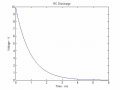
Checking this with the more exact exponential form:
i(t)=i0*e^(-t/RC)
where i(t) is the current with time, and i0 is the initial current (0.1 amps) we get:
i(0.1)=0.09900498 amps
and since the load resistance must be 100 Ohms for it to be 1 watt at 10 volts, the final voltage must be:
v(final)=100*0.09900498
which comes out to:
v=9.900498 volts
which is just a tiny tiny bit above the ideal 9.9 volts. Thus the original calculation should be good enough.
There will be another variation however because the cap value can not be chosen to be exactly 10uf because caps are not that accurate around that value. This means you have to test the circuit to see if it matches what you really want.
Also, aging of the cap may allow the voltage drop more after some years of operation so it would have to be replaced.
Luckily 10us is not too long of a time period so the cap does not have to be too high in value. If you needed a time of say 1 second it would have to be much much larger, around 1 Farad.
Oh yes when i read that i thought you were not giving all the information yet and asking the original poster if they could take it from there.
So that explains it then

 Facebook
 Google
 GitHub
 Linkedin