How consistent is current shared in parallel conductors?

Status
Not open for further replies.

#12

Joined Nov 30, 2010
18,224
it would be sweet if a shunt could be fabricated or even bought where the peak current could be captured and held on a display.
Sample and hold circuits have been available for longer than I have been a student of electronics. If strantor wants one, they are easy enough to find.
 

Thread Starter

strantor

Joined Oct 3, 2010
6,875
I have a question. This appears to be an AC spot welder, would that be correct?
correct

Using some microwave oven transformers (have to love those things) correct?
correct

The weld time duration is said to be a few milliseconds derived using a foot switch. So, what I don't get is how we know where we are on the AC sine wave with respect to time? I mean here in the US a full repetition of an AC 60 Hz sine wave id 16.666 mSec and across the pond where 50 Hz is the go to mains frequency that would be 20 mSec. So if the cycle time of the weld is measured in milliseconds how do we know where we are at on the sine wave?
Good point, sorry for the confusion. Wherever I said a few mS, what I should have said is "a few cycles" or a "a few hundred mS."

My experiences years ago with large spot welding machines and magnaflux machines were all with DC type machines. Large banks of capacitors were charged from a large DC power supply and a Triac or SCR about the size of my fist was fired. A sort of 'thud" sound was heard and the parts were forever bonded in a matrimonial type state.
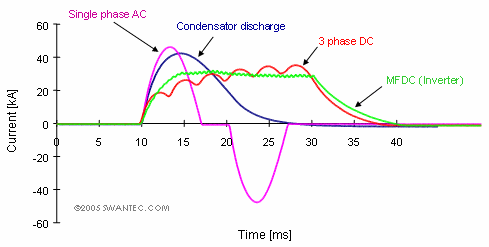
Here is a comparison of welding times and currents between AC and DC spot welders:

I can't reach those high amp numbers, so my weld times are longer. Here and here's some more info about it if you're curious.

I do have a handful of monster SCRs and a box full of monster caps, so I could probably pull off what you're talking about, but it's a little late in the game for that.
While I can appreciate this is a scrap parts inexpensive project it would be sweet if a shunt could be fabricated or even bought where the peak current could be captured and held on a display.
That's what I hope to accomplish with the chinese voltmeter. But I haven't decided. I may make a peak hold circuit.
Anyway, really nice and from the looks of the welds gets the job done quite well, real nice job!

Ron
Thanks!
 

#12

Joined Nov 30, 2010
18,224
That's what I hope to accomplish with the Chinese voltmeter. But I haven't decided. I may make a peak hold circuit.
Two threads today with an apparent need for a precision rectifier. :)
Rectify the peak and "hold" it to drive the display.
 

MaxHeadRoom

Joined Jul 18, 2013
30,680
I do have a handful of monster SCRs and a box full of monster caps, so I could probably pull off what you're talking about, but it's a little late in the game for that.
Thanks!
This requires High voltage DC and all the SCR does is dump the charge into the tip of the item being welded, it is often done to weld a bolt onto a frame for example, the bolt head has a small projection that makes contact with the frame, and when enough pressure is exerted the SCR dumps the whole charge in one shot effecting the weld.
Max.
 

#12

Joined Nov 30, 2010
18,224
the bolt head has a small projection that makes contact with the frame, and when enough pressure is exerted the SCR dumps the whole charge in one shot effecting the weld.
I remember seeing some nuts with 3 small, but intentional bumps on one side. Is this what you are thinking of?
 

Thread Starter

strantor

Joined Oct 3, 2010
6,875
This requires High voltage DC and all the SCR does is dump the charge into the tip of the item being welded, it is often done to weld a bolt onto a frame for example, the bolt head has a small projection that makes contact with the frame, and when enough pressure is exerted the SCR dumps the whole charge in one shot effecting the weld.
Max.
True, but in the course of researching spot welders i also found DC spot welders that operate on the same principle. The chart i posted earlier shows it labeled "condenser" IIRC (can't see the chart right now).
 

MaxHeadRoom

Joined Jul 18, 2013
30,680
I remember seeing some nuts with 3 small, but intentional bumps on one side. Is this what you are thinking of?
It is possible but I think that probably could have been a projection weld, this is similar to a spot welder, but the electrodes make pressure with the nut and whatever plate it is attached to and the power is typically cycled in shots, instead of one continuous process.
Early in my career I worked at maintaining an automotive plant that manuf the gas tanks, among other items, and they seam welded the tanks, this was a spot welder principle, but instead of single electrodes, they were copper wheels that seamed the two halves of the tank together, the other process was to projection weld a vent fitting, the third was to silver solder the filler pipe by induction heat (455Khz).
Max.
 
Last edited:

shortbus

Joined Sep 30, 2009
10,050
Dumb question as usual, if the amperage isn't going to be variable, why the need for a gage? With my Miller hand held spot welder you hold the switch until the spot gets cherry red then let trigger go. The tips really should be made of beryllium copper, to withstand the heat in the welding.
 

gerty

Joined Aug 30, 2007
1,305
Dumb question as usual, if the amperage isn't going to be variable, why the need for a gage? With my Miller hand held spot welder you hold the switch until the spot gets cherry red then let trigger go. The tips really should be made of beryllium copper, to withstand the heat in the welding.
Sometimes a person just has to know what kind of monster he's created :)
 

Thread Starter

strantor

Joined Oct 3, 2010
6,875
Dumb question as usual, if the amperage isn't going to be variable, why the need for a gage? With my Miller hand held spot welder you hold the switch until the spot gets cherry red then let trigger go. The tips really should be made of beryllium copper, to withstand the heat in the welding.
My answer probably won't satisfy you. Basically Just because i want one. I don't know what I'm doing as far as spot welding or designing spot welders. I want to explore different things and learn. I want to add an input power controller and weld timer and see what happens. An Output current display (especially a peak output) would be a big window into what's going on with the weld. It would help me improve the welder and the welds. I want this welder to perform on a level as close to a high dollar production welder as possible. I want it to outperform your miller spot welder. Why? Just because. It would be personally gratifying to me.
 

GopherT

Joined Nov 23, 2012
8,009
@strantor
Sorry, I would have been impressed with your project yesterday - I just visited a world-scale chemical manufacturing plant today based on electrolysis. The buss bars had 80 square inch cross-section! I could hear the transformers hum from the parking lot.

Ok, I am impressed that you have a diy project with 1000+ amps but my tour was really impressive.
 

shortbus

Joined Sep 30, 2009
10,050
Couldn't you measure the primary current ? And then by that and the transformer ratio recalibrate the meter's scale to reflect the output?

The only thing more amps will do is allow thicker metal to be welded. And then you need more pressure than the visegrip can apply. I'm not trying to put you down, but am coming from experience. From using both the hand held Miller and large air operated machine at work. When you use a high amp machine on thin (sheet metal ~20Ga) it blows out many of the welds. What is this going to be used for?
 

Thread Starter

strantor

Joined Oct 3, 2010
6,875
Couldn't you measure the primary current ? And then by that and the transformer ratio recalibrate the meter's scale to reflect the output?
Gerty suggested that back in post #4 and I replied questioning the accuracy of it, but the discussion took a turn in another direction.
Since you know the ratio, measure the primary current and multiply, another ballpark figure..
How accurate is that? If my transformer(s) are 80% efficient at 800A output, can I assume they will be 80% efficient at 3000A output? That is after all where I get the 3000A estimate from, by making that assumption; but I do not know if the assumption is correct.
So now that we're back, do you know the answer? Is the output current always going to be related to the input current by the same proportion? Or will it change depending on load? If so, how much?


The only thing more amps will do is allow thicker metal to be welded. And then you need more pressure than the visegrip can apply. I'm not trying to put you down, but am coming from experience. From using both the hand held Miller and large air operated machine at work. When you use a high amp machine on thin (sheet metal ~20Ga) it blows out many of the welds.
No worries. I'm not trying to ignore your advice and experience, either. As I mentioned, I have no experience in the area. I'm all ears. I have actually blown out a few welds with this machine on 20Ga; I correlated it with insufficient clamp force; I guess too high current is a player as well. With the vise grips I can fine tune the clamp force, and what I found with this fixed-current machine is that the looser the grip, the more aggressive the weld. If I clamp loosely, the weld happens faster than I can move my foot. If I tighten very tight, the weld takes longer and I get a lot of undesirable glowing and blueing of the metal. If I make the grip too loose, it just explodes the metal out and makes a hole.

From what I've read of the scholarly resources of spot welding, I gleaned the idea that if I could double or triple my output current and cut my weld time by 1/2 or 2/3, then I could get near-instantaneous welds, with negligible heating of the surrounding metal, minimal glowing/blueing of the weld spot, minimal cooling/heatsinking cycle, minimal distortion of the weld spot, and minimal trauma to my electrodes.

When I look at the back of my washing machine where it's spot welded by production machines, I struggle to find the weld spots because they are so clean. That's what I want to achieve. Currently it's obvious where I welded, as you can see in the pics in the thread below.

What is this going to be used for?
If you're interested in what I made with this, check out this thread. It's a baby-sized version of an operator's console that will be used as a desktop simulator/training aid so I can teach people how to run a subsea cutting tool.
In addition to that, I also want to be able to weld larger pieces. And welding larger pieces to smaller pieces would be cool, too. Like welding 20Ga sheet to 1" angle iron. Not sure if that's in the realm of possibility, even with a commercial production unit, but I'll still try it nonetheless.
 

gerty

Joined Aug 30, 2007
1,305
Gerty suggested that back in post #4 and I replied questioning the accuracy of it, but the discussion took a turn in another direction.

So now that we're back, do you know the answer? Is the output current always going to be related to the input current by the same proportion? Or will it change depending on load? If so, how much?
page 12-6 for formula, but in another place they mention IF they have 100% efficiency, which we doubt
 

Attachments

MaxHeadRoom

Joined Jul 18, 2013
30,680
In addition to that, I also want to be able to weld larger pieces. And welding larger pieces to smaller pieces would be cool, too. Like welding 20Ga sheet to 1" angle iron. Not sure if that's in the realm of possibility, even with a commercial production unit, but I'll still try it nonetheless.
Re my comment on the tip dia for small power units, check out the tips use here.
http://www.akfiles.com/forums/showthread.php?t=125506
For a lot of repetitive welding, it is usually necessary to go to water cooled tips, otherwise the heating softens and enlarges the tip drastically.
Usually the limit is just under 1/8th for thickness due to the heat spread on this material.
Max.
 

shortbus

Joined Sep 30, 2009
10,050
I'd be willing to bet your washing machine was done with way less than 1000A. :) With the lower clamp force your probably getting more resistance between the tip and the metal causing more heating. But the idea behind a spot weld is to only cause the surface of the metal where it joins to get hot. More heat in a part when welding (called the haz, heat affected zone) just causes more warpage.

Like Max said spot welding is usually limited to a combined thickness of ~1/8". To weld thin(20Ga) to thick ~1/4" a rosette weld is usually done. A hole drilled through the thin and filled with weld to the thick. My old Millermatic 135 mig welder has a setting for that.
 

Thread Starter

strantor

Joined Oct 3, 2010
6,875
I'd be willing to bet your washing machine was done with way less than 1000A. :)
I'm certainly not disagreeing with you, and I intend to test your way, their way, and every other conceivable way, but for the sake of discussion I would like to bring this to your attention. It is a spot welder manufacturer's table of recommended clamp pressure, amperage, and weld time for various conditions.

20Ga sheet is .9mm thick and according to their table (first table on the page) it should be welded with a 5mm dia electrode tip, with 1.4 to 2.6kN of force, for 7-12 AC cycles, at 6,000-10,000A. That's pretty much in-line with everything else I've read as well. However when browsing through all this data I keep getting that feeling that I'm reading out-to-lunch theoretical perfect world crap passed off as working parameters. The same feeling I get when reading a datasheet for a 120A-capable MOSFET in a TO-220 package; only difference is I'm not certain if I'm reading garbage, only suspicious.
 

tranzz4md

Joined Apr 10, 2015
315
Well, I sure like your project, and can understand your "because I want one" motivation, but I can only contribute to your original question,,,, and wish you the best of luck.

If you have all those conductors parallel, but insulated, you've got a much different monster than if you strip them all to build a large stranded cable, which could be seen as a single conductor. My own belief is that you'd get better results with the "single conductor" cable, but it too will behave strangely. Parallel insulated conductors will absolutely not share the current equally due to many factors, and the inductance component will be far more significant if you stay A.C.. I'm sure you're aware of skin effect, and may be aware of the existence and utilization of segmented power cable, so simply connecting two small insulated conductors to points on the surface of your cable (to implement the voltage drop method of current measurement) will not give you accurate total values either. Remember, the extremely high and short bursts of current (probably highest near, but following the voltage peak of the first half of the first cycle) is a product of field collapse. I'd think your more utilitarian measurement would be obtained using a CT on your primaries. Measuring that instantaneous peak value in your ("secondary") leads would require far more complicated field detection and measurement equipment than your welder itself.

.....but, you probably suspected as much.
 

KLillie

Joined May 31, 2014
137
I tried using coppScientistsng early on in the build (with transformers in parallel). I found the resistance of 1/4" copper tubing to be much higher than I expected. you can see in the picture below I have 4 hammered copper pipes in parallel. I found that what I had assumed to be negligible resistance "bus bar" actually had higher resistance than 3 parallel 12AWG wires. It was limiting my current output. So I ditched the hammered copper pipe idea.

View attachment 84361

I would like to avoid anything that limits my current output. I am actually going to shorten the leads so that I can get more current out of it. Shortening the leads and then addin a shunt seems like one step forward and two steps back.
That is one scary piece of equipment! Dare I use the phrase "Mad Scientist".
 
Status
Not open for further replies.
Top