Facebook
 Google
 GitHub
 Linkedin

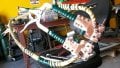
I've made a resistive spot welder from a pile of microwave transformers and it's a real beast. My clamp meter only measures up to 1000A, so I can't measure how many amps this thing is puking out. According to the efficiency that I can measure at lower input/output amperages (~80% efficiency), I calculate it's putting out over 3000A at direct short.
I want to put an output current meter on it (fast-deflecting analog meter movement preferably). All my attempts at winding a torroidal current transformer for it have failed. Looking at 3000:5 and 4000:5 commercial CTs, I can see why I failed. The CT would have to be the size of a Bible in order to work. I don't want one of those ginormous iron bricks weighing down my machine, nor do I want to pay for one.
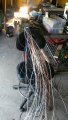
So I'm considering placing a smaller CT around one of the parallel conductors of my welding leads. My welding leads/transformer(s) secondary are made of all the scrap wire I had in my garage, in parallel. They are comprised of:
( 1X) 3AWG stranded, bare, building ground/bonding wire
(11X) 12AWG stranded, insulated, machine panel wire
(16X) 12AWG solid, insulated (recovered from ROMEX)
( 8X) 12AWG solid, bare (recovered from ROMEX)
( 4X) 14AWG stranded, insulated, building wire
So, 40 parallel conductors of varying gauges and geometries, all in parallel sharing the same load. If I eeney-meeney-miney-moe and pick one conductor to put a CT around it, can I reasonably be assured that the current going through that specific conductor will be a fixed ratio of the overall current, in all instances?
I'm not looking for a high degree of accuracy, just a reasonable degree of consistency. I will use the amperage readout to adjust system parameters like input power, clamping force, weld time, etc.
It is my understanding that the conductors will tend to automatically share the load as they have a positive temperature coefficient; if one carries more current than the others, it heats up, increasing its resistance, pushing the other conductors to carry more of its load. But I have no idea the time scale involved. Do you have to be pumping thousands of amps for 10+ minutes in order for this miracle of nature to automatically balance the load? Or does it work out nicely beginning from the first AC half-cycle? My weld times are measured in mS, so I need the correct current indication right away.
I want to put an output current meter on it (fast-deflecting analog meter movement preferably). All my attempts at winding a torroidal current transformer for it have failed. Looking at 3000:5 and 4000:5 commercial CTs, I can see why I failed. The CT would have to be the size of a Bible in order to work. I don't want one of those ginormous iron bricks weighing down my machine, nor do I want to pay for one.
So I'm considering placing a smaller CT around one of the parallel conductors of my welding leads. My welding leads/transformer(s) secondary are made of all the scrap wire I had in my garage, in parallel. They are comprised of:
( 1X) 3AWG stranded, bare, building ground/bonding wire
(11X) 12AWG stranded, insulated, machine panel wire
(16X) 12AWG solid, insulated (recovered from ROMEX)
( 8X) 12AWG solid, bare (recovered from ROMEX)
( 4X) 14AWG stranded, insulated, building wire
So, 40 parallel conductors of varying gauges and geometries, all in parallel sharing the same load. If I eeney-meeney-miney-moe and pick one conductor to put a CT around it, can I reasonably be assured that the current going through that specific conductor will be a fixed ratio of the overall current, in all instances?
I'm not looking for a high degree of accuracy, just a reasonable degree of consistency. I will use the amperage readout to adjust system parameters like input power, clamping force, weld time, etc.
It is my understanding that the conductors will tend to automatically share the load as they have a positive temperature coefficient; if one carries more current than the others, it heats up, increasing its resistance, pushing the other conductors to carry more of its load. But I have no idea the time scale involved. Do you have to be pumping thousands of amps for 10+ minutes in order for this miracle of nature to automatically balance the load? Or does it work out nicely beginning from the first AC half-cycle? My weld times are measured in mS, so I need the correct current indication right away.