How can one make a transmitter 100% legal without spending excessive money?

Thread Starter

testuserabcdef

Joined Jul 12, 2016
127
I made myself a simple transmitter off the net using ceramic capacitors. The problem now is tolerance. I'm trying to make one for 433Mhz but the tolerance of the capacitors and inductor is a problem. Inductor is 0.1uH with 10% tolerance. Capacitors are 3.4pF (1.2pf+2.2pf in parallel) and 2.2pF and arranged in a colpitts oscillator fashion.

After doing the math, I get the worst case scenario frequencies of 379.03Mhz (if inductor in question actually is +10% of intended value and capacitor is +20% of intended value) and 513.21Mhz (if inductor in question actually is -10% of intended value and capacitor is -20% of intended value). This means my frequency will be anything from 379.03Mhz to 513.21Mhz and this excludes the additional capacitors I might add to the circuit to (try to) control tuning.

I know to somewhat eliminate this problem is to use parts with lower tolerance percentages but that tends to be expensive, especially if I go from ceramic to mica capacitors.

I was also thinking of buying a commercial receiver/transmitter at 433Mhz and somehow calibrate to it but I feel either way I'll have to spend money and wait.

What can anyone suggest I should do to fix my issue? I mean if the frequency is like 5 to 10Mhz off, then I might be ok, but 20-100Mhz isn't ok.

Since I'm in canada, this law applies to me: http://www.ic.gc.ca/eic/site/smt-gst.nsf/eng/sf10759.html
 

Papabravo

Joined Feb 24, 2006
22,058
I don't think there is a way to do what you want to do on the cheap. For a build of one, you need the test equipment to verify that your design meets the legal requirements. Without the ability to verify and calibrate your design one might conclude that you willfully chose to violate the law, which could lead to stiffer sanctions and penalties. That's my US point of view, don't know if Canada is more lax or more strict when it comes to these things.
 

joeyd999

Joined Jun 6, 2011
6,204
This is not my realm. But if I required a stable, accurate high frequency oscillator, I'd use PLL to generate the HF from a lower frequency crystal oscillator.
 

Papabravo

Joined Feb 24, 2006
22,058
This is not my realm. But if I required a stable, accurate high frequency oscillator, I'd use PLL to generate the HF from a lower frequency crystal oscillator.
An oscillator is only part of a transmitter, and a PLL doesn't exactly fit my definition of "simple", but nevermind. The TS didn't say what the transmitter was for and that has a bearing on what might or might not be appropriate for him. RF design in the UHF range is not really a good place for beginners to start out.

It might be worth pointing out that many UHF designs do use crystals excited in their overtone modes for designing UHF transmitters. It's not a PLL, but it does work.
 

DickCappels

Joined Aug 21, 2008
10,661
You have not described what you are doing in any detail so I will just make a general observation, this is not necessarily a good solution to your problem but it is relevant.

SAW DEVICES
I have thought about the problem of lowering cost of a transmitter/receiver pair for over a decade and it appears to me that using a (SAW) surface acoustic wave resonator is the best way to be sure your transmitter is at the correct frequency. Some resonators I bought from DigiKey are specified to operate at 433.920 MHz ± 75 kHz.

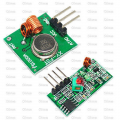
In the photograph below is a 433 MHz transmitter and receiver. It is available on eBay for US$0.99 including shipping to most countries. That tin can on the transmitter is a SAW resonator. I figure that if over the decades of use of the combination of SAW transmitter and regenerative receiver for basic functionality has not been replaced by something cheaper, I am unlikely to come up with a better method.

With transmitter/receiver pairs selling for US$1 each (about the price of SAW devices on Digikey's website, one could buy the transmitter/receiver pair, remove the SAW and banish the rest to the junk box.

upload_2017-5-8_11-56-0.png
http://www.ebay.com/itm/433Mhz-RF-t...918135?hash=item20c38f8c37:g:7PoAAOSwIgNXkG7T
The frequency at which you are allowed to operate unlicensed transmitters in Canada depends partially upon the type of emission and is limited in power according to the frequency. For example, a momentarily operated in the 260MHz to 470MHz range is allowed emissions of 1,500 to 5,000 uV/meter (For 260-470 MHz: Field Strength (µV/m) = (16.67 × f)-2833.33), I did not find any provision for other kinds of emissions near 430 MHz, but I only spent a little time looking through the rules.

LC DEVICES
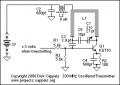
I have a remote controlled gate across my driveway. The receiver is a regenerative type similar to that shown in the photo above, but at 330 MHz. On hot days the receiver drifts the receiver drifts out of tune and the sensitivity to the SAW transmitter is very low. I also have a remote control transmitter that uses an LC oscillator in which the inductor is etched onto the fiberglass printed circuit board and the capacitors are a combination of NPO ceramic and a trimmer. It seems that the LC transmitter drifts along with the regenerative receiver. I would not submit such a circuit for manufacturing without rigid stability analysis, but I have used the same LC receiver for over seven years continuously and have not had to retune it.

Below is the schematic of the basic circuit, just in case you find it helpful.
upload_2017-5-8_12-35-31.png

If you plan to market your device/system I suggest going with the SAW device and also get your transmitter certified under Canadian law.
 
Top