How can I choose a corresponding diode in Multisim?

Thread Starter

raziell122

Joined Mar 28, 2023
85
Hello everybody!
I want to build a simple circuit in Multisim, to simulate an homework exercise.
I need to use a diode that has a voltage drop of VD=0.6V.
How can I find such diode in Multisim?
Looking for your help please :)
 

MisterBill2

Joined Jan 23, 2018
27,180
In the simulator create a series string of all the diodes. Then use a current source to force the specified current through the string, and measure the voltage across each diode, and find one with Vf=0.6 volts.
 

crutschow

Joined Mar 14, 2008
38,318
I need to use a diode that has a voltage drop of VD=0.6V.
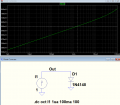
Diodes do not have a fixed voltage drop, it's a logarithmic function of the forward current, and is quite similar at lower currents for all silicon junction diodes (typical sim below).
There is some voltage differences at higher currents due to the diode's intrinsic resistance, which is lower for higher current diodes.
It's also decreases about 2mV for every 1°C increase in junction temperature.

At what current do you want the 0.6V drop?
The typical room temperature forward drop of a silicon junction diode is 0.6V at about 1.5mA of current.

1684540359449.png
 
Last edited:

MisterBill2

Joined Jan 23, 2018
27,180
Diodes do not have a fixed voltage drop, it's a logarithmic function of the forward current, and is quite similar at lower currents for all silicon junction diodes.
There is some voltage differences at higher currents due to the diode's intrinsic resistance, which is lower for higher current diodes.
It's also decreases about 2mV for every 1°C increase in junction temperature.

At what current do you want the 0.6V drop?
The typical room temperature forward drop of a silicon junction diode is 0.6V at about 1.5mA of current.
I dealt with all of those concerns in my instructions given in post #2.
 

Thread Starter

raziell122

Joined Mar 28, 2023
85
Diodes do not have a fixed voltage drop, it's a logarithmic function of the forward current, and is quite similar at lower currents for all silicon junction diodes (typical sim below).
There is some voltage differences at higher currents due to the diode's intrinsic resistance, which is lower for higher current diodes.
It's also decreases about 2mV for every 1°C increase in junction temperature.

At what current do you want the 0.6V drop?
The typical room temperature forward drop of a silicon junction diode is 0.6V at about 1.5mA of current.

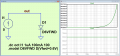
View attachment 294547
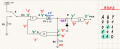
It's abit confusing me to check which current flow I get here in the circuit through the diode so I attach here the circuit:
1684563200367.png
This is a monostable M.V. circuit.
RED STATE: stable state
GREEN STATE: unstable state
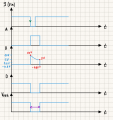
I tried to plot the graphs for points Vin, A, B, D, Vout, and at the point that the voltages at 'A' point drops from Vdd= '1' = 10V to Vdd ='0' = 0V I plotted this voltage drop at point B, since the capacitor is charged with 5V, point 'B' voltage want to drop to -5V but then the diode wants to limit it to -0.6V (it is given that VD=0.6V) but I don't know how to continue my graph at point 'B', that's why I tried the simulator but I'm not sure what is the current through the diode.
1684563577147.png
 

MisterBill2

Joined Jan 23, 2018
27,180
Doesn't seem like it to me.
Certainly I did deal with them. I stated "put all of the diodes in series" That covers all of those available in the simulator library. Then I stated " Then use a current source to force the specified current through the string." That covers the variations in forward voltage drop with current. Then I said to "measure the voltage across each diode to see which one was closest ."
Of course I did not elaborate about any logic circuits or provide such happy graphics. The TS requested a simple process and I described it. And the best part is it takes no hardware and not a whole lot of skill to do. No fancy description about thepopulation of charge carriers and such, just a simple means to get the answer that the TS asked for.
 

crutschow

Joined Mar 14, 2008
38,318
Then use a current source to force the specified current through the string."
You did not mention that the forward voltage varies with current, and that there likely is not much difference between diodes at a given current, which seems a critical missing factor.
 

MisterBill2

Joined Jan 23, 2018
27,180
I was quite specific in suggesting the use of the specified current, which I intended to mean the current that would flow in the intended application.
If the TS does not know what current will pass through the diode then there is a different problem.
 

MisterBill2

Joined Jan 23, 2018
27,180
This is where the data sheet becomes useful. It usually gives the output voltage at a couple of current levels, Al evicec dso recall that many CMOS logic devices have internal protection diodes that have unpublished specifications.
This is not a very practical circuit anyway.
 
Top