I've always felt there is no such thing as "size" when it comes to the universe. Wherever you might be, say at the so-called edge of the universe, you can always go a mile farther. If our universe is somehow a closed bubble we can't leave, then I suppose it's a grain of sand on a beach of similar universes.
While we're at it, I don't support the Big Bang nonsense.
I've always felt there is no such thing as "size" when it comes to the universe. Wherever you might be, say at the so-called edge of the universe, you can always go a mile farther. If our universe is somehow a closed bubble we can't leave, then I suppose it's a grain of sand on a beach of similar universes.
While we're at it, I don't support the Big Bang nonsense.
I've got my own misgivings regarding certain well accepted Theories of the Universe. I've got a big issue with all of the mass of a black whole being contained within a point-like singularity: there will never have been enough time elapsed for any material that was outside the event horizon to ever approach the singularity.
But I'm just some non-PhD'd idiot who hangs out on geeky websites causing trouble. What do I know?
Hi all,
I have an idea that maybe, from a certain point of view, can reduce (o redefine?) the perception of the size of the universe.
I try to summarize in very few points:
if you look at a star distant X lightyear, you are seen the star X years ago (this is a fact)
but, because the star is moving in space, somewhere we have also the same star at Y years ago and Z years ago.. and so on
so, if we point our telescope in another region and look to a different star... maybe is not a different star but is the same of first point, just in another time - and seems to us a different object
Hi all,
I have an idea that maybe, from a certain point of view, can reduce (o redefine?) the perception of the size of the universe.
I try to summarize in very few points:
if you look at a star distant X lightyear, you are seen the star X years ago (this is a fact)
but, because the star is moving in space, somewhere we have also the same star at Y years ago and Z years ago.. and so on
so, if we point our telescope in another region and look to a different star... maybe is not a different star but is the same of first point, just in another time - and seems to us a different object
I agree with @MrChips. If this was possible stars would either have to have a punctuated motion where they sometimes suddenly accelerated to superluminal speeds or they would all look like vectors not points—since they are constantly moving.
Hi,
why do you think the star have to move at the speed of light or faster? And what mean "punctuated motion" and why have to suddenly accelerate?
I argument this idea in two different way.
The first way is logical:
1) if you, from the Earth look at one star distant X lightyear, you are seeing the star X years ago (and this is a fact)
2) nothing is still in space, so the star is moving - it will probably orbit around the center of its galaxy, and the galaxy orbit around something other and so on (i think also this is a fact)
3) if the star is moving, after sufficient time, it will be in another portion of the universe (and i think also this, again, is a fact)
4) if that portion of the universe is visible from the Earth... why we can't see it?
It is only important that both "versions" are placed in a portion of the universe in the "past of the Earth".
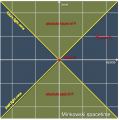
The second way is using Minkowski diagram with light-cones, that probably you already have seen.
Something like that:
The future of P is in the upper yellow cone - the past in the lower cone - what is out cant be influenced by P and cannot influence P (like Q in the picture)
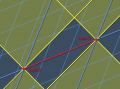
Something running superluminal appear like that:
And this is not allowed from (actually accepted) laws of physics.
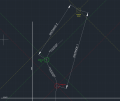
But I am talking about something like that (click to enlarge, otherwise read will be difficult...)
RED is the star in time 1: the Earth is contained in its future light cone.
GREEN is the star in time2: and again the Earth is contained in its future light cone.
YELLOW is the Earth, and "both the stars" are contained in its past light cone.
Why don‘t we observe vectors (that is, lines of light) along the path of the star rather than the points we do see? What is special about T1 and T2 that we can see the star as a point but not see the star at every other interval between them.
Why don‘t we observe vectors (that is, lines of light) along the path of the star rather than the points we do see? What is special about T1 and T2 that we can see the star as a point but not see the star at every other interval between them.
I get your point, it is a good question and I don't have any answer; i just have shared an idea, as I get.
Maybe simply the idea is wrong.
Or maybe your question will have an answer in future from someone.
If we suppose what you describe don't happen because the idea is wrong, what is in your opinion that not working with the formulation?
What can be a reason because we can look in the past of a object, but only to a specific moment in his journey around the universe?
I get your point, it is a good question and I don't have any answer; i just have shared an idea, as I get.
Maybe simply the idea is wrong.
Or maybe your question will have an answer in future from someone.
If we suppose what you describe don't happen because the idea is wrong, what is in your opinion that not working with the formulation?
What can be a reason because we can look in the past of a object, but only to a specific moment in his journey around the universe?
Because we are looking at the present for the object from our space time coordinates. The object has only one time, we are seeing that time, delayed by the distance.
The object we are seeing no longer exists. If somehow we couldn't instantaneously travel to intercept what we see, we would find it isn't there. Think of it this way—it is a common experience to hear a sound lagging a sight for an event in the distance. We know the to coincide very closely nearby the object but quickly move farther apart in time for an observer proportional to the distance from the event.
If a distant observer reports that she carefully timed the interval between the sight and sound to be 1s, is it correct for her to conclude the sound occurred 1s after the sight? If not, why not? What is actually happening?
Our case is similar. We are observing electromagnetic radiation with a less than infinite speed of propagation at a great distance. If there was some emission that was instantaneous, it would arrive as the light does, leading the sound, and the light would take on the sound role.
We don't have that, but we can calculate the lag—if we know the distance—and like the light/sound gap above, we are not seeing the object emitting light, we are seeing the light emitted by the object. So, this "seeing into the past" is quite misleading if you try to extend that informal description too far.
Consider this question: when you look at a photograph, what are you seeing? How do we talk about the content of that photo compared to its reality? What is identity?
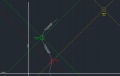
In term of Minkowsky diagram, probably my error was to don't consider that the edge of the cone represent the travel of the light.
So, if Earth see the object at T1, T2 remains for the Earth in the "forbidden zone" because the edge of future cone of the star is coincident with edge of past cone of the Earth:
I think this also mean that all the stars we see now "lies" on one of the two yellow traiectories (=edges of the past cone of the Earth) - and, as you tell by the start, just one image per object.
I've got my own misgivings regarding certain well accepted Theories of the Universe. I've got a big issue with all of the mass of a black whole being contained within a point-like singularity: there will never have been enough time elapsed for any material that was outside the event horizon to ever approach the singularity.
But I'm just some non-PhD'd idiot who hangs out on geeky websites causing trouble. What do I know?
I've had that same idea. This leads me to believe that the 'singularity' would be a small shell like a hollow sphere if we assume complete symmetricalness, and a bumpy hollow sphere if not.
That's unless we don't understand how particles can be crushed together at very extreme pressures, which we have no physics yet for. Can they occupy the same space or not. If there is really a 4th Euclidean dimension, then they might be able to rotate and form a long needle like structure where we only can detect one end.
I have not been inside a black hole yet though so I can't say for sure
Hi all,
I have an idea that maybe, from a certain point of view, can reduce (o redefine?) the perception of the size of the universe.
I try to summarize in very few points:
if you look at a star distant X lightyear, you are seen the star X years ago (this is a fact)
but, because the star is moving in space, somewhere we have also the same star at Y years ago and Z years ago.. and so on
so, if we point our telescope in another region and look to a different star... maybe is not a different star but is the same of first point, just in another time - and seems to us a different object
Are you trying to say that you want to track the movement of the star over time relative to earth?
If so, how does that help understand the size of the universe?
By 'size' I mean the total size or the observable size, either one which fits what you are looking to figure out.
Look up the neutron star. I would call that extreme pressure. What we don’t know is what happens beyond that. Can matter become more dense than nuclear matter? Yes, or we could not have black holes, but, for once, I agree with you, we have no good theory for that.
Look up the neutron star. I would call that extreme pressure. What we don’t know is what happens beyond that. Can matter become more dense than nuclear matter? Yes, or we could not have black holes, but, for once, I agree with you, we have no good theory for that.
If you only agreed with me once I have to pity you
As to the word 'dense' you used, it is apparent that you are not open to accepting more than three Euclidean dimensions, and that's ok I guess because what we observe in everyday life appears to be that limited. With sub atomic particles however, I am no so sure we can restrict ourselves to that limitation. Possibly quantum physics will reveal more about this.
If you only agreed with me once I have to pity you
As to the word 'dense' you used, it is apparent that you are not open to accepting more than three Euclidean dimensions, and that's ok I guess because what we observe in everyday life appears to be that limited. With sub atomic particles however, I am no so sure we can restrict ourselves to that limitation. Possibly quantum physics will reveal more about this.
Only when you think you can talk down to someone I bet. That's also not good etiquette and a bit strange when you have no idea who you are really talking too.
If you want to discuss this further I suggest we do it in PM's.
I do appreciate your input though most of the time.
I have watched some of Sabine Hossenfelder's videos. She has a way of explaining many of these questions. Very often, her final answer is "We just don't know and will never know".
She explains away the problem of the Big Bang hypothesis by saying there are two concepts of the Big Bang.
1) The expansion from a singularity.
2) The expansion after the initial expansion.
Her argument is that the current Big Bang hypothesis is (2) and not (1). We don't know that a singularity is even possible. The universe could actually be cycles of a Big Bang and a Big Crunch without having to become a singularity.

 Facebook
 Google
 GitHub
 Linkedin