The two ways I know about are referred to as 'level' or 'edge'.
With the 'level' method, the I/O device changes the 'level' of a signal from 'high' to 'low' or 'low' to 'high'. You can use either 'high' or 'low' to mean "I need service", but within a given system you should adopt a consistent convention. The I/O device keeps this signal in the "I need service" state until the microprocessor comes along, provides the service and tells the I/O device to 'clear' or 'release the "I need service" signal. The microprocessor should verify that the I/O device performs this operation or it might conclude later that the device still needs service.
With the 'edge' method, the I/O device creates an 'edge' from 'low' to 'high', or 'high' to 'low'. The edge is normally captured by a flip-flop and converted to a 'level' and things proceed as above. At some point the edge capturing flip-flop needs to be RESET so it can capture the next edge.
Think about how you know when to put the dog out. You can occasionally look at the dog and see if they appear to need to go out, or the dog can take action to get your attention when they need to go out. The same thing applies for I/O devices.
The two ways I know about are referred to as 'level' or 'edge'.
With the 'level' method, the I/O device changes the 'level' of a signal from 'high' to 'low' or 'low' to 'high'. You can use either 'high' or 'low' to mean "I need service", but within a given system you should adopt a consistent convention. The I/O device keeps this signal in the "I need service" state until the microprocessor comes along, provides the service and tells the I/O device to 'clear' or 'release the "I need service" signal. The microprocessor should verify that the I/O device performs this operation or it might conclude later that the device still needs service.
With the 'edge' method, the I/O device creates an 'edge' from 'low' to 'high', or 'high' to 'low'. The edge is normally captured by a flip-flop and converted to a 'level' and things proceed as above. At some point the edge capturing flip-flop needs to be RESET so it can capture the next edge.
Thanks for your time, I'm looking it up, and found it on Wikipedia, "Types of Interrupts"
So that's kinda related on why do you need software to disable interrupts?.
Think about how you know when to put the dog out. You can occasionally look at the dog and see if they appear to need to go out, or the dog can take action to get your attention when they need to go out. The same thing applies for I/O devices.
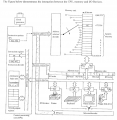
As an overall picture of processor architecture it has some probitive value, but in this specific case it is woefully short on details. To gain a deeper understanding you should continue asking questions like the original one you asked and continue asking them until the "Ahhh..Ha" LED goes off in your consciousness. As an alternative I highly recommend the detailed study of processor datasheets, especially those with pictures and diagrams. I recommend the company, Microchip, for their attention to detail. If there is a particular part you are studying, you can provide a link to a datasheet and we can play "stump the chump". There is no question about the operation of any microprocessor that I cannot eventually find the answer to.
As an overall picture of processor architecture it has some probitive value, but in this specific case it is woefully short on details. To gain a deeper understanding you should continue asking questions like the original one you asked and continue asking them until the "Ahhh..Ha" LED goes off in your consciousness. As an alternative I highly recommend the detailed study of processor datasheets, especially those with pictures and diagrams. I recommend the company, Microchip, for their attention to detail. If there is a particular part you are studying, you can provide a link to a datasheet and we can play "stump the chump". There is no question about the operation of any microprocessor that I cannot eventually find the answer to.

 Facebook
 Google
 GitHub
 Linkedin