Facebook
 Google
 GitHub
 Linkedin

Hi Guys,
I recently made a shed in my home as a small make shift office space. I bought a portable air conditioner to cool it.
After using it for a few months its control card stopped working and that pushed me to open it and look inside. I have never worked with an air conditioner before so I googled allot to learn how an AC works and figured out that the control board was just a bunch of microcontrollers reading in from thermostats and switching the compressor on and off.
So I removed all control circuits, wired the AC fans to the power supply, and also hotwired the compressor and its capacitor to the mains power coming into the unit. The thing works fine, blows cold air in, and hot air out.
But to save on electricity bills I wanted to have the compressor switched on and off so I added a heavy duty electrical switch between the mains and the compressor. I use this switch to turn the compressor on when things get hot, and I switch it off when it becomes nice inside, all this while the AC fans keep running normally.
Here's a picture of the installed unit
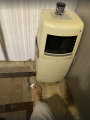
So basically "I am become PCB". I control the compressor.
My question is, would this hurt the compressor? Like I usually turn it on for 5 minutes and keep it off for 10-15 minutes. Does this switching on/off frequency damage the compressor in any way??
I have done a little googling on how the ac control PCB decides when to turn the compressor on and off. And what I have found is that there are two temperatures that it considers for turning the compressor on and off.
1. Ambient air temperature: Compressor turns on when ambient air temp is above the set temp, and off when the target is achieved.
2. Evaporator (cooling) coil temperature: Compressor turns off if the temperature drops below +3 degres celcius to prevent frosting.
So to me it seems like if I abuse the compressor and keep it on, it might hurt stuff, but as long as I'm careful and not turning it on for long periods of time it should be fine. I just wanted to get a better opinion on this so I have joined this forum.
Thanks allot.
This is a lovely community.
I recently made a shed in my home as a small make shift office space. I bought a portable air conditioner to cool it.
After using it for a few months its control card stopped working and that pushed me to open it and look inside. I have never worked with an air conditioner before so I googled allot to learn how an AC works and figured out that the control board was just a bunch of microcontrollers reading in from thermostats and switching the compressor on and off.
So I removed all control circuits, wired the AC fans to the power supply, and also hotwired the compressor and its capacitor to the mains power coming into the unit. The thing works fine, blows cold air in, and hot air out.
But to save on electricity bills I wanted to have the compressor switched on and off so I added a heavy duty electrical switch between the mains and the compressor. I use this switch to turn the compressor on when things get hot, and I switch it off when it becomes nice inside, all this while the AC fans keep running normally.
Here's a picture of the installed unit
So basically "I am become PCB". I control the compressor.
My question is, would this hurt the compressor? Like I usually turn it on for 5 minutes and keep it off for 10-15 minutes. Does this switching on/off frequency damage the compressor in any way??
I have done a little googling on how the ac control PCB decides when to turn the compressor on and off. And what I have found is that there are two temperatures that it considers for turning the compressor on and off.
1. Ambient air temperature: Compressor turns on when ambient air temp is above the set temp, and off when the target is achieved.
2. Evaporator (cooling) coil temperature: Compressor turns off if the temperature drops below +3 degres celcius to prevent frosting.
So to me it seems like if I abuse the compressor and keep it on, it might hurt stuff, but as long as I'm careful and not turning it on for long periods of time it should be fine. I just wanted to get a better opinion on this so I have joined this forum.
Thanks allot.
This is a lovely community.