Halp with Portable ECG Device

Thread Starter

Egaaaaa

Joined May 24, 2025
5
Hello everyone,
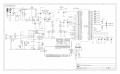
I am designing a circuit for my diploma project, but I would really appreciate some feedback from experienced members of the community. I am attaching the schematic of what I have done so far (some components are not labeled).
Could you please provide any recommendations or advice on which direction I should take next?
Thank you very much! 1748120048366.png
 

nsaspook

Joined Aug 27, 2009
16,251
Why are all of the common connections marked 'Earth'? Are these 'grounds' to the persons body as a reference to signals or an actual Earth connection to the electrical system Earth ground?

1748121031305.png
A driven voltage DRL is connected to negate the common-mode utility signals.

https://pmc.ncbi.nlm.nih.gov/articles/PMC8071160/

EMI generates an Icm flowing through the patient’s body from the sinusoidal power-line source (120 V/60 Hz or 230/50 Hz) through coupling capacitances to the ground. In order to perform an effective ECG measurement, the patient’s body has to be grounded with the ECG device. This grounding connection contributes to the rise in the Vcm primarily because of its resistance. As a consequence, it is important to reduce the impedance of the grounding electrode or to compensate for the EMI-generated current. This result can be achieved using a driven right leg (DRL) electrode [51]. It is commonly applied to the right leg, but it can be applied elsewhere on the patient’s body.

The DRL electrode senses the common-mode voltage on the body, giving feedback to the patient’s body. This negative feedback reduces Vcm to µV values [52].
 

Thread Starter

Egaaaaa

Joined May 24, 2025
5
nsaspook -
Thank you for your question! In my schematic, "Earth" refers to the local circuit ground (GND), not to the actual Earth ground of the mains electrical system.
This is a fully battery-powered, isolated system, so there is no connection to protective Earth. The ground symbol I used was just a placeholder — I will update it to a proper GND symbol to avoid confusion.
Thanks again for pointing this out!
 

Thread Starter

Egaaaaa

Joined May 24, 2025
5
Why are all of the common connections marked 'Earth'? Are these 'grounds' to the persons body as a reference to signals or an actual Earth connection to the electrical system Earth ground?

View attachment 349855
A driven voltage DRL is connected to negate the common-mode utility signals.

https://pmc.ncbi.nlm.nih.gov/articles/PMC8071160/

EMI generates an Icm flowing through the patient’s body from the sinusoidal power-line source (120 V/60 Hz or 230/50 Hz) through coupling capacitances to the ground. In order to perform an effective ECG measurement, the patient’s body has to be grounded with the ECG device. This grounding connection contributes to the rise in the Vcm primarily because of its resistance. As a consequence, it is important to reduce the impedance of the grounding electrode or to compensate for the EMI-generated current. This result can be achieved using a driven right leg (DRL) electrode [51]. It is commonly applied to the right leg, but it can be applied elsewhere on the patient’s body.

The DRL electrode senses the common-mode voltage on the body, giving feedback to the patient’s body. This negative feedback reduces Vcm to µV values [52].
Thank you for explaining the role of the DRL electrode in reducing common-mode interference.
However, in my project, I do not use a driven right leg (DRL) electrode because the device is fully portable and battery-powered, without a direct connection to mains or Earth ground.
I plan to suppress power-line interference using filters.
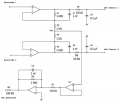
I plan to implement something like this. Снимок экрана 2025-05-13 222306.png
 

nsaspook

Joined Aug 27, 2009
16,251
nsaspook -
Thank you for your question! In my schematic, "Earth" refers to the local circuit ground (GND), not to the actual Earth ground of the mains electrical system.
This is a fully battery-powered, isolated system, so there is no connection to protective Earth. The ground symbol I used was just a placeholder — I will update it to a proper GND symbol to avoid confusion.
Thanks again for pointing this out!
Not planning on using a DRL/RLD reference electrode connection? Not being connected to Earth will help there and good filtering works to some extent (your signal frequencies are close to the undesirable common-mode signals) but it's always better to eliminated the offending signal at the source, the person/thing generating it.
 
Last edited:

Thread Starter

Egaaaaa

Joined May 24, 2025
5
Thank you for explaining the role of the DRL electrode in reducing common-mode interference.
However, in my project, I do not use a driven right leg (DRL) electrode because the device is fully portable and battery-powered, without a direct connection to mains or Earth ground.
I plan to suppress power-line interference using filters.
I plan to implement something like this. View attachment 349856
1748123319571.png
 

Thread Starter

Egaaaaa

Joined May 24, 2025
5
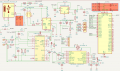
I decided to abandon the external ADC, redesigned the power supply (3.3 V is stable enough — I just smoothed it out with filters), added Bluetooth and a programming connector, added an indicator (supposedly showing battery charge level), and plan to disable the device via a voltage divider from 5 V when charging is in progress. (Don’t judge me) (Items marked in red are things I still need to calculate in the future.) 1748396668736.png
 

nsaspook

Joined Aug 27, 2009
16,251
I'd be really cautious about using switchers here instead of a LDO regulator. This is a very low signal circuit and you are creating a noise generator on the power bus that's just ripe for conducted EMI/RFI.
 
Top