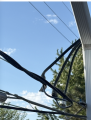
High-voltage distribution line cable insulation question

crutschow

Joined Mar 14, 2008
38,706
it would be simple to kick the wire off the person, since getting a shock from one leg to the other would not pass thru one's heart. I solved the problem!!
Depends upon the line voltage.
Don't know about you, but I definitely would not want several kV or more of distribution-line voltage going from one leg to the other!! :eek:
Besides being extremely painful, there could also be enough current through the heart to be lethal.
P.S. Strong electric shocks can also cause muscle spasms that can break bones or dislocate joints.
 
Last edited:

SamR

Joined Mar 19, 2019
5,532
The old solution in electrical labs was a wooden shepherds hook cane... No truly good solution to an already bad deadly problem. The best solution is to not put yourself and others in that particular situation. Which is why we have Electrical Codes.
 

Reloadron

Joined Jan 15, 2015
7,921
This is slightly off topic but interesting. I remember it well as it was local for me.

A 19-year-old college student named Evan Currie from Dublin, Ohio, died in a tragic Electric Shock Drowning accident at Miller Marina in Put-in-Bay on June 16, 2017.

What Happened
    • The Currie family docked their 33-foot power boat at Miller Marina and plugged into shore power.
    • Their family dog fell into the water and began to struggle.
    • The father, Jeffrey Currie, jumped in to save the dog and was immediately immobilized by an electrical current in the water.
    • Evan and his brother jumped in to help and also began struggling in the water.
    • Bystanders shouted to the mother on the boat to unplug the shore power.
    • The current stopped immediately when she unplugged the power, allowing the father and other son to get back on board.
    • Evan was pulled from the water unresponsive and could not be revived

Investigation Findings
    • Electricians inspected the marina dock outlets immediately after the accident and found the dock's electrical system functioning normally. [1]
    • The incident is known as electric shock drowning (ESD), which happens when stray alternating current (AC) leaks into the water, causing skeletal muscular paralysis that prevents victims from swimming
I assume since dock power was fine the problem was within the boat. Dock power at Put In Bay is either 240 Volt split phase 50 Amp service or 120 Volts 20 Amp service. Depends on boat size. Regardless this accident took the life of a 19 year old. I never saw a follow up on the boat. Obviously something wasn't right.

Ron
 

SamR

Joined Mar 19, 2019
5,532
You hear more of where the swimming pool lights electrical wiring has gone bad and no one knows until someone jumps into the pool. Then everyone trying to save the first affected swimmer succumb as well. Which is why the electrical code now requires GFI breakers on the supply.
 
You hear more of where the swimming pool lights electrical wiring has gone bad and no one knows until someone jumps into the pool. Then everyone trying to save the first affected swimmer succumb as well. Which is why the electrical code now requires GFI breakers on the supply.
REALLY!!, what makes even more sense is to use low voltage ISOLATED power for the pool lighting. The shock hazard from an ISOLATED 12 volt AC system, or even a 24 volt system, is a lot less.
 

SamR

Joined Mar 19, 2019
5,532
@MisterBill2 I would have to agree. I never thought 120V pool lights made any sense. Or even 120VAC Jacuzzi pumps for tubs and hot tubs but they still make them. I tend toward low risk. My point though is that what the TS started from is something that under modern electrical codes should not exist either.
 

MisterBill2

Joined Jan 23, 2018
28,090
Certainly, if shore power outlets had a GFCI protection device there would be much less hazard. And probably a whole lot less shore power used. I have been very frustrated by a GFCI system disconecting power to a power tool of mine that I was trying to use outside. That tool apparently has enough leakage to trip a sensitive GFCI but not enough leakage to ever give me a tingle when I use it.
 

B-JoJo-S

Joined Jan 3, 2026
487
I, too, agree with MisterBill2. What's pictured is not high voltage in the sense that it's 7KV. Handling 7KV without proper equipment is death. Through your arms or your feet or a combination - all are lethal. What's pictured is lower AC voltages. Since we don't know what country this picture is from we don't know the voltage on any single line to ground. And all that wiring, if it were 7KV or higher - it would not be useful to anyone in any home. No appliances run on that kind of voltage

I HAVE seen videos of animals getting hit with 7KV. They go down but I've seen them get back up and fly away. Mammals have not been so lucky. Saw a bear get hit and survived. But its leg muscle was blown away. If not for veterinary intervention the animal would have died.

Pool lighting? I have wondered just how it was powered. Also wondered about any water intrusion and someone swimming in the pool. I never considered that it might be low voltage. That makes sense now that I think of it. 24VAC would not be dangerous. Might not even be felt. I've experienced 12VDC in water and didn't notice a thing. AC, DC, there is a difference (no duh). As for being able to feel a difference, I would imagine that's possible. My fish pond has two filters. One is 120VAC powered, the other is 12VAC powered. Every time I clean the pond the pumps have been unplugged then removed first. But I've still had my arms in the pond while pumps were powered. Likely they're very well sealed against water intrusion. As for the pool lights? I have no experience with those.
 
If 3 phase, then probably 120VAC on each individual cable. If split phase (typical US Home power) then one is L1 (120VAC) another is L2 (120VAC) and N (Neutral).
 
The cables in the big cable jumble in the last photo MUST be insulated, since they are allin one jumbled mess. The individual cables that are not in focus might have a thin cover, but it is not possible to tell. The cables entering the insulators are not insulated. the single aluminum cables are obviously not insulated.
 
Quite a few of the higher voltage distribution systems are three-phase (delta) and not insulated. AND the voltage is considerably greater than our houshold power. THAT is why the upper group of wires is so much higher up .
In my area anyway. There is a lower grouping of wires fed from the low-voltage secondaries of the pole mounted transformers on every other pole. That is the 120volt three phases for each customer. None of upper the pole-to-polewires are insulated because the utility workers use tools on long poles to connect to them, and peeling insulation off of a 5700 volt live wire would be a really serious challenge.
 
Behind my house you see three uninsulated lines. One is neutral, the other two are L1 & L2, each carrying 120VAC. The very high wire alone by itself is also uninsulated but is carrying 7KVAC.

Screenshot 2026-08-31 at 9.25.13 AM.png
The next picture is two insulated lines coming from the power pole (I'm lucky to have a power pole in my back yard. Yippee!). The third line is the neutral line; it is not insulated. These three wires run to my power mast then down to the power meter. Notice that the three wires are each insulated. The neutral coming from the pole to my house is pulled tight and clamped to the house to support the other two wires. L1 and L2 are 120VAC to neutral but 240VAC from L1 to L2.
Screenshot 2026-08-31 at 9.25.39 AM.png
This is beginning to go off topic since the original question was regarding insulation.
 
If 3 phase, then probably 120VAC on each individual cable. If split phase (typical US Home power) then one is L1 (120VAC) another is L2 (120VAC) and N (Neutral).
I can share this much. Here in my little suburban world. We have two sets of 3 phase lines on my street. The lower lines are 7.0 KV which feed the transformers to get 240 VAC Split Phase. Judging by the insulators the upper lines could be 13.3 KV.
I will add that I have never seen 120 VAC 3 phase? 240 yes, 480 yes and even 4160 yes. The latter for some large pumps and compressors in an industrial setting.

Ron
 
Last edited:
Top