High power switch

Thread Starter

anikseng

Joined Sep 28, 2022
29
Hello all,

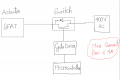
I am very new to the power electronics domain. Topology of the proposed design is shown below:
Research Process.jpeg 2023-12-20 10_49_22.png

So basically,
1) I want to deliver around 400V to the actuator from an AC supply.
2) Maximum current that the actuator will be requiring is about 4A.
3) Also there would be multiple SFAT (about 20) that would be driven.

If we use this topology then we would be requiring 20 switches and 20 driver, and those 20 drivers would be driven by the microcontroller.


So, my question is:
1) Are there any other topologies that I can use other than this which would be idea to our scenario
2) Connecting the GaNFET like this as a switch my gate driver voltage when it wants to turn on would be around 10V, however source voltage is 400V so my switch would always be in cut-off. Am I thinking in the right direction?

Thanking you
Anik Sengupta
 

Thread Starter

anikseng

Joined Sep 28, 2022
29
Hi anik,
Your MOSFET shows the internal Diode, so consider the effect when using a 400V AC supply ???
E
Internally connected diode is always there for a high power MOSFET device. So if I choose a GaNFET switch that have high Vds wont that be okay.
 

Irving

Joined Jan 30, 2016
5,122
SFAT is an acronym I don't recognise - what is it?

You have an AC supply, so a single MOSFET/GaNFET won't suffice, you need two back-to-back.

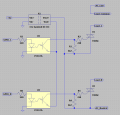
Personally I'd use an opto-isolated Triac arrangement eg:

1703075667994.png


Or what's wrong with simple relays?
 
Last edited:

Thread Starter

anikseng

Joined Sep 28, 2022
29
SFAT is an acronym I don't recognise - what is it?

You have an AC supply, so a single MOSFET/GaNFET won't suffice, you need two back-to-back.

Personally I'd use an opto-isolated Triac arrangement eg:

View attachment 310412
SFAT is just a Piezoelectric actuator. I would need to pass 400V AC supply to the actuator.
As far as I understand TRIAC is a bi-directional switch why do I need that? My supply would be a 400V sinusoidal signal of 1MHz frequency that I need to provide to the piezoelectric actuator for it to work. I dont need any backward flow of current or voltage from the Piezo to the supply.
 

Ian0

Joined Aug 7, 2020
13,132
SFAT is just a Piezoelectric actuator. I would need to pass 400V AC supply to the actuator.
As far as I understand TRIAC is a bi-directional switch why do I need that? My supply would be a 400V sinusoidal signal of 1MHz frequency that I need to provide to the piezoelectric actuator for it to work. I dont need any backward flow of current or voltage from the Piezo to the supply.
You said it was an AC signal. Current flows both ways when it is AC. That‘s why it is called “Alternating“ Current.
1MHz rather too quick for a triac.
 

Irving

Joined Jan 30, 2016
5,122
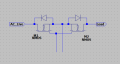
You want to pass an AC signal - which is, by definition, bidirectional. A FET has a body diode which means it provides a conducting path on alternate half cycles, hence you need 2 back-to-back to block both half-cycles else it will never be 'off'

1703077803387.png

1MHz may pose a bigger issue. however. Most power circuitry is for 50 or 60Hz. Also need to consider skin-effect.
 

Thread Starter

anikseng

Joined Sep 28, 2022
29
Yes
You said it was an AC signal. Current flows both ways when it is AC. That‘s why it is called “Alternating“ Current.
1MHz rather too quick for a triac.
Yes Sorry, my bad. My supply is a sinusoidal signal that I need to provide to my actuator with frequency of operation greater than equal to 1MHz.
 

Thread Starter

anikseng

Joined Sep 28, 2022
29
You want to pass an AC signal - which is, by definition, bidirectional. A FET has a body diode which means it provides a conducting path on alternate half cycles, hence you need 2 back-to-back to block both half-cycles else it will never be 'off'

View attachment 310414

1MHz may pose a bigger issue. however. Most power circuitry is for 50 or 60Hz. Also need to consider skin-effect.
Yes, I got your point. But we would be supplying 400V sinusoidal signal of frequency greater than 1MHz from a power amplifier to drive a Piezoelectric substance.
 

Irving

Joined Jan 30, 2016
5,122
Yes, I got your point. But we would be supplying 400V sinusoidal signal of frequency greater than 1MHz from a power amplifier to drive a Piezoelectric substance.
Can you not control the output of the power amp? How is the power brought from the amp to the actuator? 400v @ 4A = 1600W!
 

Thread Starter

anikseng

Joined Sep 28, 2022
29
Can you not control the output of the power amp? How is the power brought from the amp to the actuator? 400v @ 4A = 1600W!
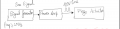
Okay to elaborate currently we have this setup shown below :

Current.jpeg 2023-12-20 13_43_08.png

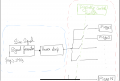
These signal generator and power amplifier are huge bulky devices which we use for now. But we want to make it on a PCB board where we will be driving several Piezo not at once thats why the switching system as shown below:

Proposed.jpeg 2023-12-20 13_43_34.png

The systems marked as blue are the bulky genetors and power amp which we would later make it on a PCB in the second phase. But for the first phase we are trying to make the part shown in red in a PCB where those switches would be driven by some controller. The purpose of switch is that we want to lets say drive piezo 1 and 2 and dont want to drive the other piezo's.

I hope I was able to explain.
 

Thread Starter

anikseng

Joined Sep 28, 2022
29
I would suggest individual amplifiers and switch the inout signals. That would give greater reliability.
For that it is a different work as I need to figure out how to generate 400V sine signal using power amplifier. I am not sure of any IC that have that high ratio to generate 400V sine signal.
 

Ya’akov

Joined Jan 27, 2019
10,235
1600W at 1MHz is a lot of power in a band that is tightly regulated. Whatever scheme you select, you are going to need some serious attention to RF containment.
 

Thread Starter

anikseng

Joined Sep 28, 2022
29
1600W at 1MHz is a lot of power in a band that is tightly regulated. Whatever scheme you select, you are going to need some serious attention to RF containment.
Why do I need RF containment, I am not transmitting any signal anywhere also I don’t have any high resistance node
 
Top