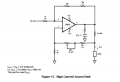
High current sink/source circuit

Thread Starter

sidk23396

Joined Jan 24, 2018
2
Hi Guys,

I am working on a project where I have to drive a Peltier device using an Arduino. After filtering and shifting the voltage level of a PWM signal, I am feeding this to a high current source/sink circuit. This circuit uses a TI LM675t op-amp and I got this circuit from its datasheet. A circuit like this was used in a similar project and it worked. I have a problem in understanding how this particular circuit works or how they got the equations in the datasheet. I would really appreciate it if someone could help me understand this.

Thanks!
 

Attachments

wayneh

Joined Sep 9, 2010
18,089
I think you will struggle to get enough current from that circuit to drive your TEC. If you don't need the TEC to be fully on, or your TEC is fairly small, it might work. But a lot of the very popular 12V TEC panels can take up to 10A to be at peak capacity.
 

Thread Starter

sidk23396

Joined Jan 24, 2018
2
The TEC I am using is fairly small. The maximum current rating for it is 3A from the manufacturer. And since I would only need to keep the load, i.e. a laser diode, at room temperature, I would only need a large current initially and then it would settle at a smaller value.
 

Janis59

Joined Aug 21, 2017
1,894
I cant see any need for Hawland circ in the task of feeding the Peltier. Peltier is not demanding about precizity. Accuracy at it is set by thermoregulator (Omron, Sestos or any other).
Thus, when I firstly decided to produce some artworks in this, I first measured the optimum current, in my case it was 12 Amps. Then I organized the 2N3055 (as I have about ton of them without of any good use) and switched it in elementary current generator circuit like this: http://www.reuk.co.uk/OtherImages/adjustable-very-high-power-supply-with-lm317-voltage-regulator.jpg
However, if I be used to make this circuit today, probably I would use a Wilsson current mirror like here: https://goo.gl/images/tvTiVb

Thus, the LDO circuit worked very well, BUT the heatsink area demand was very high. So, my next Peltier driver will be pulsed mode design. There You have a choice between start-stop regime of ir2153 like http://www.danyk.cz/igbt_1_en.html or better the smoothly regulated UC3845 like http://www.danyk.cz/reg60v_en.html. However while the LDO is still working well, there is no motivation to change anything.
 
Last edited by a moderator:

Janis59

Joined Aug 21, 2017
1,894
RE:""need to keep the load, i.e. a laser diode, at room temperature""
The task is under the hard suspiction, because the Peltier surface area is working at ultra-hard regime about heatflux per square cm. So hard, that full heat-load draining IS IMPOSSIBLE without the (traditionally) water heatsink or (less traditional) - heatpipe-based heatsink with at least 6 to 12 heatpipes. BUT toward the laser diode there I wonder if exists a way how to contact plane to plane at whole complete area. But if You shall use a thermal contact just in one or few POINTS, its failing for 101%.
 
Top