Facebook
 Google
 GitHub
 Linkedin

I'm just starting to learn PLC's and Ladder Logic, so be patient - I realize this is pretty basic. 
1.) The problem setup is a single conveyor, the conveyor has a motor that can run in two directions: forward (O:2/0) and reverse (O:2/1)
Forward and reverse operation is controlled using two normally-open switches (I:1/0 and I:1/1 respectively). Pushing either button will start the conveyor in the appropriate direction (regardless of its current state). Also, the buttons should not need to be held for the conveyor to remain in motion.
A third normally-closed switch is used to stop the conveyor (I:1/2).
The conveyor motor's reverse and forward coils should NEVER be engaged at the same time.
For this design I'm only allowed to use three basic instructions XIC, XIO, and OTE (No latches, one-shots, etc.)
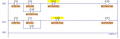
The attached image shows my setup. Rungs 0 and 2 are the seal-ins for the forward and reverse operation using momentary switches.
Rungs 1 and 3 prevent both motor coils from being engaged at the same time: Rung 1 disengages the reverse coil if the forward coil is engaged, rung 3 disengages the forward coil if the reverse coil is engaged.
The ladder accomplishes the desired results in simulation, but is there an easier/better way to prevent both coils from being engaged at the same time (using only the XIC, XIO and OTE elements)?
2.) Assuming I were alllowed to use the latching instructions, it seems like I could eliminate rungs 1 and 3 completely by just adding OTU instructions in parallel with the OTE instructions on rungs 0 and 3 (i.e. setting one motor output's bit while clearing the opposite motor output's bit.) Is there a reason I wouldn't want to do this?
3.) What would be the typical way to accomplish this task (all instructions being available)?
Thank you,
Zazoo
1.) The problem setup is a single conveyor, the conveyor has a motor that can run in two directions: forward (O:2/0) and reverse (O:2/1)
Forward and reverse operation is controlled using two normally-open switches (I:1/0 and I:1/1 respectively). Pushing either button will start the conveyor in the appropriate direction (regardless of its current state). Also, the buttons should not need to be held for the conveyor to remain in motion.
A third normally-closed switch is used to stop the conveyor (I:1/2).
The conveyor motor's reverse and forward coils should NEVER be engaged at the same time.
For this design I'm only allowed to use three basic instructions XIC, XIO, and OTE (No latches, one-shots, etc.)
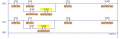
The attached image shows my setup. Rungs 0 and 2 are the seal-ins for the forward and reverse operation using momentary switches.
Rungs 1 and 3 prevent both motor coils from being engaged at the same time: Rung 1 disengages the reverse coil if the forward coil is engaged, rung 3 disengages the forward coil if the reverse coil is engaged.
The ladder accomplishes the desired results in simulation, but is there an easier/better way to prevent both coils from being engaged at the same time (using only the XIC, XIO and OTE elements)?
2.) Assuming I were alllowed to use the latching instructions, it seems like I could eliminate rungs 1 and 3 completely by just adding OTU instructions in parallel with the OTE instructions on rungs 0 and 3 (i.e. setting one motor output's bit while clearing the opposite motor output's bit.) Is there a reason I wouldn't want to do this?
3.) What would be the typical way to accomplish this task (all instructions being available)?
Thank you,
Zazoo
Attachments
-
 34.7 KB Views: 508