help with math calculation

Thread Starter

lokeycmos

Joined Apr 3, 2009
431
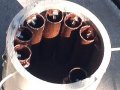
so im building whats called a Richard Quick spark gap for my tesla coil. if you dont know what that is, that is OK. you really dont need to know how it works, but i have a math question. essentially all it is is a piece of PVC tubing with 6 copper tubes spaced "x inches" apart. i attached a pic. what i need help with is finding the formula for calculating where to drill the holes in the PVC so i can get whatever gap i need whether it be 1/16, 1/32, or whatever. basically i need a formula that will tell me where to drill the holes based on the gap i put in the formula. here are the specs of the tubing:

Copper pipe 7/8” OD

PVC 4.5” OD
PVC 4” ID
 

Attachments

steveb

Joined Jul 3, 2008
2,436
I came up with the following formula. I hope someone else will verify, and I recommend that you test the formula by making some hand drawings with compass and ruler.

You were not clear about defining the gap length or the hole spacing, but I'll assume that the gap length (call it G) is the minimum spacing between the outer part of the copper tube, and the hole spacing (call it L) is the arc-length on the outer diameter of the PVC pipe.

Using inches for both G and L, try the following.

\(L=4.5\ \arcsin {{G+0.875}\over{3.125}}\)

EDIT: In case your numbers change, the general formula can be expresses as follows.

\(L=D_O\ \arcsin {{G+d}\over{D_I -d}}\)

where \(d\) is the diameter of copper pipe, \(D_I\) is the inner diameter of PVC pipe and \(D_O\) is the outer diameter of PVC pipe
 
Last edited:

Thread Starter

lokeycmos

Joined Apr 3, 2009
431
thank you for the quick reply. i will try it out on paper when i have some extra time! just to verify, arcsin is the same as (sin^-1)?
 

steveb

Joined Jul 3, 2008
2,436
thank you for the quick reply. i will try it out on paper when i have some extra time! just to verify, arcsin is the same as (sin^-1)?
Yes, it's just inverse sine function. Just be careful that you get your answer for arcsine in units of radians and not degrees. This is an option on most calculators.

Otherwise, if you have the angle in degrees, multiply by pi and divide by 180 to get the angle in radians.
 

WBahn

Joined Mar 31, 2012
33,016
I came up with the following formula. I hope someone else will verify,

\(L=D_O\ \arcsin {{G+d}\over{D_I -d}}\)

where \(d\) is the diameter of copper pipe, \(D_I\) is the inner diameter of PVC pipe and \(D_O\) is the outer diameter of PVC pipe
I came up with:

\(L = 2D_0\;\arcsin \left( \frac{G+d}{2D_I-d} \right)\)

I'm pretty sure the difference is that you set the arglength between the centers of the copper pipes to be the outside diameter plus the desired gap. But the better way is to set the straight line distance between centers equal to that same thing. For small angles, the two solutions should be very close, but as the included angle increases (gap increases and/or ratio of copper pipe OD to PVC pipe ID increases), the two will start to diverge.
 

steveb

Joined Jul 3, 2008
2,436
... you set the arglength between the centers of the copper pipes to be the outside diameter plus the desired gap.
No, i didn't try to do that. - at least not deliberately

But the better way is to set the straight line distance between centers equal to that same thing.
That's what i tried to do.

However, I will go back and check it, to be sure.
 

steveb

Joined Jul 3, 2008
2,436
I think a simple way to test a formula, and be sure that a small angle approximation has not been made, is to take the following case.

Do=Di=D

d=D/2

G=0

This case has two copper pipes fitting perfectly inside an ultra-thin PVC pipe, with no gap at all. Clearly this case should have an outer arc length between drill holes of L=πD/2, which means the holes are on opposite sides; that is 180 degrees apart.

If I'm not mistaken, my formula gives the correct answer. Please let me know if I've overlooked something here.
 

steveb

Joined Jul 3, 2008
2,436
what is the difference between the two formulas? (in laymans terms) TY
No difference. Once WBahn corrected his error, both equations match exactly. He accidentally treated the PVC diameters as the radii. This explains why he has 2Do and 2Di in place of my Do and Di.
 
Last edited:
Top