Math help - and this is NOT homework.

Thread Starter

Tonyr1084

Joined Sep 24, 2015
9,744
I've almost all my life been poor at math. I'm reading the tutor on AAC on the 555 timer. I understand the timer and at this time I'm not building anything, just trying to learn how they came up with this number. The paragraph says:

"EXAMPLE
To design a 555 astable with a frequency of 1kHz and a mark to space ratio of 2:1

Periodic time T = 1/f = 1/1000 = 1ms

Charge time tC = 2/3T = 667μs

Discharge time tD = 1/3T = 333μs

Assuming (from Fig. 4.4.1) a 10nF capacitor will be used, which discharges via R2 only:

tD = 0.7 x R2 x C1

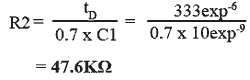
Re-arranging the formula to find R2 gives:
" (AAC http://www.learnabout-electronics.org/Oscillators/osc44.php)

When I try to handle these numbers I come up with 4.757e-12 (e stands for exponent). I've gone to my white board and done this problem over and over, changing some of the ways I'm handling the numbers. When I put 333e-6 I come up with 7.339. When I divide 7.339 by (0.7 • 10e-9) I come up with 0.000 000 000 7 (spaces added so I can count the correct number of 0's) I just can't come up with the 47.6 K they come up with for a value of R2.

Can you see my error? Can you point me in the right direction?

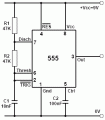
Here's the diagram if that helps any:
 

Attachments

Thread Starter

Tonyr1084

Joined Sep 24, 2015
9,744
Just ran the numbers again with a different calculator and came up with 0.000 001 047 699 071

DANG IT ! ! ! Why is my math coming out so weird?

EDIT! OH GEEZ! Now I came up with 47571.43 Ω That's what they get.

Well, let me walk you through my processes: First, I'm calculating 10e-9 and I get 0.000 000 001 (you do powers and roots first). Then I multiply that by 0.7 and come up with 0.000 000 000 7 (again, spaces to help me track the placeholders). Clear the memory key then kick that number into memory. Then I do the 333e-6 and come up with 7.339. Then I hit the divide key and recall the memory, and then I don't know why I kept coming up with 4.75714-e12. I switched calculators and got the same result. Then I did the whole process again using my cell phone calculator and lo-and-behold, I got 47.6KΩ I have no idea why. So I ran the numbers again in my scientific calculator just the same way and this time I got the right numbers.

How's a guy supposed to learn when he can't get the same results repeatably and reliably? AAC GAVE me the answer. I wanted to walk through the process for exercise and got really frustrated! In my frustration I posted this question. Kept working at it and then for some reason I can't figure out - I got the right answer.
 
Last edited:

dl324

Joined Mar 30, 2015
18,329
Kept working at it and then for some reason I can't figure out - I got the right answer.
Try putting parenthesis around the two numbers in the denominator.

Your problem is that you're doing a multiply when you should have divided.

If your calculator doesn't have parenthesis, you could do the denominator multiply first, divide by the numerator, then take the reciprocal.
 

Thread Starter

Tonyr1084

Joined Sep 24, 2015
9,744
Try putting parenthesis around the two numbers in the denominator.
After reading your comment I did it this way just to see if I'd get the same error I got before. I did 333e-6 ÷ 0.7 • 10e-9 and came up with the 4.757e-12. I couldn't even repeat my error before. Turns out, when I did the math with parenthesis I got the right number. I thought my Scientific Calculator would understand to do powers first before multiplications and divisions.

Thanks. I finally know what I did wrong. When I did it "Long Hand" on the white board I got the right answer.

Thanks again.

{edit}
Your problem is that you're doing a multiply when you should have divided.
I mis-spoke. I didn't divide even though my statement said I did. Sorry, "Divide" - "Multiply" - all the same to me. Not really. I just said divide when I meant multiply.
 

Thread Starter

Tonyr1084

Joined Sep 24, 2015
9,744
I'M SO CONFUSED!

My SyCalc - when I put 333e-6 ÷ 0.7 • 10e-9 I come up with 4.757e-12.

However, when I calc 0.7 • 10e-9 first and toss that into memory, then run 333e-6 (and come up with 7.339), then hit the divide key then the mem key I get 47.6KΩ.

But when I use the parenthesis I also get 47.6KΩ

It's that darn math stuff - circles and arrows, parabola's, vortices and exponential gear ratios of the dynamic figures of Pythagorus pencil. It's mostly Greek to me. Remember, I graduated from the fourth worst school in Los Angeles. They catered to the gifted children and just passed the rest of us whether we knew the info or not. I'm one of the "NOT's".
 
Last edited:

dl324

Joined Mar 30, 2015
18,329
You have this equation:
\( \small R2 = \frac{333e-6}{0.7*10e-9} \)

If you do this calculation 333e-6/0.7*10e-9, you get the e-12 answer you were questioning.

If you do this calculation 333e-6/0.7/10e-9, you get the right answer.

If you do this calculation 333e-6/(0.7*10e-9), you get the right answer.
 

dl324

Joined Mar 30, 2015
18,329
It's that darn math stuff
If you do some of the arithmetic in your head, you can reduce the calculation to a single divide.

Just notice that 0.7 * 10e-9 is 7e-9. Then do the division: 333e-6/7e-9 = 47.6k

Coming from an age when calculations were still done with slide rules, we learned to do simple calculations in our head to reduce slide rule operations and we learned to keep track of the decimal place. Calculators make you lazy and you'll find yourself writing down wrong answers to several decimal places because your brain isn't really engaged in the calculation.
 

Thread Starter

Tonyr1084

Joined Sep 24, 2015
9,744
If you notice the chrome dome - they say 'grass doesn't grow on a busy street'. Well, I got news for y'all, grass don't grow on concrete neither!
 

MrChips

Joined Oct 2, 2009
34,817
333E-6/(0.7x 10 x 1E-9)

Save yourself the headache.
Do the exponents separately.

333/7 = 47.6

E-6/E-9 = E3

Result = 47.6k
 

Thread Starter

Tonyr1084

Joined Sep 24, 2015
9,744
If you do this calculation 333e-6/0.7/10e-9, you get the right answer.
I see that this works. But I don't understand why. Why is 333e-6/0.7/10e-9 the same as 333e-6/(0.7•10e-9)? What changes? I understand the parenthesis, but don't understand why removing them and changing the function from multiplication to devision works.
 

Thread Starter

Tonyr1084

Joined Sep 24, 2015
9,744
333/7 = 47.6
This is another part that always gets me - 47.6K. Seems I always have to convert everything to its full decimal equivalent to even have a chance of coming close to the right answer. My answer was 47571.4 ohms. In other words, 47.6KΩ I guess it just comes down to repetition and use with these numbers.
 

Thread Starter

Tonyr1084

Joined Sep 24, 2015
9,744
I think I first need to learn how to boil an egg before I start making egg salad. I understand how to use reciprocals, but you folks have much more experience and practice with handling these numbers than I have. A lot of what you're saying is greek to me. I see that taking the recip of .00021021 comes out with 47571.4; so I know it works. However, there are too many roads to grandma's house and on most of them I get lost.

Not to fear, I'll get there with practice.
 

Thread Starter

Tonyr1084

Joined Sep 24, 2015
9,744
All this simply because I'm building a marble machine for my grandsons. Aside from the mechanical aspect of moving a marble to the top rung of a spiral cut dowel and letting gravity take it down differing paths back, I want to put flashing lights in it. Hence, a 555 timer. Rather than experiment with caps and resistors I'd like to be able to do the engineering (calculate the RC constants of it) and KNOW WHAT I'm going to build before I build it. I'm even considering a digital marble counter, a simple 7 segment display that counts the number of marbles that roll past a photo sensor. Maybe use ambient light as the source and the shadow of the marble to trigger a count event. I'm OK with the basics of Ohms Law, and I understand enough about the logic circuits that I can actually build such a thing. It's simply a desire more so to KNOW how to calculate and factor into my parts list than to have a stockpile of thousands of choices to experiment with.
 

MrChips

Joined Oct 2, 2009
34,817
Learn to juggle your decimal place (or zeros) around.

1000nF = 1μF
100nF = 0.1μF
10nF = 0.01μF
1nF = 0.001μF

333us/(0.7 x 10nF)
= 333us/(0.7 x 0.01μF)

The μ cancels out from the top and bottom.

= 333/(0.7 x 0.01)
= 333 x 1000 / 7
= (333/7) x 1000
= 47kΩ
 

MrChips

Joined Oct 2, 2009
34,817
All this simply because I'm building a marble machine for my grandsons. Aside from the mechanical aspect of moving a marble to the top rung of a spiral cut dowel and letting gravity take it down differing paths back, I want to put flashing lights in it. Hence, a 555 timer. Rather than experiment with caps and resistors I'd like to be able to do the engineering (calculate the RC constants of it) and KNOW WHAT I'm going to build before I build it. I'm even considering a digital marble counter, a simple 7 segment display that counts the number of marbles that roll past a photo sensor. Maybe use ambient light as the source and the shadow of the marble to trigger a count event. I'm OK with the basics of Ohms Law, and I understand enough about the logic circuits that I can actually build such a thing. It's simply a desire more so to KNOW how to calculate and factor into my parts list than to have a stockpile of thousands of choices to experiment with.
When it comes to arriving at the right RC time-constant in real life, I start with the formula to give me a ball park value. Eventually, I have to tweak the real values to get exactly what I need.

If the value is critical, design in a variable resistor in series with a fixed resistor.
Decide what percentage adjustment you need in the trimmer. For example, if you need 20% adjustment, make the trimmer 20% of the total resistance. Make the fixed resistor 90% of the total resistance. You now have a resistor that goes from 90% to 110% of your target resistance.
 
Top