Help with Manual/Auto Resetable Change-over Circuit

eetech00

Joined Jun 8, 2013
4,705
Good day all,

Any one with idea on how to achieve this Changeover I would like to make.

I want to manually switch my Refrigerator to Inverter AC power using a simple Switch + 12v DPDT Relay on NO. But when Grid power is restored, the Relay should automatically be switched back to Grid on NC so the Refrigerator continues on Grid power but when the Grid goes off, theRefrigerator goes off. So to use the Refrigerator on Inverter, I need to use the switch again.

I hope the explanation does it.

Thanks
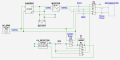
Is this what you are describing?

1767139242285.png

Operation:
1.0 Grid Power on:
--------------------
1.1 K3 energized. K1,K2 de-energized.
1.2 GRID supplies House power

2.0 Grid Power Loss:
--------------------
2.1 K3 de-energizes
2.2 House power loss

3.0 Manual power transfer
--------------------
3.1 XFR Pushbutton is pressed and released.
3.2 K1 energizes and latches via K3 NC contact.
3.3 K2 energizes via K1 NO contact and transfers house power to inverter.
3.4 House power re-established.

4.0 GRID power returns:
--------------------
4.1 K3 energizes. K3 NC contact unlatches (de-energizes) K1.
4.2 K1 NO contact de-energizes K2
4.2 House power returns to GRID power.

5.0 repeat from 1.0
 

whsh93a

Joined Jan 1, 2021
18
This is SO easy and everyone is making it SO hard.
Buy an ATS (automatic transfer switch).

Step one - put the ATS into "manual" mode.
Step two - move the ATS switch to the inverter input side.
Step three - put the ATS into "automatic " mode
Step four - after the grid returns the ATS will automatically switch to the grid.
Step four - go to step one.

Buy the ATS - unless you are a die-hard DIY person and think you can somehow make one as safe and reliable as a commercial device that's been around forever. Amazon might have the best selection. The size you need costs maybe 40 bucks.
 
Last edited:

eetech00

Joined Jun 8, 2013
4,705
Yes, except he want to be able to turn off the transfer if the battery gets too low, so there needs to be an OFF PB added, or use a bistable latch.
If the transfer battery gets too low, the XFR relay will de-energize anyway.
But I can insert a resistor (or pot) in the latch path of the XFR relay to provide just enough V/I to maintain latch.
If the transfer battery gets too low, the XFR relay will de-energize based on the adjusted level. Is anything more than that necessary?
 

crutschow

Joined Mar 14, 2008
38,529
This is SO easy and everyone is making it SO hard.
Not SO much.

Step one - turn on the inverter connection to the Fridge when the Grid quits, if wanted.
Step two - turn off the inverter connection if the battery gets too low.
Step three - after the Grid returns, the Fridge is automatically connected to the grid.
 

crutschow

Joined Mar 14, 2008
38,529
If the transfer battery gets too low, the XFR relay will de-energize based on the adjusted level. Is anything more than that necessary?
In theory, no.
But how will you accurately adjust this, as mechanical relays typically have a very large hysteresis, unless you add level detection circuitry for that?
 

eetech00

Joined Jun 8, 2013
4,705
In theory, no.
But how will you accurately adjust this, as mechanical relays typically have a very large hysteresis, unless you add level detection circuitry for that?
How accurate does it have to be?
I thought K1,K2 would be 12V general purpose power relays. So once the hold/dropout is set, it should remain somewhat consistent, and maybe acceptable. I imagine over time it would need to be re-adjusted but not very often. Saves buying a low voltage detector if acceptable.
 
Last edited:

eetech00

Joined Jun 8, 2013
4,705
Detecting battery voltage charge condition generally needs the accuracy to be within a couple tenths of a volt.
The problem is, the hold/dropout voltage of a mechanical relay is typically well below the pull-in voltage by several volts.
The relay will get pulled in at full voltage (12v) but the hold level would need to be adjusted as it could be as low as 1.6v
Could the resistor not be set to so that the hold voltage is somewhat higher and still release in a somewhat linear relationship to the battery voltage?
 

whsh93a

Joined Jan 1, 2021
18
Not SO much.

Step one - turn on the inverter connection to the Fridge when the Grid quits, if wanted.
Step two - turn off the inverter connection if the battery gets too low.
Step three - after the Grid returns, the Fridge is automatically connected to the grid.
Yes - that's easy - use an ATS. All of your three steps are easily implemented.
Or maybe add a battery monitor device that can detect when the battery bank drops below, say, 11.6V and turns off the inverter. Then, maybe turns it back on when the bank recovers to, say, 13.6V. That device costs around ten bucks.
This exact situation has been encountered by thousands of people in the past and solved. That's why the ATS was invented and hundreds are sold every week.
The most recent iterations of a standard ATS are microprocessor control and have all kinds of safety features (under voltage, over voltage, over current, fire resistant, etc. etc.).
 
Last edited:

MisterBill2

Joined Jan 23, 2018
27,587
That circuit in post #53 would leave at most 3 volts across the relay coil. With a lower voltage zener it could possibly work, except that it is very temperature sensitive because of the copper wire coil in the relay.
The low voltage cutout is the only one detail that I left out of my description.
 

eetech00

Joined Jun 8, 2013
4,705
That circuit in post #53 would leave at most 3 volts across the relay coil. With a lower voltage zener it could possibly work, except that it is very temperature sensitive because of the copper wire coil in the relay.
The low voltage cutout is the only one detail that I left out of my description.
Yes. The chosen components would be tuned to the relay specifications.
 

eetech00

Joined Jun 8, 2013
4,705
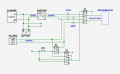
Here is an alternate suggestion, but uses a DYI under-voltage detector circuit.
1767303048597.png
If battery voltage is above the under-voltage detection level, its output is high (OK) enabling the XFR pushbutton to energize and latch K1, and transfer house power to standby power. If battery power goes below under-voltage detection level, XFR pushbutton is disabled, and K1 is automatically de-energized if latched.

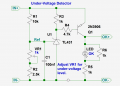
The Under-Voltage detector is shown below.
1767388385138.png
The Under-Voltage uses a TL431 as a comparator with threshold set by VR1.
Output and LED is on when the input voltage exceeds the under voltage detection level.

Edit: changed R3 to 1k. Added R6.
 
Last edited:

crutschow

Joined Mar 14, 2008
38,529
The Under-Voltage detector is shown below.
That looks similar to a circuit I've posted as an SCR crowbar circuit (and have seen it reproduced with this error).
Note that, since the minimum operating current for the TL431 is just a little under a mA, R3 should be no more that about 1kΩ to generate that operating current before Q1 starts to turn on.
I would use about 500Ω for margin.
 
Last edited:

eetech00

Joined Jun 8, 2013
4,705
That looks similar to a circuit I've posted as an SCR crowbar circuit (and have seen it reproduced with this error).
I haven't seen your circuit
I used a TI TL431 application note to design my circuit.

Note that, since the minimum operating current for the TL431 is just a little under a mA, R3 should be no more that about 1kΩ to generate that operating current before Q1 starts to turn on.
I would use about 500Ω for margin.
Good advice.
I changed R3 to 1k after bench testing.
I also added R6 as it provides a little sharper LED on/off behavior.
I've revised post #56.
 
Top