Help with Hartley oscillator

Thread Starter

mostmatt

Joined Jul 31, 2019
6
Hello,

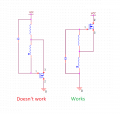
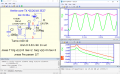
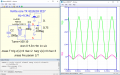
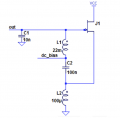
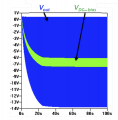
I am designing a Hartley oscillator cold start circuit based on this paper. The JFET is on the high side and the oscillator produces a negative DC bias. Is it possible to modify the circuit to produce a positive DC bias instead? I have tried various configurations with the JFET moved to the low side and I can't get self-sustaining oscillation.
1.png2.png
 

sparky 1

Joined Nov 3, 2018
1,218
There are a few studies, one in particular 2015 that asks the question Which mosfet topology lends itself to self start up to improve a thermoelectric effect using DC to DC for low voltage. Why they suggest depletion mosfet using ring oscillator?
Sub-Threshold Startup Charge Pump using Depletion MOSFET for a low-Voltage Harvesting Application

Edited: because there might be more introduction to jfet Hartley oscillator that is working

In 2017 Brazilian team has an ultra low start up below 50mV
(PDF) Modeling of a MOS ultralow voltage oscillator: experimental results
 
Last edited:

Thread Starter

mostmatt

Joined Jul 31, 2019
6
There are a few studies, one in particular 2015 that asks the question Which mosfet topology lends itself to self start up to improve a thermoelectric effect using DC to DC for low voltage. Why they suggest depletion mosfet using ring oscillator?
They say the depletion transistor of small size should be first as a startup and an enhancement mode be secondary for harvesting.
Almost 10 years later now, what happened to the TEG depletion mosfet charge pump? If you assume it works what supply values would that give you.
Would'nt that give you an Rds that will be closer to ideal, and a JFET Hartley oscillator can work on a split supply? The TEG project has less blanks to fill in to get to a tangible working circuit. Guessing game papers is a product of bad teaching.
Sub-Threshold Startup Charge Pump using Depletion MOSFET for a low-Voltage Harvesting Application
My volume restrictions are very tight (<0.5cc) so I've basically ruled out ring oscillators due to the large number of discrete components. Additionally, I need a startup voltage more than an order of magnitude less than what was achieved in that paper. The Hartley oscillator I pictured does work, and I have been able to miniaturize it adequately. But inverting the output nearly doubles the component count. I believe a low-side switched version would provide positive voltages, but I'm having trouble understanding why it doesn't work. Shouldn't the following two circuits be basically equivalent?

3.png
 

MisterBill2

Joined Jan 23, 2018
27,197
Often the effective gate bias can be added by instead putting a bit of resistance in the source circuit, at the very bottom, and often shunting that resistance with some capacitance to assure that the oscillator starts rapidly. In the circuit in post #3 that works, a hundred ohms between the coil bottom connection and the "0" volts ground, shunted by a 0.1 mfd small capacitor. Moving the source voltage in the positive direction is effectively moving the gate voltage in a negative direction. It is a classic method, ignored by some folks.
 

MisterBill2

Joined Jan 23, 2018
27,197
In addition, why not take the output from a less sensitive point in the circuit?? Take the signal off of the drain, by adding a 100 ohm series resistor between the drain and the Vcc.
 

MisterBill2

Joined Jan 23, 2018
27,197
With such a slow sweep rate we are not able to see any distortion of the wave form.
Mostly, a Hartley oscillator does not need that much feedback, unless rapid starting is the only requirement and harmonics do not matter.
So now that it works, at least in simulation, reducing C1 to 30pf and reducing R1 to 100K should reduce the distortion and the harmonics that result.
 

Bordodynov

Joined May 20, 2015
3,430
With such a slow sweep rate we are not able to see any distortion of the wave form.
Mostly, a Hartley oscillator does not need that much feedback, unless rapid starting is the only requirement and harmonics do not matter.
So now that it works, at least in simulation, reducing C1 to 30pf and reducing R1 to 100K should reduce the distortion and the harmonics that result.
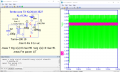
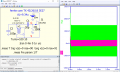
You are too self-confident and have a bad idea of how the scheme works. So I fulfilled your offer:

1731072646211.png

1731072869212.png
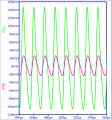
I tried to show that the circuit can work at a supply voltage of 50 mV. There was no way to get a small distortion of the target. For small distortions, you need to use a normal supply voltage.
1731073729024.png
 

MisterBill2

Joined Jan 23, 2018
27,197
It is not clear what difference the fast versus slow sweeps made, except that the waveform could not be seen with the slow sweep. And fast starting with a very low supply voltage is seldom a goal. And referencing papers in links is not the best way to present your ideas. And many commercial product oscillators do not use the active device directly tied to common for exactly the same reasons.
And if rapid starting at very low voltages was important then being much more specific about it would keep it in the foreground.
In addition, in many applications, the presence of harmonics because of distortion in the oscillator creates the requirement of additional circuitry to remove those harmonics.
 

Bordodynov

Joined May 20, 2015
3,430
MisterBill2
I hope that the values of capacitance and resistance you have proposed are bad - they sharply reduce it. I took a 50mV power supply because there was a link to an article in which 50mV was supplied as an achievement. Such a generator can be used to obtain a higher voltage from a thermoelectric cell or a solar cell. Note that I have given the winding data and the ferrite core in the diagram. I did not model some kind of abstract scheme. The Internet is full of generators with normal power supply.
 

MisterBill2

Joined Jan 23, 2018
27,197
MisterBill2
I hope that the values of capacitance and resistance you have proposed are bad - they sharply reduce it. I took a 50mV power supply because there was a link to an article in which 50mV was supplied as an achievement. Such a generator can be used to obtain a higher voltage from a thermoelectric cell or a solar cell. Note that I have given the winding data and the ferrite core in the diagram. I did not model some kind of abstract scheme. The Internet is full of generators with normal power supply.
INDEED the internet is full of all kinds of circuits! And just as certainly, a few of them are well designed and will perform exactly as claimed. And much more certainly, quite a few of them are totally faked, and every bit of their performance is a total lie!!

An oscillator circuit created for boosting the very low output voltage of some thermal power source is certainly much different from an oscillator circuit to be used to produce a signal for communications purposes, which is the more common use that I had guessed was your purpose. So I guessed incorrectly.

Power conversion systems certainly do have much different requirements from communications systems, in nearly all aspects. So having guessed incorrectly as to the primary goal of your quest, my advice was not on target.
Certainly, stating the specific goal of your efforts at the beginning would have been a benefit.
Like many other participants here, my ability to read what is in another persons mind is very poor. My apology for that handicap on my part.
 

sparky 1

Joined Nov 3, 2018
1,218
I had a chance to think about the different approaches and tend to agree that the size limitation
makes this quite a challenge or honey I shrunk the kids. Some of the low voltage mosfet research in the nanometer range
such a TLDR had oscillations that might work, also super current source followers using negative feed back had significant gain improvements
that might work along with a hybrid Hartley approach, and somehow those ideas could merge.
 

MisterBill2

Joined Jan 23, 2018
27,197
To utilize those low voltage thermal power sources it is also often possible to put a number of them in series. and in cases where that is not practical, it just might be that not every application actually deserves a wireless control link. Convenience is seldom adequately valuable to actually support some of the creations that provide no other feature than a bit of convenience, while consuming a fair amount of resources.
 
Top