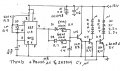
Help with fading/throbbing LED - more than 1 LED

You could also put a 6V Zener backwards in the diode circuit to offset the voltage back to where it was before switching from the 6V battery to the 12V battery. More precise than trying to make up the voltage with extra LEDs not quite knowing what their voltage drop will be.

Actually, that's not entirely true. It'll offset the voltage back down but it will be sweeping through a larger range because it goes from 1/3 the supply to 2/3 the supply.
 

Thread Starter

Dmm

Joined Apr 13, 2015
70
I did some more reading up on the 555 timer and testing of my circuit. Also want to say my knowledge is limited so some replies are beyond what I know. I'm a complete noob at this stuff, and I kind of started over on everything this weekend...reading up on things and starting with just getting to know the 555 and thinking of the steps I need to take to get my desired effects...specifically just getting the 555 to cycle LED on and off. Then I can build from this.

I will also restate my desired effect maybe a little more clear. I will have a 12vdc power source (no more 6v as originally posted) and I would like to have a few LEDs, example 8 of them, gradually fade on and off. Not instant on/off, but a slow glowing/fading/throbbing or whatever word you want to use. I would then connect a few of these circuits in parallel (eventually, not right away) with each other to expand the total number of LEDs in my project. I would like the total time the LEDs are completely off to be much longer than they are on (or a fading on/off cycle.) for example off time around 20-30 seconds, and a fade on/off cycle of 3-10 seconds. Then repeat, 20-30 seconds of darkness/off, then fade in/out and repeat.

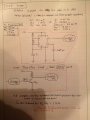
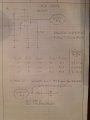
So the 555 can only have a duty cycle as low as 50% so the on/off time would be the same at best. I then read about NOT gate. So if I can get the on time around 20 seconds and the off time around 5 seconds then I should be able to add to my circuit a not gate to swap the on/off cycle to get my desired effect. I did some testing of my circuit and I have the 555 cycling nicely about 10-20 seconds on and 5-10 seconds off by adjusting the resistors -see attached picture. I feel comfortable with this circuit and can get the times I like, however I need to swap them with a NOT gate. That is my next step to experiment with.

I found a calculator to help get values close to what I want out of the 555. I have not added the NOT gate to my 555 output yet. I found a reference how to make the gate, but is there anything special how to size the resistors in this circuit for the gate? Once I get the not gate working I will then look at how to fade the LED in/out.

To recap my current state/questions:
Can I simply make the not gate shown in the picture? How do I size the resistors shown? Once I get that working how do I connect my LEDs from the output of the not gate to fade them in and out?

image.jpg image.jpg
 

Bernard

Joined Aug 7, 2008
5,784
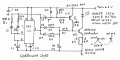
Lighthouse Light. 00000.jpg Duty cycle of 555 can be anything from 1% to 99% including true 50%. I might try to modify my lighthouse ckt. to give your desired effect. It brightens for 4 sec, dims for 4 sec. then off for 8 sec. On breadboard 4 red LEDs pulse 4 on 4 off with no dead zone. Might need a second 555 for long off?
Will throw in lighthouse ckt for ideas. PS, it works great.
Note: With R1 & R2 , duty cycle can be adjusted to any value. Same with up & down light via R3 & R4. Output is voltage controlled constant current.
 
Last edited:

Bernard

Joined Aug 7, 2008
5,784
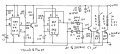
On the breadboard it seems to do as asked, 7 sec up, 7 sec down, & 25 sec off. Just for monitoring , added 1k & LED U1-3 to ground.
U1 time is up + pause time. U2 is your not gate, inverter. R6-R7 started as pots, when satisfied with timing can be replaced with closest std. values. If they are close to same value, can eliminate D's and use one R. Adjust R6 to give 3 V at top of R9 at peak brightness, which gives LED's 20 mA peak.Throb & Pause 00000.jpg
 

Thread Starter

Dmm

Joined Apr 13, 2015
70
Wendy - Thanks for the post. I had found your work prior to my posting when I first started out and learned a lot from it!

Thank you Bernard, you got me looking in the right direction. I still can't follow everything on your circuit but that in conjunction with a google search got me some info I needed. I finally understand the two diodes and how they work that you had shown which allows for duty cycle less than 50%. This page I found helped me through it as well: LINK. I did some testing and found that my "on" time is about 30% more than the calculated times in that link. Not sure where the difference is coming from but the times are what I was looking for in my testing. Not necessary to know why, but I'm the type of person that it bugs me why it's off like that.

So now, I will need to take my output from the 555 and try to get an LED and capacitor circuit so that the LED fades on and fades off, instead of instantly turning on and off. I will do a little more testing and see what I can get to work. But my question now is, how (and what) do I add to my circuit to get the LED to fade/throb instead of instant on/off?

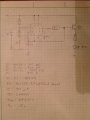
image.jpg
 

Thread Starter

Dmm

Joined Apr 13, 2015
70
So I thought the attached would work perfectly, how foolish of me! I tried to add the 33k-ohm, and transistor from my very 1st post, and try to connect that capacitor in the same way as from first post as well, thinking this would cause the LED to fade in and out. But instead the LED stayed on permanently.

Is there a simple way to get it to fade?

Edit: I see an error in my sketch. The node below D1/D2 should have been drawn so it connects at pin 2/6 node (above C1.) I do have it wired correct just showed incorrect on sketch.

image.jpg
 

Bernard

Joined Aug 7, 2008
5,784
Back to post #1 with some added trash. In last ckt with edit, R1, R2, D1 & D2 are not needed; it is like two circuits are combined for unknown
result. Output taken from top of C1 ( tolerance may be more than +_ 10 % ), is distorted triangular wave 4V peak to peak, top at+8V, bottom at 4V. V at base of Q1 at low then is 4V which is about 1.4 V over needed V to start D3 conducting at 3 mA. Peak V of 8V minus Vf of LED & .6 V E-B leaves5.4 V or 12 mA LED current with big " IF" Q1 does not load down charging of C1 so that C1 never reaches 8V, leaving LED always on.
Now if output is taken from pin 3 & using another RC as in Throb & Pause U3, a wide range of control is possible.
 

Thread Starter

Dmm

Joined Apr 13, 2015
70
Bernard, later today I will read through your post to try to understand it better. I did have my transistor backwards on my breadboard so fixing that, using 12v, the LED fades on in <1s, but stays on permanently (disconnected from battery after 2 minutes.)

My D1/2 and R1/2 I think make sense to me. The diodes force the capacitor to only charge through R1 and only discharge through R2. Making it very easy to change the time hi and time lo the LED is on/off for. This is how I get a duty cycle less than 50%. In my post #26 that circuit I understand fairly well - as far as: I know more about the 555 than I did before, and I can fine tune both the on and off times by changing R1 & R2. Right now that makes sense to me. That was my 1st big hurdle understanding how that worked to adjust the timings separate for on and off.

I then took my circuit from post #27 (fixing my backward transistor, and the node location between C1 & the diodes in the sketch on post #27)...and changed the battery back to 6v. This made the LED fade on and then off in about 4.3s. It immediately starts to fade back on when it completes the cycle. There is no completely off state of the LED, or at least very very short time that you just can't see.

So I don't understand why changing between 6v and 12v makes a difference? I'm guessing the 12v may overpower the transistor making in "on" all the time?

I also don't understand if my timing was set to about 27s off and 3s to 5s on (see post #26, I don't recall the exact setting I left connected, but think it was the 3.1s time on) then why don't I have the long 27s off time?
 

Thread Starter

Dmm

Joined Apr 13, 2015
70
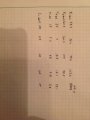
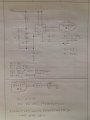
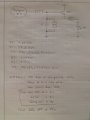
Think I'm getting closer to my desired effect! See attached 2 pictures. I went back to NOT connecting C1 to the output so that I can turn an LED on/off via the 555 rectangle output on pin 3. I have that fairly well understood how to make the times I want. I set up the circuit so that output from the 555 is high about 4.2 seconds, and low about 35 seconds. The LED works as expected when connecting with a current limiting resistor R3 on the first attached picture. So now, I experimented with taking the output from the 555 and trying to fade the LED on and off, instead of instantly turning on and off. The second picture attached I cobbled together from help from this page.

This sort of worked. The LED faded on extremely fast (I would like a slower fade on) then it stayed on shortly and faded out slowly. So I take it the capacitor C3 is charging really fast and that turns the LED on quickly. But then discharges slowly. Am I thinking about this correctly...The C3 has a + and - side and I have the + side connected to the R4. So does C3 charge through R4 (which is 4.62 K-ohm) while my 555 timer output is high (for about 4 seconds) and discharge through R5 (which is 37.2 k-ohm) into the base of the transistor when the 555 timer output is low (for about 35 seconds)?

The author in the link I referenced said the resistors create a voltage divider so timing the fade on/off can't be adjusted much. Need to do some reading on voltage divider to understand that one. I also would like to use a smaller C3 in my circuit just for space requirements. Any help here?

image.jpg image.jpg
 

Bernard

Joined Aug 7, 2008
5,784
I modified the Throb & Pause ckt. to eliminate U1. Up time approx. R5 X C3, or as measured 8 sec. C3 charging current bypasses R4 thru diode D3. Down time R4 X C3, about 30 sec. which is LED decay + pause time. R6 is adjusted to give 3 V at U5 emitter or 20 mA LED current. R7 adjusted to give desired decay time, here 8 sec.Throb & Pause #3 00000.jpg
To shrink C size, would go to C555, CMOS version of 555. C3 10 & R4 800k +-. C4 10 & R6-7 in meg range. U4- MPSA14.
 
Last edited:

Bernard

Joined Aug 7, 2008
5,784
C3-C4 both now 47 uF @ 16V, 5mm X 11.5mm. How small do you need to go?
Duty cycle can be just about anything. With R4 0 ohms negative pulse a few U sec. depending on C used.
R3 maybe 100 ohms to 3 meg. C- guess 10pF to 20,000 uF. Best long time I've reached was 3 h.
 

Thread Starter

Dmm

Joined Apr 13, 2015
70
Latest update:
Think I am getting close but still not understanding everything as much as I would like to. I have some ideas that I can try but don't want to spend too much time on this one right now. It's for halloween decorations so want to have a circuit I understand for this year, and work on this fading circuit later on for next year. I have postponed this project and started a simpler one (and started a new thread with my questions on that circuit.) will resume this circuit at a later date and hope to post a final working circuit when finished.

Thank you all for the help so far!
 
Top