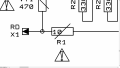
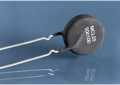
That could be -- and it would make sense to have the slash indicating that it's not a fixed value, but not have the usual arrow at the end indicating that it's settable.I'm thinking it could be a PTC themistor of sorts as a method of managing inrush or some sort of polyswitch?
I agree with Marc, in this instance R1 looks like it should be a thermistor.. It is also clear that this drawing uses a number of symbols not normally seen. Do you know the country of origin for this drawing? There are several countries that do not follow the IEC standards, and use totally different symbols. It seems that they choose intentionally to be confusing.I'm thinking it could be a PTC themistor of sorts as a method of managing inrush or some sort of polyswitch?
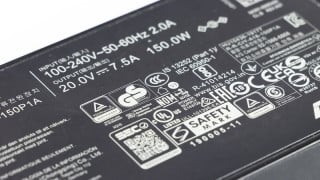
The triangles with the exclamation points indicate that mains voltage is directly connected to those items and hence there is a shock hazard. Which is true. But a fusable resistor needs to carry a current rating, which is not present on the drawing. That points to it either being a surge limiting thermistor or else one of those thermisters that develop a very high resistance when they heat up, so as to greatly limit fault current. And that device in post #9 looks like an updated version of the ones that used either a 12 volt bulb or a neon bulb and resistor, that were used by some folks for tracing electrical problems by poking the wire insulation full of holes. The users never realized that insulation once punctured never heals, and salt water always corrodes copper wire..I think it is a fusible resistor. I think the exclamation mark inside a triangle is a warning that for safety reasons the exact part number must be used.
Les.
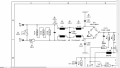
Here's the full schematic. I don't know where it's from.Now I am interested, there are some unusual things and circuit variations that it would be educational to understand.
Indeed, The whole unit is a high-end audio amplifier with some interesting features. It may have come from "The free Information Society" or 'Schematics for free", two of my favorite sites. Are you trying to repair this device? Or just hoping to understand it?Thanks for all the great responses. I'm going to try a 10 ohm PTC for 2 reasons: 1) The original part was green, and I haven't seen green NTCs. 2) PTC makes the most sense to me at that location.
Use of an NTC to limit the power-on surge as the bulk capacitor charges is common in modern power supplies too. Unfortunately, the temperature/power and the temperature/time curves are unknown, but it might help to use an NTC the same size as the one that was destroyed.hi,
Some early valve [tube] equipment used NTC's in their filament/heater circuits, in order to limit high power On currents.
Gradually falling in resistance as the heaters warmed up.
I would go for a NTC device, in that circuit location
E
I'm attempting to resurrect it. It had a blown transistor, which had taken out the rectifier and R1. It looks like it might be good otherwise.Indeed, The whole unit is a high-end audio amplifier with some interesting features. It may have come from "The free Information Society" or 'Schematics for free", two of my favorite sites. Are you trying to repair this device? Or just hoping to understand it?
That is definitely an item worth restoring, even if you had to simply replace the entire power supply. As for the thermistor current limiter specifications, nameplate watts will give you the steady state current, and from that and the needed rectified voltage you can figure out the warm resistance and that should be what you need. Be sure to get the cold resistance high enough, though.I'm attempting to resurrect it. It had a blown transistor, which had taken out the rectifier and R1. It looks like it might be good otherwise.


Seen it quite a few times in Industrial equipment, usually to mitigate large transformer inrush.I would not choose to use a PTC device for startup surge limiting,.
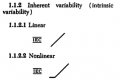
I actually found out from the manufacturer that it is indeed an NTC Thermistor. Obviously for inrush.According to IEEE Std 315-1975 and ANSI Y32.2-1975, page 23, this line ( / ) is:
View attachment 169730
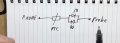
EDIT: This is NTC thermistor for inrush current limiting (circuit on Figure 1).
View attachment 169734