Facebook
 Google
 GitHub
 Linkedin
PhilTilson
- Joined Nov 29, 2009
- 156
There are so many errors in post #14 that it's hard to know where to start!
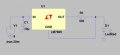
First major point: look at the original circuit diagram - it shows a power supply with an LED (which is almost certainly just to show that it is 'on') and a REGULATED 9V output. If you remove the regulator, you will NOT get a regulated output! This is obviously designed, as the OP says in post #11, to power the other examples in the book. Removing the regulator is a pretty dumb thing to do!
Which then makes the second item much easier to determine. If we have 9V regulated output and want, say, 15mA through the LED (though, as others have said, that will probably be more than enough) then subtract the typical forward voltage (2.2V) from the 9V = 6.8V, divide by .015 and get a result of 453 ohms - which is almost exactly the 470 ohms suggested by a couple of other respondents. Job done.
Ignore all the stuff about peak volts and RMS. You have a very basic wall wart, whose output could vary enormously, so we have to deal with it. A large capacitor across the output of the wall wart/input of the regulator is essential, especially if it really does use a half wave rectifier (which I doubt; I would lay odds that any item the OP gets hold of will use a bridge rectifier) since you will otherwise get massive ripple on the regulator input and output. 1000μF, 25V should be fine, but there should also be the 0.1μF parallel capacitor to prevent regulator instability.
A relatively small capacitor can be used on the output of the regulator - say 10μF, 16V - and again, a 0.1μF in parallel will help with high frequency instability. As others have said, these should be located as close as possible to the regulator.
That's all you need to know. Good luck!
First major point: look at the original circuit diagram - it shows a power supply with an LED (which is almost certainly just to show that it is 'on') and a REGULATED 9V output. If you remove the regulator, you will NOT get a regulated output! This is obviously designed, as the OP says in post #11, to power the other examples in the book. Removing the regulator is a pretty dumb thing to do!
Which then makes the second item much easier to determine. If we have 9V regulated output and want, say, 15mA through the LED (though, as others have said, that will probably be more than enough) then subtract the typical forward voltage (2.2V) from the 9V = 6.8V, divide by .015 and get a result of 453 ohms - which is almost exactly the 470 ohms suggested by a couple of other respondents. Job done.
Ignore all the stuff about peak volts and RMS. You have a very basic wall wart, whose output could vary enormously, so we have to deal with it. A large capacitor across the output of the wall wart/input of the regulator is essential, especially if it really does use a half wave rectifier (which I doubt; I would lay odds that any item the OP gets hold of will use a bridge rectifier) since you will otherwise get massive ripple on the regulator input and output. 1000μF, 25V should be fine, but there should also be the 0.1μF parallel capacitor to prevent regulator instability.
A relatively small capacitor can be used on the output of the regulator - say 10μF, 16V - and again, a 0.1μF in parallel will help with high frequency instability. As others have said, these should be located as close as possible to the regulator.
That's all you need to know. Good luck!