in the instructions say to get only Current from R3 and potency from R4... Shouldn't I ignore the others meshes/nodes?, since I got 2 power supplies in the mesh and 1 on the node..
But i dont get it -frustration-.. ive been here since like 3pm trying to do all the exercises the teacher left us and this is the last one omfg so hard...
But i dont get it -frustration-.. ive been here since like 3pm trying to do all the exercises the teacher left us and this is the last one omfg so hard...
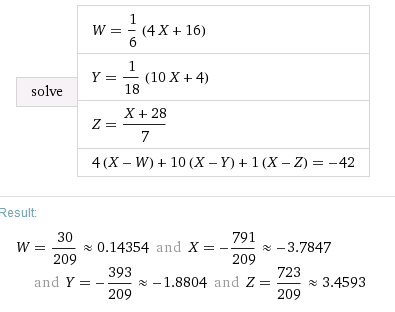
Now. Take the last equation: 4(I2-I1)+10(I2-I3)+1(I2-I4)=-42
and replace I1, I3, and I4 with:
\(I1=\frac{4(I2)+16}{6}\)
\(I3=\frac{10(I2)+4}{18}\)
\(I4=\frac{I2+28}{7}\)
Solve for I2.
Once you know I2, find I3. I3 is current through R4. Use Ohm's Law (V=I*R or I think you use E=I*R) to find voltage (potency? potential?) across R4.
Then use I2 and I3 to find current through R3. Remember how we represented the voltage across R3? V=R3*(I2-I3) So the current through R3 is I2-I3. You know I2, you know I3, subtract one from the other. If you do I2-I3 and you get positive answer, than the current is in direction of I2. If I2-I3 gives you a negative answer, then the current is in direction of I3.
Whenever you deal with a resistor that is shared by two meshes, then you need to consider the mesh current in both meshes that share that resistor.
For example. R3 is shared by two meshes. So you can not say: The current though R3 is I2, or, The current though R3 is I3. The current through R3 will be some portion of current from I2 and some portion from I3.
Now look at the R1. This resistor belong to only one mesh. So there is only one current passes through it. In this case I1 passes though R1. So it is simple.
I1=0.1435
I2=-3.784
I3=-1.88
I4=3.4593
These are mesh currents.
The negative numbers indicate that my original choice of direction was wrong. Remember, I chose that all the mesh currents will be in clockwise direction. I1 and I4 are in clockwise direction. I2 and I3 are negative, that means they are in counter clockwise direction.
Now. Potency of R4. I assume that means potential across R4. You use E for potential?
E=R4(I3)=8(1.881)=15.04 volt
Next. Current on R3. I assume that means current through R3.
I2-I3=-3.78-(-1.88)=-1.9 ampere
I originally assumed that the current will be moving clockwise. In this case from left to right. The negative sign indicate that my assumption is wrong. So if I change direction of the current, then the sign change too. The current though R3 is 1.9 ampere and this current is from right to left.

 Facebook
 Google
 GitHub
 Linkedin


 .. thanks for ur help <3