Any time you post a SPICE question please post your file.
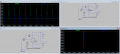
It looks like you are using DAD8029 but I can't see well. I can't find that maybe it is a AD8029. Here is where a file would really help. I think you signal is too fast for these amplifiers.
To make the output pulse reasonably "square", the amplifier bandwidth must be wide enough to amplify at least the 5th harmonic of the input signal without significant attenuation. That bandwidth is well into the GHz region, and neither of the two opamps shown can handle it. Based on the datasheets, the LTC part is the faster of the two; which is why its output is less distorted.
Please add unique net names to the schematics so we can tell which plots go with which schematics.
When you choose an amplifier there are several things to look at.
There is Slew Rate: 180V/μs. This is how fast the output will move at the very best it can do. 180V/uS is 0.18V/nS
The next thing to look at is GBW = 420MHz. On very fast amplifiers it is more complicated, but I don't have time. The simple answer is that at a gain of 1 you have 420mhz bandwidth. At a gain of 10 you have only 42mhz.
As stated before, a 420mhz signal using a 420mhz amplifier will not pass harmonies, leaving you (at best) a sign wave not a square wave. Remmeber running an amplifier at ats -3db frequency will get you a -3db signal.
Some amplifiers were designed for general purpose use and don't care how they are used. For fast amplifiers look to see why they were designed. Some are built for low gain use. Some are not to be used at a gain of 1. (or low gain)
"500pS" is really hard to work with. If you are just learning, drop down to the audio range and use more standard amplifiers.
Post #4 is a detailed explanation of the fact that some IC amplifiers have slower response speeds than others. That means that the output will not change as fast as the input changes.

 Facebook
 Google
 GitHub
 Linkedin