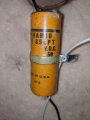
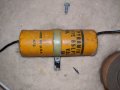
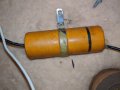
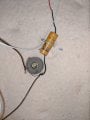
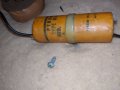
I pulled this 50+ year old capacitor out of a speaker and wanted to try and get the speakers working. Any help and guidance on what to get to replace it would be great. Thanks!
It looks a HF tweeter in a cross-over system. Can you show us everything in the system?
The MFD value is covered over by the metal ring but it looks like 4.
If this is correct, then you need 4μF 50VDC non-polar capacitor.
Why do you think the capacitor needs to be replaced?
Very, very, little sound out of the speakers when volume is almost maxed. Vintage stereo sites suggested that these fail/weaken over time. Speakers are from the 60s.
Disconnect the capacitor and test the system without the capacitor and hence the tweeter disconnected.
You should still hear good sound from the main speaker. If not, then the problem is not the capacitor but somewhere else.
Would connecting the tuner wires directly to the main speaker be an appropriate test or do I need to actually cut out the capacitor and run the wires through the regular connections?
Run the speaker wires as for normal operation.
Simply remove the capacitor. Do not reconnect the wires where the capacitor was connected.
If the tuner and speakers are in proper working order you should hear good sound.
If this is a stereo receiver, both left and right channels should be working. Work the BALANCE control back and forth to remove any built up crud. Only do this on the VOULME control with the power off otherwise there is a danger of overloading the speakers and your ear drums.
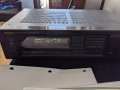
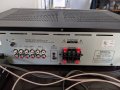
It might be a good idea to tell us the make and model of the unit and to post pictures of the front and back.
Looks like the problem is in the amplifier and not the speakers.
Posting pictures of the insides and outsides of the unit will help us see what you have.
The headphone check is a good idea. The amplifier has one of those big plugs rather than the newer smaller ones. I think I have one somewhere and an old cube speaker that I used for PC sound before the war.
Pictures of outside of amplifier are attached (no time before work to open it up). It has been boxed up for a very long time but otherwise was working then and shows no visible damage.
Looks like the problem is in the amplifier and not the speakers.
Posting pictures of the insides and outsides of the unit will help us see what you have.
Thank you for identifying the capacitor before. Would you say that the speaker capacitor status is unknown at this point? Or do you believe the capacitor is most likely good based on it's appearance and such?

 Facebook
 Google
 GitHub
 Linkedin
 125.9 KB Views: 13

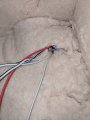
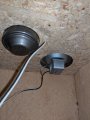
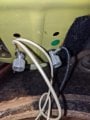
 - sound at about 90% volume but very, very softly.