help identify this..-component

Thread Starter

roadrash-uk

Joined Feb 14, 2016
3
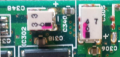
Please can someone identify these component for me. I removed one and it looks like a radial cap inside a removable plastic casing and apart from the marking you can see in the picture I can just make out 6N R3 on the end of the can. These are on a graphics card in a vintage Toshiba laptop that is continuously shutting down about 5 seconds after turning on but If i remove the graphics card the laptop turns on & keeps running except no display of course. I already replaced all cmos batteries etc before suspecting this, I am hoping these are electrolytic capacitors that have dried up as there is nothing much else I can replace on this pcb as everything else is very small smd parts and beyond my skills to replace. This was working all working but has been stored up for about a year.
 

Attachments

dl324

Joined Mar 30, 2015
18,327
Welcome to AAC!

With those values, they're more likely to be tantalum which tend to fail shorted.

The Moderators would appreciate it if you posted a smaller image file.
upload_2016-11-6_7-37-19.png
 

Thread Starter

roadrash-uk

Joined Feb 14, 2016
3
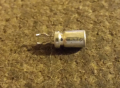
Here is a picture of the component removed from the plastic cover. Are tantalums available in a radial metal package like this? Ive checked and none of them are testing as shorted.
 

Attachments

ian field

Joined Oct 27, 2012
6,536
Here is a picture of the component removed from the plastic cover. Are tantalums available in a radial metal package like this? Ive checked and none of them are testing as shorted.
Basically just aluminium electrolytics thinly disguised as SMD components.

The only thing the plastic bit does is make it fit the pointy end of the assembly robot.

Such low voltage ratings are less common, it might be easier to use a tantalum bead and a spot of glue.

They could be organic semiconductor dielectric, so tantalum may be (nearly) your own option. OS capacitors were hailed as the best thing since sliced bread, but I've only encountered very few, they seem to have gone out of fashion very rapidly - which might have something to do with the problem you're having.

MLCC capacitors might be an option - I've seen brochures offering up to 180uF, 47uF is a nice find when they turn up, but they certainly exist. They're about as good as it gets for ESR an will certainly be less leaky than any kind of electrolytic.
 

ian field

Joined Oct 27, 2012
6,536
Please can someone identify these component for me. I removed one and it looks like a radial cap inside a removable plastic casing and apart from the marking you can see in the picture I can just make out 6N R3 on the end of the can. These are on a graphics card in a vintage Toshiba laptop that is continuously shutting down about 5 seconds after turning on but If i remove the graphics card the laptop turns on & keeps running except no display of course. I already replaced all cmos batteries etc before suspecting this, I am hoping these are electrolytic capacitors that have dried up as there is nothing much else I can replace on this pcb as everything else is very small smd parts and beyond my skills to replace. This was working all working but has been stored up for about a year.
They look like aluminium electrolytics - as long as they're not organic semiconductor dielectric; there's a trick you can try.

The electrolyte is caustic and the dielectric is an electro-formed oxide layer on one of the aluminium foil plates. In long storage; the electrolyte etches away the oxide layer. The capacitance increases but the part can no longer withstand the rated voltage. If you apply the full voltage without first re-forming the dielectric; the leakage current causes heating - it can build up a head of steam and burst.

You can clear such problems by removing each capacitor in turn and feed it with its rated voltage via a current limiting resistor. Any that haven't picked up to near the supplied voltage in 24h are scrap.

Capacitors that seem to charge up on a continuity tester can draw a lot of current or short altogether at full voltage - its one of those tricks of the trade you have to do sometimes to find out the truth.
 

Thread Starter

roadrash-uk

Joined Feb 14, 2016
3
Thank you everyone for your replies they are very interesting. I certainly have never seen capacitors packaged like this before and it had me wondering. Luckily they are fairly easy to replace so I think its best I try some tantalum caps to see if it cures the problem. If it doesn't I fear there is nothing else I can do to repair this old vintage laptop as surface mount stuff is beyond my repair skills.
 

ian field

Joined Oct 27, 2012
6,536
Thank you everyone for your replies they are very interesting. I certainly have never seen capacitors packaged like this before and it had me wondering. Luckily they are fairly easy to replace so I think its best I try some tantalum caps to see if it cures the problem. If it doesn't I fear there is nothing else I can do to repair this old vintage laptop as surface mount stuff is beyond my repair skills.
You have to be careful with tantalum - they can't survive *ANY* reverse voltage, they sometimes go leaky in signal coupling applications.

Supply rail decoupling usually doesn't suffer that problem, but supply tands can fail - the bead type sometimes go off like a match head.
 
Top