Help explaining the operation of a circuit

Thread Starter

tgatsrgdvrstbg

Joined Jul 25, 2024
7
Hey all,

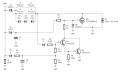
I'm attempting to reverse engineer a PCB I've been given, I'm fairly confident the schematic I've produced is accurate, though I'm having some trouble understanding how it actually operates as I'm not particularly good with analog electronics. For reference this PCB is designed as a dummy electric brake magnet, intended to connect to brake controllers and acting as a fake load, the PWR input is a ~13V variable PWM signal (pulling only around 0.1A at ~13V and close to 100% PWM from my measurements).

Initially I thought that the gate of the mosfet was being held at a constant voltage which limited it's drain to source current, and thereby limiting the current allowed through the big inductors to ground. But no matter what way I seem to approach analysing it, that doesn't seem to work, and neither have the other theories I've toyed with.
 

Attachments

Thread Starter

tgatsrgdvrstbg

Joined Jul 25, 2024
7
It does depend on the frequency of the PWM input and the values of the capacitors. Can you give us anything on those things?
Unsure what the cap values are, if I had to take a crack I'd say around 1uF based on the footprint. As for the PWM frequency, that can vary, but it'll generally be in the range of 100Hz - 1kHz, so fairly low frequency.
 

AnalogKid

Joined Aug 1, 2013
12,045
I don't see a PWM input anywhere on the schematic. Also, note that a PWM signal has a constant frequency for either the leading or trailing edge, and a variable time between the pulse edges. If what you are seeing is a true variable frequency signal, that is not PWM. Do you have a frequency counter / scope / frequency reading DMM?

ak
 

Thread Starter

tgatsrgdvrstbg

Joined Jul 25, 2024
7
I don't see a PWM input anywhere on the schematic. Also, note that a PWM signal has a constant frequency for either the leading or trailing edge, and a variable time between the pulse edges. If what you are seeing is a true variable frequency signal, that is not PWM. Do you have a frequency counter / scope / frequency reading DMM?

ak
The frequency will be constant for a given brake controller, but this could be connected to any general brake controller and receive a PWM signal at an unknown frequency. The frequency will be constant during operation, but the circuit will handle a number of PWM frequencies.
 

MisterBill2

Joined Jan 23, 2018
27,186
For starters, unless the electric brake magnets include all of those protective diodes, the action will not be similar at all. Likewise, the effect of the TVS protection diode across the mosfet.
The action of actual inductive coils would be to resist the rapid rise of current at the first instant, and then increase the current thru the mosfet as the gate capacitor charges.
Not quite sure what Q1 and Q2 do other than shunt some of the gate drive away.
 

Thread Starter

tgatsrgdvrstbg

Joined Jul 25, 2024
7
I've toyed around with it a bit more and I think it's essentially just shorting those inductors to ground through the MOSFET initially, so you can get a slowly increasing current initially as the inductors resist the rapid rise in current. After some time the voltage drop across the inductor leaves us with ~1.4V or so on the other side, which allows Q1 and Q2 to essentially saturate and provide an alternate path through some of the resistors to ground, leaving us with a fairly low current draw once it all settles out.
 

MisterBill2

Joined Jan 23, 2018
27,186
It is the delay in increasing the current that simulates the large inductance of the actual brake coils. Current into an inductor is delayed and that is why there would be a requirement for simulation. Except that adjusting the torque on a dyno is mostly done rather slower than faster. UNLESS there is some effort to do it with PWM control, which I have no ideas as to how that would work.
 

Thread Starter

tgatsrgdvrstbg

Joined Jul 25, 2024
7
It is the delay in increasing the current that simulates the large inductance of the actual brake coils. Current into an inductor is delayed and that is why there would be a requirement for simulation. Except that adjusting the torque on a dyno is mostly done rather slower than faster. UNLESS there is some effort to do it with PWM control, which I have no ideas as to how that would work.
Yeah, the inductors provide a slowly increasing current draw until we reach the target voltage that cuts off the low resistance path to ground and provides a new one through the BJT's with higher resistance and hence only letting the current through the inductors build up for a short period of time before lowering us to a smaller steady current draw.
I used a clamp meter and had a look at the current draw of the system and that's basically what I observe, you see the current ramp up and then a quick downwards spike as it settles down to it's lower current draw state.
 
Top