Help eliminating pop in JFET changeover circuit...

Thread Starter

liquidair

Joined Oct 1, 2009
208
Hi all,
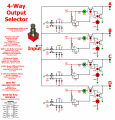
I've been struggling for some time with trying to switch between two inputs without pops and clicks. Originally I just used a toggle switch but this always popped audibly, even after trying all the usual tricks like resistors to ground on both sides of the switch, resistors across the switches, etc. My bright idea was to do this with JFETs so the transitions could be tapered. This was better but even after a few iterations of this there's still a slight click that is audible most of the time. Here's the schematic:
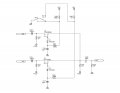
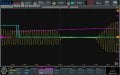
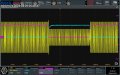
JFETChangeover.jpgThis forced me to get a digital scope, but it has only helped so much. The following scope shots are a 1kHz sine wave (yellow) with the 2 JFET control voltages: blue is the node at R26/R27 and magenta is the node at R28/R29.
Changeover.jpg

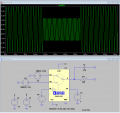
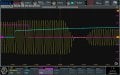
A spike is clearly visible on the transition between IN2 to IN1 (smaller of the signals). Here's both of these transitions zoomed in:

IN2 to IN1:
In2ToIn1Zoom.jpg

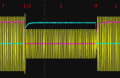
IN1 to IN2:
In1ToIn2Zoom.jpg

Strangely, you can actually see an inverse spike here, notice the IN1 wave gets around 10% smaller for a bit.

Another thing to note is that I need a break-before-make action here so the gaps are OK and very short.

So, my question is, what am I doing wrong & how can I fix this to make a silent transition? Or, is there a better option here?

Thank you!!
 

ronsimpson

Joined Oct 7, 2019
4,647
IMO
I think there is a time when the output is 1+2 and a time when the output is nothing. (not 1 not 2)
This information is just information. It probably does not effect the pop much.
Your ear is good at find "pops".
Is the input signal about 0.3 volts?
1714480547349.png
 

LadySpark

Joined Feb 7, 2024
194
Hi all,
I've been struggling for some time with trying to switch between two inputs without pops and clicks. Originally I just used a toggle switch but this always popped audibly, even after trying all the usual tricks like resistors to ground on both sides of the switch, resistors across the switches, etc. My bright idea was to do this with JFETs so the transitions could be tapered. This was better but even after a few iterations of this there's still a slight click that is audible most of the time. Here's the schematic:
View attachment 321218This forced me to get a digital scope, but it has only helped so much. The following scope shots are a 1kHz sine wave (yellow) with the 2 JFET control voltages: blue is the node at R26/R27 and magenta is the node at R28/R29.

View attachment 321220

A spike is clearly visible on the transition between IN2 to IN1 (smaller of the signals). Here's both of these transitions zoomed in:

IN2 to IN1:
View attachment 321223

IN1 to IN2:
View attachment 321224

Strangely, you can actually see an inverse spike here, notice the IN1 wave gets around 10% smaller for a bit.

Another thing to note is that I need a break-before-make action here so the gaps are OK and very short.

So, my question is, what am I doing wrong & how can I fix this to make a silent transition? Or, is there a better option here?

Thank you!!
It looks like its switching without a bias.
R22 and R23 should go to 9V, R26 and R28 go to 4.5V and R24 goes to gnd.
I don't think you need the diode and cap in the gate circuit either.
 

MisterBill2

Joined Jan 23, 2018
27,186
To remove the pop, change the two capacitors, C16 and C 17 to 0.47 mfd, and the resistors, R27 and R29, both to either 2.2 Megohm or 4.7 Megohm. The pop is due to a fast transition.
 

Alec_t

Joined Sep 17, 2013
15,103
Have you considered usiing a transmission gate IC such as the CD4066 (providing signal amplitude could be reduced to be within the IC supply rails)?
 

Thread Starter

liquidair

Joined Oct 1, 2009
208
Have you tried that circuit without the diodes?
The diodes are key to turning the JFETs on with an audio signal. When Vgate is high, those diodes turn off leaving the gate to float and then the gate-source capacitance passes the audio signal in, making Vgs = 0V (thus on). This ensures the signal can swing positive without that making the Vgs negative enough to start turning it off.
 

Thread Starter

liquidair

Joined Oct 1, 2009
208
I think there is a time when the output is 1+2 and a time when the output is nothing. (not 1 not 2)
I was thinking that too but how do you explain the negative spike in the IN1 to IN2 pic? Look just above the horizontal "3" cursor the signal is bigger then drops for a bit before turn-off starts. I can't figure out what I'm seeing there. I suspect it has something to do with the actual toggle switch transitions but I'm not sure what.

Your ear is good at find "pops".
Is the input signal about 0.3 volts?
Thanks! It's obvious when listening to it because it's random, I'd say 60% of the time its a perfect transition. And yes, around 0.4V it's from guitar.
 

MisterBill2

Joined Jan 23, 2018
27,186
OK, you are welcome to ignore the suggestion of slowing the transition. Using a transmission switch is also a good choice. either the AD switch as shown, or the CD4066, or even the CD 4051, CD4052, ormtheCD4053 analog switch is another option. AND using something less noisy than a mechanical switch can improve things also.
And you can totally ignore the suggestion .
 

Thread Starter

liquidair

Joined Oct 1, 2009
208
Maybe use another FET to ground (blank) output during changeover?
I definitely thought about this and have used the technique before. The problem I had is how to generate the pulse, but looking at the scope shots above, there's a brief point when both control voltages are high, so an and gate of some sort might work. Good idea.
 

Thread Starter

liquidair

Joined Oct 1, 2009
208
To remove the pop, change the two capacitors, C16 and C 17 to 0.47 mfd, and the resistors, R27 and R29, both to either 2.2 Megohm or 4.7 Megohm. The pop is due to a fast transition.
I'm not ignoring you MisterBill2, I promise! Just haven't been able to get here yet today. The problem with this is the switching action needs to be more or less instantaneous with the actual toggle setting. I plug these values in and see what happens though!
 

Thread Starter

liquidair

Joined Oct 1, 2009
208
Have you considered usiing a transmission gate IC such as the CD4066 (providing signal amplitude could be reduced to be within the IC supply rails)?
Briefly. My concern was distortion but then again, plenty of audio has passed through these chips over the years. I imagine with 4 switch elements I could halve the distortion by using 2 (or even 4) in parallel?
 

AnalogKid

Joined Aug 1, 2013
12,045
Back in another life, I used to hang around a psychacoustics research lab. A rapid increase or decrease in volume is perceived as having a pop at the transition, even when there isn't one in the waveform. This is an acoustic manifestation of the Gibbs phenomenon. Your pure sinewave signal may have zero harmonics, but the transition points have lotsa.

There is a corresponding distortion in visual perception, which is why most people's "robot dance" movement is way over-exaggerated at transition points

https://en.wikipedia.org/wiki/Gibbs_phenomenon

ak
 

Thread Starter

liquidair

Joined Oct 1, 2009
208
How about a part designed for the job? Break before make, rail-to-rail..
I briefly looked into a similar chip. These seem perfect aside from the big catch, cost. They're about 5x the cost of the problematic circuit, although we can probably offset that because we no longer need the extra blocking caps and bias circuitry. Any other of these chips that might be a bit cheaper?
 

Irving

Joined Jan 30, 2016
4,996
4066 datasheet says 0.05% distortion

The ADG1419 is $4-$5 and quotes 0.016% THD

The H11F1M look interesting, 1 in series, 1 in parallel with signal. They have the advantage, being optical, of having no charge injection into the audio path, a possible source of 'pop'. And you can modulate the resistance to avoid any rapid level change. But at $4 each they are the most expensive option.
 

Thread Starter

liquidair

Joined Oct 1, 2009
208
1. When IN2 is not selected, the right side of C15 is at 4.5 V. When IN2 is selected, the right side of C15 sees 2.25 V because the FET is essentially 0 ohms and R23-R24 form a voltage divider. This is a large step change in the DC across the cap.
Interesting. Last night I was researching all this and noticed those resistors are basically across the switch when off, but I didn't put them causing a step change together. Can this be minimized? This circuit is more or less used all the time in audio with a seemingly instantaneous switch transition WITH longer time constants (<- likely the key).

There is a corresponding distortion in visual perception, which is why most people's "robot dance" movement is way over-exaggerated at transition points
This explains so much why people call for medical help when I try to dance. Amazing.;)
 
Top