Facebook
 Google
 GitHub
 Linkedin

Hi all! I'm designing a headphone mixer and amplifier for myself, but probably not for sale as I think it will not be very producible.
This was born out of my own need as a musician; no product on the market has all the inputs I want, and is also small enough to fit on my guitar pedalboard. I've already more or less sorted out the physical design; connectors and knobs and PCB will live in a tall-ish aluminum hammond box, with the circuit board below them. Here are a couple of pictures of the assembly:
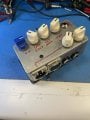
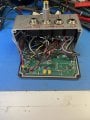
As you can see it's pretty tight in there, not much room. The connectors are mms away from the bottom of some of the potentiometers. But for audio frequencies, I'm not too worried. I hope!)
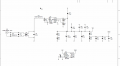
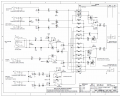
The schematic is below. Sorry for the large images, but it's a bit unreadable it I make them smaller! There's nothing revolutionary about this, although I am new-ish to multiple channel audio circuit designs. (I have experience mainly in ADC, analog filtering MCUs, etc.)
The unit will run on 12VDC which is regulated by LDO to 9V for the main supply. There is also a 4.5V reference IC to provide a midscale voltage, since all inputs will be AC coupled. (I don't want to do dual supplies, - although if someone knows of a simple, single IC solution to get like ±9 or ±5V, I'll listen.)
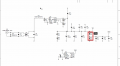
There are two unbuffered inputs, one mono and one stereo, which will come from my guitar pedalboard. (main guitar signal + click). These are relatively high output level so I thought I might not need to buffer them.
The other inputs are:
- microphone in/through (differential, low signal level so it needs gain)
- Monitor in (stereo, also *could* be low level so I added a gain stage, but could turn it down for higher level inputs.)
- Aux instrumental in (just an extra input since I had an extra half opamp, no immediate use for it. :-D )

You can see in one of the pictures that I've already built the prototype PCBA, and started wiring to the connectors and pots. It more or less matches the above schematic.
My main issues so far are getting everything to work properly, which I think I'll be able to do, but I do have some general audio design questions for mixers and headphone drivers.
1. Is there a limit to the number of stages that can be mixed into a single opamp like this? I have 5 for both left and right sides.
2. Should I be doing the mixing stage separately from the headphone driver stage? You can see that they are currently combined into a single opamp.
3. Should I be unity gain buffering the higher level input stages?
4. If I want to implement a master volume control (shown redlined x-d out in the main schematic), what's the best way to do it? obv the 10k pot in series with the 100k for feedback on the driver stage won't get me very much volume change, but playing with component values is easy once a PCB is built.)
Once I sort out the issues in this initial design I will almost surely spin the PCB and improve it. It's not too pricey, I got the qty 3 of the prototype built for around $100. (Double-sided, single drill, singe side silkscreen.)
Thanks for any thoughts! Like I said I'm experienced in electronics, but not in audio design specifically.
Geoff
This was born out of my own need as a musician; no product on the market has all the inputs I want, and is also small enough to fit on my guitar pedalboard. I've already more or less sorted out the physical design; connectors and knobs and PCB will live in a tall-ish aluminum hammond box, with the circuit board below them. Here are a couple of pictures of the assembly:
As you can see it's pretty tight in there, not much room. The connectors are mms away from the bottom of some of the potentiometers. But for audio frequencies, I'm not too worried. I hope!)
The schematic is below. Sorry for the large images, but it's a bit unreadable it I make them smaller! There's nothing revolutionary about this, although I am new-ish to multiple channel audio circuit designs. (I have experience mainly in ADC, analog filtering MCUs, etc.)
The unit will run on 12VDC which is regulated by LDO to 9V for the main supply. There is also a 4.5V reference IC to provide a midscale voltage, since all inputs will be AC coupled. (I don't want to do dual supplies, - although if someone knows of a simple, single IC solution to get like ±9 or ±5V, I'll listen.)
There are two unbuffered inputs, one mono and one stereo, which will come from my guitar pedalboard. (main guitar signal + click). These are relatively high output level so I thought I might not need to buffer them.
The other inputs are:
- microphone in/through (differential, low signal level so it needs gain)
- Monitor in (stereo, also *could* be low level so I added a gain stage, but could turn it down for higher level inputs.)
- Aux instrumental in (just an extra input since I had an extra half opamp, no immediate use for it. :-D )
You can see in one of the pictures that I've already built the prototype PCBA, and started wiring to the connectors and pots. It more or less matches the above schematic.
My main issues so far are getting everything to work properly, which I think I'll be able to do, but I do have some general audio design questions for mixers and headphone drivers.
1. Is there a limit to the number of stages that can be mixed into a single opamp like this? I have 5 for both left and right sides.
2. Should I be doing the mixing stage separately from the headphone driver stage? You can see that they are currently combined into a single opamp.
3. Should I be unity gain buffering the higher level input stages?
4. If I want to implement a master volume control (shown redlined x-d out in the main schematic), what's the best way to do it? obv the 10k pot in series with the 100k for feedback on the driver stage won't get me very much volume change, but playing with component values is easy once a PCB is built.)
Once I sort out the issues in this initial design I will almost surely spin the PCB and improve it. It's not too pricey, I got the qty 3 of the prototype built for around $100. (Double-sided, single drill, singe side silkscreen.)
Thanks for any thoughts! Like I said I'm experienced in electronics, but not in audio design specifically.
Geoff
Attachments
-
 58.6 KB Views: 6
 -
 231.5 KB Views: 87