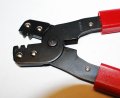
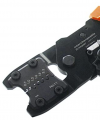
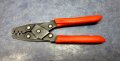
Those styles of terminals have what was called an "F"crimp, because the two sets of tabs that get crimped look like thatletter in profile, prior to crimping. That style crimp is very demanding on the crimper to produce the correct set of bends, and to squeeze hard enough to create the proper amount of deformation and metal flow. But unless the crimp is also correctly soldered it will be subject to failure if salt water gets into the crimped portion. Probably fresh water will also cause problems.
Which is why I prefer a force multiplying compound joint with a ratcheting mechanism over a simple scissors joint.
Scissor Joint
Force multiplying compound joint
For larger AWG they use longer handles to further increase the force or ultimately use hydraulics. As to soldering, my experience with stranded wire (especially with fine diameter more flexible stranded wire) is the solder wicks into the wire strands and the wire doesn't fail at the crimp but at the point where the wicking into the wire ends. Shouldn't have any effect on solid wire though.
Also, the ratcheting mechanism allows you to insert and lightly grip the "lug" and wire and allows me to double check the alignment before executing the crimp. I find that I am less prone to bad crimps than by using a simple scissor joint tool.
When soldering on a terminal it is VITAL to know when to stop! Otherwise excess solder will indeed wick up the strands. Also, it is important to apply the heat at the correct location, which is NOT on the wire.
And a note about actually making my own wire connectors: Yes, I have done that a few times when I needed a heavy-duty connection to replace the end of the ground wire from the battery to the engine block. The wire size was either about #6 or #4, I don't recall exactly. I did this in 1970, so it was a while back.
I used a piece of 3/8 inch copper tube. First I cleaned the inside with some steel wool, then fluxed it and tinned the first inch, holding it with pliers and using a propane torch. Then I took the insulation off the wire so that the bare strands reached through the tube, with the insulation entering the end of the tube a bit. I did put some rosin solder flux on the strands of the wire. The wire went into the non-tinned end of the tube. Then I mashed flat the end onto the strands so that they were captured quite well, and I soldered that end to assure the connection. Then drilled the hole for the connection bolt in the flat end. That patch lasted very well,
That style crimp is very demanding on the crimper to produce the correct set of bends, and to squeeze hard enough to create the proper amount of deformation and metal flow.
Are you saying it will wear down the tool faster? Or is it actually demanding on the user when they have to do this 10,000 times in a day? For comparison I need 16 crimps for my prototype and another 1,008 crimps if this makes it to production.
I won‘t question @MisterBill2 ’s experience but here’s mine.
I learned from experts that crimped connections with the right tool are more reliable than solder connections. Properly applied, crimped connectors have a gas tight seal and a pullout resistance that exceeds the wire strength in most cases.
Adding solder to a properly crimped connector reduces strength at the point where the wire enters the connector. It does nothing to improve the electrical properties of the connection.
Here is a manual from Molex on best practices for crimping. It’s pretty deep in the weeds because it concentrates on quality control. Well worth reading.
Here is a manual from Molex on best practices for crimping. It’s pretty deep in the weeds because it concentrates on quality control. Well worth reading.
I know what you mean. Before I explicitly researched crimped connections I had a lot of misconceptions based on assumptions I had made. But I knew from some milspec documents that required crimped connections they were considered more reliable than soldered connections.
Once I learned the details I was making really nice crimped connections: right tool, right connector, and right stripping length.
y demanding I mean that the crimp die has to be just the right size for the specific terminal type. The amount of squeeze is critical to getting that "more reliable than solder" connection. Of course the sellers will make that claim! And a perfect crimp possibly is that reliable. But I have never seen a crimp connector that is intended to be re-usable, and in my case that was a non-negotiable need, since cables could fail and neither replacement pins nor a suitable crimper were available on site. But a soldering tool I always had with me.
Of course not everybody who needs to make a connection is able to solder well, I have seen that evidence many times.

 Facebook
 Google
 GitHub
 Linkedin