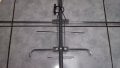
Ground TV antenna with PVC mast

Thread Starter

Gauzz

Joined Jan 5, 2011
23
So I have a TV antenna on my roof and I just found out it's not grounded, the problem is that the mast is made out of PVC. So I was wondering how to ground it given that the antenna circuit simply consists of a balun or matching transformer connected to two wires from the antenna itself.

Should I simply hook a ground wire to any of those two wires from the antenna?

Here's a picture of the antenna, the balun is connected to the two wires on the top of the antenna.
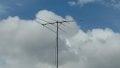
20171001_131206.jpg
 
Last edited:

ifixit

Joined Nov 20, 2008
652
Use a lightning arrester suited for 300 ohm twin lead. Mount it outside near where the lead enters the building. Run a ground wire from there to a ground rod near by. The lead should be mounted on 4" standoffs to keep it away from anything flammable, such as your house. Cross your fingers and wish for no lightning strikes.

Don't expect these precautions to protect your equipment from damage, it is only meant to prevent your house from catching fire. Extra surge and lightning protection at the receiver (TV?) wouldn't hurt. This helps protect against nearby strikes to your electrical system.

Where do those guy wires goto? They are a little harder to deal with. Hopefully the strike will follow the more attractive antenna and lead wire.

Careful on your roof,
Ifixit
 

BR-549

Joined Sep 22, 2013
4,928
The twin lead should be connected to the driven element(s). Are you using PVC for the horizontal mast?

I believe the horizontal mast should be metal. An insulated element could acquire a charge. Holding a net charge up in the air is bad juju.

If the vertical mast and guy wires are not grounded......they may acquire a charge.

Normally the horizontal mast and the vertical mast are metal. The bottom of vertical mast has ground wire running to ground rod. This will protect 90% of the antenna structure by preventing charge build up and giving you a cone of protection around the house.

It looks like the balun is connected to 3 dipoles. And it appears to be 75 ohm coax from the balun. So a coax arrester and ground rod assembly at feed line entrance.
 

Lectraplayer

Joined Jan 2, 2015
123
I have not really heard of a PVC mast (and I'm assuming the vertical mast is PVC pipe) being stable enough for mounting an antenna assembly. ...but there may be enough grounding if you install a barrel like what dish and cable companies use to ground the shield of the coax. My bet is the horizontal mast is aluminum since most antennae I see are sold that way. I doubt you made that one. Did you?

...but I would not trust PVC to hold and may be installing a metal mast before long.
 

#12

Joined Nov 30, 2010
18,224
Here's a different idea derived from the power poles around me. Put a vertical metal piece longer than the largest radius of the receiving antenna on the top of the mast and ground that with a bare wire running down the mast to a ground rod pounded into the earth. Presto! Your PVC pole and metal antenna head become unattractive to lightning because there is a much better path to ground available.
 

Thread Starter

Gauzz

Joined Jan 5, 2011
23
Use a lightning arrester suited for 300 ohm twin lead. Mount it outside near where the lead enters the building. Run a ground wire from there to a ground rod near by. The lead should be mounted on 4" standoffs to keep it away from anything flammable, such as your house. Cross your fingers and wish for no lightning strikes.

Don't expect these precautions to protect your equipment from damage, it is only meant to prevent your house from catching fire. Extra surge and lightning protection at the receiver (TV?) wouldn't hurt. This helps protect against nearby strikes to your electrical system.

Where do those guy wires goto? They are a little harder to deal with. Hopefully the strike will follow the more attractive antenna and lead wire.

Careful on your roof,
Ifixit
My roof is metal, the other day I believe lightning struck it, that's why I got interested in grounding the antenna, but I think that my electronics were saved by the fact that the mast is pvc, I know it's all like a gamble, if a lightning strikes the antenna things could go really bad. But on the other hand the surface area of the roof is way larger than the antenna's.
 
Last edited:

Thread Starter

Gauzz

Joined Jan 5, 2011
23
The twin lead should be connected to the driven element(s). Are you using PVC for the horizontal mast?

I believe the horizontal mast should be metal. An insulated element could acquire a charge. Holding a net charge up in the air is bad juju.

If the vertical mast and guy wires are not grounded......they may acquire a charge.

Normally the horizontal mast and the vertical mast are metal. The bottom of vertical mast has ground wire running to ground rod. This will protect 90% of the antenna structure by preventing charge build up and giving you a cone of protection around the house.

It looks like the balun is connected to 3 dipoles. And it appears to be 75 ohm coax from the balun. So a coax arrester and ground rod assembly at feed line entrance.
The vertical mast is metal, the roof is metal (so I think that counts as a ground, the roof is also connected to the rebars inside the concrete walls that go a couple feet underground), the horizontal mast is PVC, I uploaded a new picture.
 

Thread Starter

Gauzz

Joined Jan 5, 2011
23
I have not really heard of a PVC mast (and I'm assuming the vertical mast is PVC pipe) being stable enough for mounting an antenna assembly. ...but there may be enough grounding if you install a barrel like what dish and cable companies use to ground the shield of the coax. My bet is the horizontal mast is aluminum since most antennae I see are sold that way. I doubt you made that one. Did you?

...but I would not trust PVC to hold and may be installing a metal mast before long.
Horizontal is PVC, vertical is metal (check the new picture), I didn't make the antenna, someone bought it like that but until now I figure it's PVC, looks pretty artisanal to me.
 
Last edited:

#12

Joined Nov 30, 2010
18,224
The coax shield is grounded. The balun is an isolation transformer but it's so small that it's useless in the face of a lightening strike. Put the grounding device on the coax as recommended earlier than drive a ground rod and strap that to the bottom of the antenna pole. That's what I learned about 40 years ago.

You can buy a pass-through connector for the coax which has a ground lug on it.
 

PRFGADGET

Joined Aug 8, 2011
53
IF the "BOOM" of the antenna is metal (that's the horizontal piece that the element's are mounted to) attach a ground wire there.
Take the other end of your "GROUND" wire to the mains electrical ground which should be near the power company's meter.
NO the metal roof DOES NOT count as a ground UNLESS each panel is properly bonded to the next and also to the mains ground rod as described above , same with the support mast.
From what I can see of the feed line, it appears to be coax coming off the Balun , if so there are special lighting arresters available for that coax that must be grounded also (check with a local installer , cable company , or other EXPERIENCED professional).
 
Top