Glowing a LED wirelessly

Thread Starter

ThePLAYGOD

Joined Nov 16, 2016
8
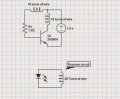
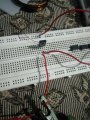
The aim to design a circuit to glow a 3w led wirelessly.The circuit that i followed is given below.Success was also acheived was able to transmit upto 6-8 cms.
Well i know the principles involved,DC into converted to a pseudo AC which generates flux in transmitter coil and the receiver catches those field lines to produce current in second coil.What i cant get is how the transistor(BD139) that i used is convertind that DC to a pulsating DC/Pseudo AC ? Any help regarding how the transistor is behaving in the circuit is appreciated.
 

Attachments

ian field

Joined Oct 27, 2012
6,536
The aim to design a circuit to glow a 3w led wirelessly.The circuit that i followed is given below.Success was also acheived was able to transmit upto 6-8 cms.
Well i know the principles involved,DC into converted to a pseudo AC which generates flux in transmitter coil and the receiver catches those field lines to produce current in second coil.What i cant get is how the transistor(BD139) that i used is convertind that DC to a pulsating DC/Pseudo AC ? Any help regarding how the transistor is behaving in the circuit is appreciated.
The blocking oscillator current waveform is assymetric so you have to maintain the correct orientation between the TX & RX coils - an inverse parallel pair of LEDs would improve matters, it would also provide reverse breakdown protection when the coil orientation allows large unloaded voltage pulses.
 

Thread Starter

ThePLAYGOD

Joined Nov 16, 2016
8
Thanks for ur useful compliments.But my question is how the transistor works in the circuit.I am unable to get that physics?
 

ian field

Joined Oct 27, 2012
6,536
Thanks for ur useful compliments.But my question is how the transistor works in the circuit.I am unable to get that physics?
In a tea chest somewhere at the back of my garage, I have a book on blocking oscillators - the technical details and mathematics are very complex.

A simplistic description is; the resistor in series with the base winding allows sufficient bias to turn the transistor on, as current in the collector winding increases it induces current in the base winding, the regenerative action saturates the transistor with a vengeance. At some point; the inductor core saturates and the feedback collapses. When this happens, the transistor falls out of saturation and the cycle repeats.

The enthusiastic transistor saturation gives it pretty good switching current performance.
 

Thread Starter

ThePLAYGOD

Joined Nov 16, 2016
8
Thats the answer i wanna listen,thank you very much sir.Can u just suggest some references where i can find more about this,any book or website if possible.
 

ian field

Joined Oct 27, 2012
6,536
Thats the answer i wanna listen,thank you very much sir.Can u just suggest some references where i can find more about this,any book or website if possible.
I've pretty much just said what's good enough for millions of experimenters. There were and probably still are loads of BO circuits on blogs all over the place.

You can run it off more than 1.5V - but you have to modify the bias arrangement.

The essential points are; you have to AC couple the base winding to block DC. Generally you'd ground one end of the base winding and couple the top to the base with a capacitor. Secondly; the base no longer has any bias, so you need a start up resistor from +V to the base - I'd start with about 470k and lower it if it doesn't start.
 

Thread Starter

ThePLAYGOD

Joined Nov 16, 2016
8
As suggested by u sir i followed some of the BO circuits understood how the transistor saturates and goes to cutoff ,creating a pulse.I wud defenitely try ur recommendations.Still some queries in my mind ,I wud also like know how the no of coils in the circuit is determined whats the mathematics involved behind this?How the analysis of the circuit is done?
 

ian field

Joined Oct 27, 2012
6,536
As suggested by u sir i followed some of the BO circuits understood how the transistor saturates and goes to cutoff ,creating a pulse.I wud defenitely try ur recommendations.Still some queries in my mind ,I wud also like know how the no of coils in the circuit is determined whats the mathematics involved behind this?How the analysis of the circuit is done?
The mathematics of blocking oscillators isn't trivial - its a very simple circuit that most people develop empirically.

The easiest thing to concentrate on is the energy storage capacity of the magnetics.
 

Thread Starter

ThePLAYGOD

Joined Nov 16, 2016
8
can u plz help about calucating the no of turns in the coil.As per ur suggestion i increased the battery to 6v and how to decide the no of turns in the coil if u cud explain it mathematically it wud be nice.WIRE USED 25 awg insulated copper wire.
 
Top