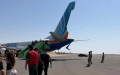
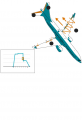
Glad I'm not a passenger

nsaspook

Joined Aug 27, 2009
16,503
I'm glad to hear that -- an all too uncommon victory of common sense over bureaucracy.

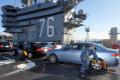
They don't look like they are tied down in any way, but maybe they are still loading. I can't tell if those "puddles" are actually tiedown points. They seem to be periodically spaced, though.
I'm glad to hear that -- an all too uncommon victory of common sense over bureaucracy.

They don't look like they are tied down in any way, but maybe they are still loading. I can't tell if those "puddles" are actually tiedown points. They seem to be periodically spaced, though.
1790361463788.png
 

WBahn

Joined Mar 31, 2012
33,309
That's a LOT of chocks! I wonder how many a carrier normally stocks.

But I don't believe that they rely on chocks alone. Auto carriers have sunk because cars that weren't adequately tied down banged into each other in heavy seas and caught on fire.

There do appear to be a pretty good density of tie down points available. Given the crew size, it wouldn't take long to secure them all an all-hands type operation, but I doubt that's how they do it. In fact, since they probably can't transport more than five or six hundred cars, it would only take a fraction of the crew to do it in very short order, provided the chains and other hardware was distributed efficiently (and one thing that Navy crews are good at is figuring out procedures to things like that pretty efficiently). My guess is that since the onboarding operation is going to take many hours, they probably have a work gang of several dozen people working their way forward as the cars are loaded, probably with one team per column (or perhaps each team works multiple columns). Once a vehicle is parked, someone chocks it, someone else lays out the chains and hardware, someone else secures it, and someone else inspects it to make sure it is adequate. They probably don't have a single group of sailors doing the entire thing, either, but might have each group work for a couple hours and then get relieved by another group to spread the love.

It's not unlike generating a large flight of aircraft for a mission. You have small teams of people dedicated to specific things like fuel and armaments and the teams essentially pipeline their way down each row of the flight line prepping the aircraft. It's highly-orchestrated chaos.
 

atferrari

Joined Jan 6, 2004
5,031
In Ro-Ro vessels—or more specifically, car carriers—several thousand cars can be loaded in under 24 hours. Drivers work in a well-coordinated sequence, leaving the vehicles extremely tightly stowed. That´s what they have ample stern ramps for.

While chains might seem like the most appropriate option for lashing, straps and ratchets are actually used instead.

Lashing team follow closely behind the loading process.
 

nsaspook

Joined Aug 27, 2009
16,503
That's a LOT of chocks! I wonder how many a carrier normally stocks.

But I don't believe that they rely on chocks alone. Auto carriers have sunk because cars that weren't adequately tied down banged into each other in heavy seas and caught on fire.

There do appear to be a pretty good density of tie down points available. Given the crew size, it wouldn't take long to secure them all an all-hands type operation, but I doubt that's how they do it. In fact, since they probably can't transport more than five or six hundred cars, it would only take a fraction of the crew to do it in very short order, provided the chains and other hardware was distributed efficiently (and one thing that Navy crews are good at is figuring out procedures to things like that pretty efficiently). My guess is that since the onboarding operation is going to take many hours, they probably have a work gang of several dozen people working their way forward as the cars are loaded, probably with one team per column (or perhaps each team works multiple columns). Once a vehicle is parked, someone chocks it, someone else lays out the chains and hardware, someone else secures it, and someone else inspects it to make sure it is adequate. They probably don't have a single group of sailors doing the entire thing, either, but might have each group work for a couple hours and then get relieved by another group to spread the love.

It's not unlike generating a large flight of aircraft for a mission. You have small teams of people dedicated to specific things like fuel and armaments and the teams essentially pipeline their way down each row of the flight line prepping the aircraft. It's highly-orchestrated chaos.
You might be surprised at how hard it is to move a heavy, rubber non-spinning tire vehicle on the flight-deck non-skid. During calm seas (a coast hugging route from Wa to Ca during a port change) and while at a leisurely pace, the carrier is a very stable platform.
 

WBahn

Joined Mar 31, 2012
33,309
You might be surprised at how hard it is to move a heavy, rubber non-spinning tire vehicle on the flight-deck non-skid. During calm seas (a coast hugging route from Wa to Ca during a port change) and while at a leisurely pace, the carrier is a very stable platform.
But how often can they count on being able to hug the coast in calm seas? Even going from WA to CA, they aren't going to wait for a couple of days of forecast calm seas to set sail. They sure aren't going to count on calm seas if going from CONUS to Pearl Harbor or from the east coast to the west coast.
 

nsaspook

Joined Aug 27, 2009
16,503
But how often can they count on being able to hug the coast in calm seas? Even going from WA to CA, they aren't going to wait for a couple of days of forecast calm seas to set sail. They sure aren't going to count on calm seas if going from CONUS to Pearl Harbor or from the east coast to the west coast.
1790380601696.png
Sure but you see pictures of what actually happened, on that trip, not what could have happened under different conditions.
 

nsaspook

Joined Aug 27, 2009
16,503
Plane plummets 17,000 feet after ‘violent incident’ between pilots


https://edition.cnn.com/2026/09/30/world/live-news/dubai-israel-plane-flydubai-intl
https://www.timesofisrael.com/liveblog-september-30-2026/amp/

Passenger lauds ‘heroism’ of Israelis who subdued attacker on board flydubai flight, as videos show moments of fear

1790775749739.png

“Suddenly I heard a struggle. Something like a fight coming from the cockpit,” he says, on the phone from Saudi Arabia’s Tabuk Airport, where the flight eventually landed. “The door was slightly ajar and I saw an attempt to push someone out. Then three Israelis who were sitting behind me came to see what was happening, and the plane suddenly went into a very steep dive, nose down, with a very intense spin.

“From what I understood, a copilot stabbed the captain, and once they subdued the attacker, there were two other pilots on the plane and they took control,” he says. There have been reports off two off-duty pilots taking the reins after the captain had been incapacitated.
 

Thread Starter

cmartinez

Joined Jan 17, 2007
8,880

WBahn

Joined Mar 31, 2012
33,309
Something seems off. $100 million to do the repairs needed to keep it operational as an emergency landing field? Midway has 7800'x150' runway. Other airports with runways of similar size that have been completely refurbished, including milling, overlay, drainage, and signage in recent years have only cost about $25 million. Yes, it's remote, but getting the equipment and workers there to do that work isn't THAT expensive. Maybe the bulk of the work would be on the sea wall? Seems odd that $5 million a year for an airport that sees extremely little use isn't sufficient to keep it in shape. Just what are they spending that money on? There are only about 100 landings (and the same number of takeoffs) a year. Most of those are government operations by federal agencies. There's only about one emergency divert of an aircraft every two years. So that's about $50,000 for each aircraft that lands there. Why? A typical small airport with a runway about that size has an annual budget, including accruing funds for capital maintenance, of about $250k/yr. Yes, Henderson is different. But 20x different? Plus, the $2.5 million that the FAA gives is specifically for capital improvement. So where has that money been going such that the facilities have deteriorated to the point that $100 in new money is now needed?

Sounds like HUGE waste -- and very possibly fraud and abuse -- to me.

Airport runways have a structural life of 20 years, but most last much longer than that if they are reasonably maintained. And that's with normal traffic hundreds of times heavier than Midway sees. The article says that 44k flights a year list Midway as their ETOPS planning. Figure an average of 200 passengers per flight. Over 20 years, that's 176 million passengers. If we take the $100 million at face value, the solution is pretty simple going forward. Put a per-passenger surcharge of $1 for each flight that uses it in their ETOPS planning and then have a consortium of airlines manage the task of keeping the airport in proper shape, including accruing funds for outyear maintenance projects. They have the vested interest in keeping it available as a divert airfield and would also have the vested interest in seeing the funds managed well. Plus, if the primary benefit of keeping it operational is for the airline industry, then the airline industry (i.e., the passengers) should be footing the bill to cover the costs. Since the federal agencies are the ones that actually use the airport (as opposed to just having it available as a divert option), they should be charged a landing fee that covers a reasonable share of the actual operating costs if the airfield was just being used for that kind of traffic (i.e., not including the costs of personnel, equipment, and training that are in place because it is a divert airfield for the airlines).
 
Last edited:

nsaspook

Joined Aug 27, 2009
16,503
https://www.wsj.com/business/airlin...4?st=BzZt4W&reflink=desktopwebshare_permalink

1791044422711.png
For the 737 MAX, its ability to stay intact after Wednesday’s near-catastrophe was an achievement for a plane that by Boeing’s own count, had once held the worst safety record of any modern-day aircraft. It marks a win for the U.S. plane maker after years of crises, including two fatal crashes and concerns over the quality of the work performed at its factories.
 

Thread Starter

cmartinez

Joined Jan 17, 2007
8,880
https://www.wsj.com/business/airlin...4?st=BzZt4W&reflink=desktopwebshare_permalink

View attachment 371909
For the 737 MAX, its ability to stay intact after Wednesday’s near-catastrophe was an achievement for a plane that by Boeing’s own count, had once held the worst safety record of any modern-day aircraft. It marks a win for the U.S. plane maker after years of crises, including two fatal crashes and concerns over the quality of the work performed at its factories.
Problems or not ... that craft proved to be a sturdy bucket of bolts ...
 

WBahn

Joined Mar 31, 2012
33,309
Fond memories of the F4 Phantoms. Yes, those small details matter. :)

Ron
I, too, have always liked the F-4. It is the most intimidating looking airplane I can think of. It just looks like it means wicked business. Never enjoyed working on them, too much, but by the time I got the opportunity to work on my first one I had been well and truly spoiled by the F-15. For months I cherished the notion that the F-4 had to be the worst bird to work on, until I got the chance to work on the SR-71. Give me a Phantom ANY day!
 

Reloadron

Joined Jan 15, 2015
7,975
But I don't believe that they rely on chocks alone. Auto carriers have sunk because cars that weren't adequately tied down banged into each other in heavy seas and caught on fire.
They use what we call Padeyes which can be found on the flight deck and hangar bays.
A padeye (or pad eye) on an aircraft carrier is a heavy-duty, flush-mounted metal anchor point used primarily to tie down and secure aircraft, heavy vehicles, and equipment. This is a good example.

Ron
 
Top