Glad I'm not a passenger

nsaspook

Joined Aug 27, 2009
16,475
I'm glad to hear that -- an all too uncommon victory of common sense over bureaucracy.

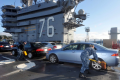
They don't look like they are tied down in any way, but maybe they are still loading. I can't tell if those "puddles" are actually tiedown points. They seem to be periodically spaced, though.
I'm glad to hear that -- an all too uncommon victory of common sense over bureaucracy.

They don't look like they are tied down in any way, but maybe they are still loading. I can't tell if those "puddles" are actually tiedown points. They seem to be periodically spaced, though.
1790361463788.png
 

WBahn

Joined Mar 31, 2012
33,187
That's a LOT of chocks! I wonder how many a carrier normally stocks.

But I don't believe that they rely on chocks alone. Auto carriers have sunk because cars that weren't adequately tied down banged into each other in heavy seas and caught on fire.

There do appear to be a pretty good density of tie down points available. Given the crew size, it wouldn't take long to secure them all an all-hands type operation, but I doubt that's how they do it. In fact, since they probably can't transport more than five or six hundred cars, it would only take a fraction of the crew to do it in very short order, provided the chains and other hardware was distributed efficiently (and one thing that Navy crews are good at is figuring out procedures to things like that pretty efficiently). My guess is that since the onboarding operation is going to take many hours, they probably have a work gang of several dozen people working their way forward as the cars are loaded, probably with one team per column (or perhaps each team works multiple columns). Once a vehicle is parked, someone chocks it, someone else lays out the chains and hardware, someone else secures it, and someone else inspects it to make sure it is adequate. They probably don't have a single group of sailors doing the entire thing, either, but might have each group work for a couple hours and then get relieved by another group to spread the love.

It's not unlike generating a large flight of aircraft for a mission. You have small teams of people dedicated to specific things like fuel and armaments and the teams essentially pipeline their way down each row of the flight line prepping the aircraft. It's highly-orchestrated chaos.
 
In Ro-Ro vessels—or more specifically, car carriers—several thousand cars can be loaded in under 24 hours. Drivers work in a well-coordinated sequence, leaving the vehicles extremely tightly stowed. That´s what they have ample stern ramps for.

While chains might seem like the most appropriate option for lashing, straps and ratchets are actually used instead.

Lashing team follow closely behind the loading process.
 

nsaspook

Joined Aug 27, 2009
16,475
That's a LOT of chocks! I wonder how many a carrier normally stocks.

But I don't believe that they rely on chocks alone. Auto carriers have sunk because cars that weren't adequately tied down banged into each other in heavy seas and caught on fire.

There do appear to be a pretty good density of tie down points available. Given the crew size, it wouldn't take long to secure them all an all-hands type operation, but I doubt that's how they do it. In fact, since they probably can't transport more than five or six hundred cars, it would only take a fraction of the crew to do it in very short order, provided the chains and other hardware was distributed efficiently (and one thing that Navy crews are good at is figuring out procedures to things like that pretty efficiently). My guess is that since the onboarding operation is going to take many hours, they probably have a work gang of several dozen people working their way forward as the cars are loaded, probably with one team per column (or perhaps each team works multiple columns). Once a vehicle is parked, someone chocks it, someone else lays out the chains and hardware, someone else secures it, and someone else inspects it to make sure it is adequate. They probably don't have a single group of sailors doing the entire thing, either, but might have each group work for a couple hours and then get relieved by another group to spread the love.

It's not unlike generating a large flight of aircraft for a mission. You have small teams of people dedicated to specific things like fuel and armaments and the teams essentially pipeline their way down each row of the flight line prepping the aircraft. It's highly-orchestrated chaos.
You might be surprised at how hard it is to move a heavy, rubber non-spinning tire vehicle on the flight-deck non-skid. During calm seas (a coast hugging route from Wa to Ca during a port change) and while at a leisurely pace, the carrier is a very stable platform.
 

WBahn

Joined Mar 31, 2012
33,187
You might be surprised at how hard it is to move a heavy, rubber non-spinning tire vehicle on the flight-deck non-skid. During calm seas (a coast hugging route from Wa to Ca during a port change) and while at a leisurely pace, the carrier is a very stable platform.
But how often can they count on being able to hug the coast in calm seas? Even going from WA to CA, they aren't going to wait for a couple of days of forecast calm seas to set sail. They sure aren't going to count on calm seas if going from CONUS to Pearl Harbor or from the east coast to the west coast.
 

nsaspook

Joined Aug 27, 2009
16,475
But how often can they count on being able to hug the coast in calm seas? Even going from WA to CA, they aren't going to wait for a couple of days of forecast calm seas to set sail. They sure aren't going to count on calm seas if going from CONUS to Pearl Harbor or from the east coast to the west coast.
1790380601696.png
Sure but you see pictures of what actually happened, on that trip, not what could have happened under different conditions.
 
Top