Glad I'm not a passenger

Alec_t

Joined Sep 17, 2013
15,124
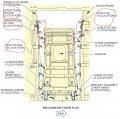
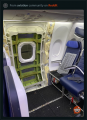
Given that the door plug has to move vertically to be released, there has to be space above the door to allow that movement. This space is clearly visible from the outside of the plane....
1704973545390.png
What is not clear (to me at least) is how is that space sealed airtight?
As for the missing bolts, cotter pin removal/failure plus unscrewing of the nuts* would have had to occur for all four bolts to have separated from the parts they were supposed to lock. That's statistically extremely unlikely.

Edit: * or fracture of the bolts
 
Last edited:

WBahn

Joined Mar 31, 2012
32,935
Given that the door plug has to move vertically to be released, there has to be space above the door to allow that movement. This space is clearly visible from the outside of the plane....
View attachment 312467
What is not clear (to me at least) is how is that space sealed airtight?
As for the missing bolts, cotter pin removal/failure plus unscrewing of the nuts would have had to occur for all four bolts to have separated from the parts they were supposed to lock. That's statistically extremely unlikely.
The plug can be opened to 15° to facilitate maintenance, so one possibility would be that it was opened, which requires removing the six bolts (four in the slots and two in the hinge posts) and they weren't put back after the plug was closed.
 

Alec_t

Joined Sep 17, 2013
15,124
That's certainly one possibility, but since the plane was virtually new (~2 months old), would there have actually been any maintenance scheduled prior to the incident?
 

WBahn

Joined Mar 31, 2012
32,935
That's certainly one possibility, but since the plane was virtually new (~2 months old), would there have actually been any maintenance scheduled prior to the incident?
That I don't know. Depends on what kind of maintenance is done that required the plug to be opened. I've certainly seen aircraft that were designed such that things that normally wouldn't have to be touched for the life of the aircraft have to be painstakingly removed in order to perform maintenance that has to be done every month. But that doesn't explain those loose bolts that they've shown in those pictures since those are not the bolts that have to be removed to open the door. Those bolts may be unrelated to this incident, but are still indicative of a bigger, wider spread problem.
 

killivolt

Joined Jan 10, 2010
836
I think maybe it’s all designed around seating capacity, sacrifice safety for additional space.

Or the engineer is narcissistic, unwilling to sacrifice his ego and put people at risk.

kv
 

nsaspook

Joined Aug 27, 2009
16,353

Thread Starter

cmartinez

Joined Jan 17, 2007
8,788
Root cause people.

That plug door design is not new and is perfectly safe if the bolts are actually in it.
Yes, of course the root cause always comes to people ... and still, I think an inward opening door (or plug, in this case) would've not only added valuable redundancy, but it would've (probably) been mechanically simpler and with fewer parts involved.
 

WBahn

Joined Mar 31, 2012
32,935
There's actually quite a few aircraft that have outward opening exits. I looked into this some time ago and discovered that there are more than I had thought. Many exits that appear to be outward opening initially open inward and then move so that they can open outward from that position. This is very common with main entry doors. Cargo doors usually open outward to maximize usable cargo space. Emergency exits seem to come in a mix. One concern with inward opening emergency exits, which are expected to be operated by passengers with lots of other passengers cramming behind them that all want to get out, is whether there will be the room necessary to open the door inward against a crush of possibly panicked passengers. There's a reason why fire exits almost universally open outward.
 

nsaspook

Joined Aug 27, 2009
16,353
Yes, of course the root cause always comes to people ... and still, I think an inward opening door (or plug, in this case) would've not only added valuable redundancy, but it would've (probably) been mechanically simpler and with fewer parts involved.
That plug is designed to never open unless there is sizable maintenance action to the aircraft. As @WBahn as said there are safety advantages with an outward opening 'emergency' door but this was not a door.
 

WBahn

Joined Mar 31, 2012
32,935
That plug is designed to never open unless there is sizable maintenance action to the aircraft. As @WBahn as said there are safety advantages with an outward opening 'emergency' door but this was not a door.
No, it wasn't a door (it really wasn't a plug, either, but rather plug-like), but it had to be compatible with the emergency door system at that station.
 

Alec_t

Joined Sep 17, 2013
15,124
I'm still puzzled by the visible gap above the door plug when the latter is correctly locked in place. Surely that is aerodynamically inefficient and will create turbulence?
Stuffing something in there would seal the gap, reduce turbulence and prevent the door plug inadvertently moving vertically. I think I'll suggest it to Boeing :D.
 

nsaspook

Joined Aug 27, 2009
16,353
I'm still puzzled by the visible gap above the door plug when the latter is correctly locked in place. Surely that is aerodynamically inefficient and will create turbulence?
Stuffing something in there would seal the gap, reduce turbulence and prevent the door plug inadvertently moving vertically. I think I'll suggest it to Boeing :D.
I'm guessing you're joking.
1705004912782.png
The door needs to move physically up to unlock from the guides and be free of the holding flanges (the A320 does exactly the same thing, check the video) to hinge down or hinge to the side.
 

WBahn

Joined Mar 31, 2012
32,935
I'm still puzzled by the visible gap above the door plug when the latter is correctly locked in place. Surely that is aerodynamically inefficient and will create turbulence?
Stuffing something in there would seal the gap, reduce turbulence and prevent the door plug inadvertently moving vertically. I think I'll suggest it to Boeing :D.
Not much -- narrow slits that are aligned with the airflow produce only a small amount of drag. While it isn't zero, it has to be balanced against the fact that the emergency doors on aircraft that have them have to be able to move up and that the plug doors have to be compatible with them. Now, you could rig something that was, say, spring loaded and came down to fill the gap when the door was closed and that the door pushed up when it was opened, but that's added cost and weight, so will the marginally reduced drag provide sufficient savings over the ownership span of the carrier? I wouldn't be surprised if the numbers on that have been run.
 
Top