A video taken from a Ring security camera in a nearby home captured the crash. The footage shows the plane crashing nose first into the vehicle before skidding on the street. A ball of fire erupts as the aircraft breaks up into pieces.
... the design is made of one solid-molded piece of the jet fuselage while fuel is stored in self-sealing bladders on top of the fuselage instead of the jet wings.
The crew miscalculated by almost 90 tons, Business Maverick was informed. With an error like this, the take-off speeds are calculated as far too low (low TOW, low takeoff speeds). Fortunately, the Airbus is designed to correct these speeds, but not the speeds for flap retraction. Thus when the crew retracted the flaps the plane went into “alpha floor” event. This is where the airspeed is too low and the aircraft is in danger of stalling. A disaster was averted because once again the aircraft’s safety systems took over, adding power and lowering the nose slightly, preventing it from stalling.
Years ago, I was fortunate to get several hours training in Airbus level-D simulators (https://en.wikipedia.org/wiki/Full_flight_simulator) for the A320. On my last session, I asked the instructor if I could try to put the airplane in a spin. He reluctantly agreed -- I think he was curious if it could be done -- and so he put the flight controls in direct law (all protections, including alpha floor, disengaged). We quickly found out two things: 1) an A320 will indeed spin, and 2) the physics of a spin make the simulator a very uncomfortable place to be.A slight miscalculation:
Aren't those machines protected against damage in those extreme scenarios?He finally managed to hit the kill button, bringing the very expensive machine to a sudden stop. He was not happy with me.
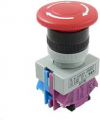
You have to always expect the unexpected. Thus in my CNC build, I have implemented two kill buttons.Aren't those machines protected against damage in those extreme scenarios?

I don't know how close we were (or if we exceeded) the mechanical limits of the simulator, but the movement was so violent and jerky that it did not feel safe. It seemed like the software, trying to simulate out-of-envelope physics, was giving the hydraulics wildly discontinuous control inputs. One would think that the software would have stricter limits than the mechanisms, but these things are as complex as the airplanes they simulate. There may be good reasons to allow "unlimited" software outputs in zero protection mode, and simply warn against such situations in the manual.Aren't those machines protected against damage in those extreme scenarios?

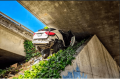
This photo provided by the California Highway Patrol shows the scene where a man fleeing from the CHP totaled his girlfriend's Maserati SUV after he careened up an embankment and slammed into the underside of an overpass, wedging the car under a freeway in Oakland, Calif.
But the captain inadvertently miskeyed, typing ‘500’ rather than ‘500A’, which neither crew member noticed. This error meant the aircraft’s autopilot would limit the aircraft to 500ft ahead of the waypoint crossing.
Luckily they are available these days...Dang it! ... I hate it when the flux capacitor does that!:
News Fail: Cranland Skydiving Accident blamed on Flux Capacitor
| Thread starter | Similar threads | Forum | Replies | Date |
|---|---|---|---|---|
| S | Hello Everyone! Glad to Join the All About Circuits Community | General Electronics Chat | 4 | |
| J | About Parasitic Amp Draw (Battery Drain) in a passenger car. | General Electronics Chat | 22 | |
| J | Drone Hits Passenger Jet | Off-Topic | 10 | |
|
|
I am so glad I am not one minute faster | Off-Topic | 14 | |
| W | Glad I found Ya'll!! | General Electronics Chat | 15 |