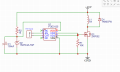
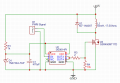
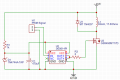
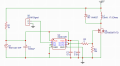
Without any series resistance, it will just take longer before it vapourises.I apologize, that is not the correct PN for the FET. I am using a power MOSFET
Exactly this. That’s why I bolded the statement.The current required for the driver is approximately equal to the driver’s quiescent current, plus the product of the MOSFET’s gate charge and the switching frequency.
In terms of spec, it's about the furthest you can possibly get from the 2N7002!Why have you chosen that MOSFET? Do you really need a 1700v device?
Its an awful device. 450mOhm Rds(on), 5A Id continuous, and, oddly for a TO-247 package, a 1.8°C/W junction to case thermal resistance (most are around 0.2°C/W).In terms of spec, it's about the furthest you can possibly get from the 2N7002!
highest switching speed will be 500Hz, and pulse width about 10%, what does the cap between 5 and 8 do? maybe a 1000uF for C1?Put a 0.1uF ceramic capacitor across pins 5-8 on U2. C1 is not good for high current.
I often use a 0.01uF at the IC, A 1 to 10uF ceramic close and an ele cap anywhere.
Then you probably don’t need a gate driver if you pick an appropriate MOSFET.highest switching speed will be 500Hz, and pulse width about 10%, what does the cap between 5 and 8 do? maybe a 1000uF for C1?
Not if you have sufficient drive and choose a sensible MOSFET with a reasonably low gate charge. What is the source of your PWM signal?if I don't use a gate driver will that not affect the FET's ton and toff?