Facebook
 Google
 GitHub
 Linkedin
Hi,
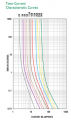
I have been having trouble understanding the Time Current Curve of a glass fuse/blade fuse. I understand that it describes how long it will take for a fuse to blow given the current rating. For example, in the graph below for a 15A fuse, it may take 10s for a 20A transient. I am struggling to understand exactly what this means. If there is a transient that last 10s, that basically means its a continuous current. The filament should have been been burnt out way before that, i.e. at 15A. My question is two fold.
How long will it take for the fuse to trip at 15A if the graph shows it will take 10s for it to blow at 20A? What I could conclude is that it happens so fast it may not be useful to even plot.\
What is the TCC conveying if the fuse is supposed to burn out at the rated current? I understand a transient can happen so quickly current may not flow long enough to heat up and burn the filament but 20A for 10s doesn't seem like a transient. Unless it is purely theoretical?
The graph below is for a blade fuse (automotive application).
Thank you in advance!
I have been having trouble understanding the Time Current Curve of a glass fuse/blade fuse. I understand that it describes how long it will take for a fuse to blow given the current rating. For example, in the graph below for a 15A fuse, it may take 10s for a 20A transient. I am struggling to understand exactly what this means. If there is a transient that last 10s, that basically means its a continuous current. The filament should have been been burnt out way before that, i.e. at 15A. My question is two fold.
How long will it take for the fuse to trip at 15A if the graph shows it will take 10s for it to blow at 20A? What I could conclude is that it happens so fast it may not be useful to even plot.\
What is the TCC conveying if the fuse is supposed to burn out at the rated current? I understand a transient can happen so quickly current may not flow long enough to heat up and burn the filament but 20A for 10s doesn't seem like a transient. Unless it is purely theoretical?
The graph below is for a blade fuse (automotive application).
Thank you in advance!


 I had burned off the 1000 Amp 1200 V 120 kW igbt when mismanaged it, whilst the 5 Amp fuse even not been blown out. So is the sad life, where simplest lesson of this fact cost just the 380 Eur.