Functional Electrical Stimulation Circuit for Foot Drop

Thread Starter

owlguy

Joined Oct 27, 2025
6
Hey everyone!

I am new to the field of electronics, and would like some help with modifying an existing design for a stimulator board. The current design uses an Arduino Uno as the MCU but since there are far better options out there (size, processing power, etc.) I decided it would be best if the design were adapted to another MCU. If anyone is willing and able let me know!
 

Irving

Joined Jan 30, 2016
4,996
Welcome to AAC

I have a lot of experience with FES, and have designed & built several stimulators for research purposes. I also own a high-end Hasomed 8 channel unit for use with my FES exercise bike.

What stimulator board do you have, and do you have schematics etc.?
 

Irving

Joined Jan 30, 2016
4,996
Why do you the processing power of the Arduino is the lmiting factor?
If its for a foot-drop stimulator the Uno isn't an ideal form factor or energy efficient for a wearable device. Processing power for a simple stimulator isn't an issue, but more complex multichannel units with pulse-shaping and micro-pulsing need a bit more oomph.
 

panic mode

Joined Oct 10, 2011
4,864
classic Arduino is bulky and only an 8-bit machine, with clock of 16MHz.
similarly priced RPI zero for example is a 32-bit machine with clock close to a GHz.
there are worlds in between....
 

Irving

Joined Jan 30, 2016
4,996
classic Arduino is bulky and only an 8-bit machine, with clock of 16MHz.
similarly priced RPI zero for example is a 32-bit machine with clock close to a GHz.
there are worlds in between....
For a wearable a RPi is just as bad, possibly worse, than a Uno, too much unneeded baggage (and much more expensive than an Uno clone). For this I'd consider a Seeed Xiao NRF52840 or ESP32-C3 (the BLE5 capability useful for configuring via a 'phone app, but turned off when not needed to conserve battery).
 

Thread Starter

owlguy

Joined Oct 27, 2025
6

Thread Starter

owlguy

Joined Oct 27, 2025
6
For a wearable a RPi is just as bad, possibly worse, than a Uno, too much unneeded baggage (and much more expensive than an Uno clone). For this I'd consider a Seeed Xiao NRF52840 or ESP32-C3 (the BLE5 capability useful for configuring via a 'phone app, but turned off when not needed to conserve battery).
That is the idea! I was already working on adapting the original design to the Seeed Xiao NRF52840 Sense since it has both a BLE module and IMU sensor integrated. The IMU sensor was the choice for gait analysis.
 

Irving

Joined Jan 30, 2016
4,996
Looks pretty straightforward job. With a new PCB layout... I'm already using the Sense for another shoe-related wearable...

1761676294976.png
 

Thread Starter

owlguy

Joined Oct 27, 2025
6
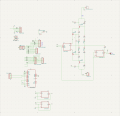
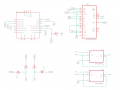
This is the current progress with the Seeed Xiao NRF52840. I'm sure that something is wrong but this is why we fail forward. Should the RC filter be used?Seeed_Xiao_NRF5208.png
 

Irving

Joined Jan 30, 2016
4,996
No info on there regarding the +/-200v supply, though not hard to create, possibly buy-in module.

I'd probably drop the AD5204 in favour of a better-toleranced dual channel from Microchip at 1/5 the price. Not sure the RC needed, esp if co-located on same board.

Looks good so far, but I'll look in more detail later, its supper time here in London.
 

Thread Starter

owlguy

Joined Oct 27, 2025
6
No info on there regarding the +/-200v supply, though not hard to create, possibly buy-in module.

I'd probably drop the AD5204 in favour of a better-toleranced dual channel from Microchip at 1/5 the price. Not sure the RC needed, esp if co-located on same board.

Looks good so far, but I'll look in more detail later, its supper time here in London.
I believe the design used was based on a previous iteration of the Howland pump, maybe the attached paper will help. Regarding the +/- 200v I was thinking of using an IC buck boost converter with that voltage output. Is this the right way to go? Or should I consider designing a discrete one.
 

Attachments

Thread Starter

owlguy

Joined Oct 27, 2025
6
No info on there regarding the +/-200v supply, though not hard to create, possibly buy-in module.

I'd probably drop the AD5204 in favour of a better-toleranced dual channel from Microchip at 1/5 the price. Not sure the RC needed, esp if co-located on same board.

Looks good so far, but I'll look in more detail later, its supper time here in London.
Also I appreciate the help! I got into electronic design very recently and getting guidance has been difficult. Is there any recommendations you would give to a beginner in this field?
 

panic mode

Joined Oct 10, 2011
4,864
the best you can do is share progress on what you are working on and get frequent feedback. that way you don't have to go back and redesign everything from scratch. for example you may want to keep bigger clearance for HV rails. make sure to check pinouts of parts. don't order PCBs if you are unsure. how comfortable you are with soldering and how many units you are thinking of? PCBA can be an option. (service that populates parts on your board, gets everything soldered and cleaned). check how things will fit - be accessible and comfortable for use, diagnostics and troubleshooting.
 

Irving

Joined Jan 30, 2016
4,996
All good advice.

±200v from, say, 11 or 12v is relatively easy using a flyback transformer although you need to consider the current as well. 100mA+ is quite likely, so that's 20W of instantaneous power. That will have implications on PCB layout, battery sizing, etc.
 

panic mode

Joined Oct 10, 2011
4,864
i am not trained or familiar with medical uses but curiosity got better of me, so i was trying to read about this. i cannot find the link now but... one of the sources i looked at mentioned that 200V is unnecessary. more over it is something that may only be needed in extreme cases and only briefly under medial supervision. more reasonable voltage is +/-48..65VDC. also the peak current was something on the order of 50mA but pulses are very brief (300us) and few (some 20-50 pulses per second). this translates to much lower average current draw, even under maximum load - which is also important because it enables practical battery use.
 

Irving

Joined Jan 30, 2016
4,996
Agreed, but to get to the underlying muscle the pulse has to get deep below the skin and that path can vary significantly from individual to individual. Average currents can be quite low, but peak currents can be much higher. On my Hasomed system activation of my calf muscles takes 80mA pulses and is highly dependant on electrode placement. One of my colleagues at UCL did his PhD on foot drop stimulation about 8 years ago; I'll see if I can find his research papers.
 
Top