Full-Wave Rectifier DC Output Calculation Error

Thread Starter

Danlar81

Joined Apr 19, 2019
87
Thanks Mr Al and Mr Chips for the further technical analysis. Very Interesting. It seems by the responses that circuit approximations are used to determine the output values which does make sense unless you have generated a voltage/current Vs time waveform.

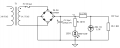
I have a further question in relation to another circuit I have uploaded.

When trying to calculate the total circuit resistance, what resistance values should be used for the LED and Zener?
The actual DC resistance measured using a multi-meter from the capacitor output to ground is approx 1250Ω, it makes sense that this is the load resistance the cap sees, however I have not considered the semiconductors with this measurement. The data sheets for both the LED and Zener give resistance values at specific test currents.
If the currents from the data sheets are not the ones used in the circuit then how can resistances be identified for these components?
Do we assume that IZmin is being maintained for which a resistance value can be determined?
Again what about the LED?
With the circuit I am unsure how to determine the branch current for the LED as I do not know the output voltage of the rectifier without knowing the load resistance.
My intuition is telling me that I cannot just use the measured DC resistance value.

How do I navigate this problem, what assumptions can be made?
 

Attachments

MrChips

Joined Oct 2, 2009
34,882
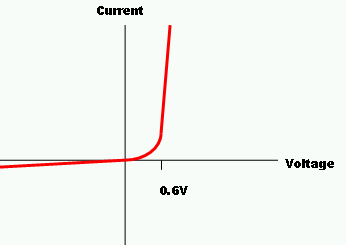
This is another one of those situations where the exact solution is a bit complex. P-N junctions are non-linear devices. You will not find formulas or values for resistances in the datasheets for diodes, zeners, and LEDs.

The I-V curve of a P-N junction looks like this.


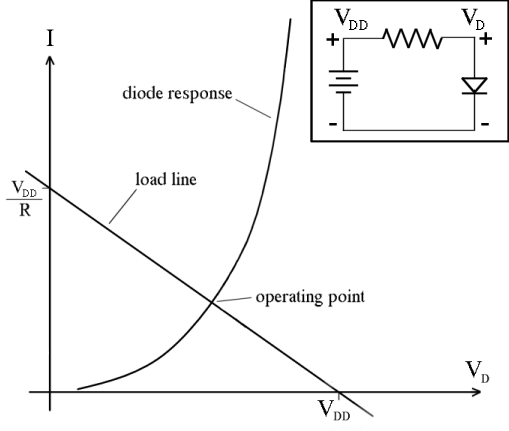
How does one solve for the operating I and V of a diode?

There are two exact ways to do this.

1) You can solve this analytically using the Shockley diode equation knowing the temperature and the reverse saturation current.

2) You can solve this by applying the load line drawn on the same I-V curve determined experimentally.


Reference:
https://en.wikipedia.org/wiki/Load_line_(electronics)

A simple pragmatic solution is use the forward voltage of the diode (or the zener voltage of the zener diode) given in the datasheet and calculate the current through the load (series) resistor.

Usually one's goal is the target current through the diode and hence will select the value of the series resistor based on the voltage drop across the resistor, i.e.

RSERIES = (VS - VD) / ID

where,
VS = supply voltage
VD = voltage across the diode
ID = diode current

In summary, one can turn the equation around. Instead of trying to measure circuit resistance with an ohmmeter, try to estimate the current drawn by the circuit.
 

Thread Starter

Danlar81

Joined Apr 19, 2019
87
Hi Mr Chips,

Yeah I thought as much. I did this Initially and obtained an output of approx 9.1 Volts which was solely based on the values used to maintain zener regulation and load current whilst the zener was regulating.
When I simulated the circuit the value on the output was far higher at around 13.1 Volts using the 10μf cap.
I am a little concerned as this is an assignment and I must include my technical analysis and measured values. When I use this method of calculation there is a big difference between calculated and measured output voltages and do not want to be marked down for this discrepancy, however the more investigation I am performing there a certain assumptions that must be made to be able to calculate values.

I was trying to account for the difference in voltage with this formula again ΔVc = Vm(1-e-t/RLC) and thinking that adjustment of R would do it.
In saying that is RL in the formula explicitly the load resistor value of 1k or the DC resistance that I can measure of 1k25Ω that appears to be what the capacitor sees?
If I do in fact use the resistance of 1k25Ω in the formula I can calculate the output as being 13.84 Volts which is closer to the simulated and measured value but again I'm not 100% sure this is the acceptable thing to do.
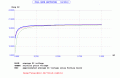
When looking at the waveform in the simulation the decay is again approx 6 mS but due to the increased resistance the ripple is greater.

So many variables.
Regards
Dan
 

MrChips

Joined Oct 2, 2009
34,882
Can you increase the capacitance to 1000μF or greater?

Instead of trying to determine the circuit resistance, determine the current drawn by the circuit first.
In order to do this, make some assumptions on the supply voltage and voltage across the LED and zener diode.
 

Thread Starter

Danlar81

Joined Apr 19, 2019
87
Hi Mr Chips,

Ok I see where you going. Initially making the assumption that IZmin is being met and based off a ½ W zener power rating which means I have 5.1 V at the load, I would then have approx 14.9 mA through Rs. Therefore a drop across Rs of approx 4 volts which would mean the supply is approx 9.1 Volts. Current can now be found for the LED branch by assuming a 2 volt drop across the LED. 9.1 - 2 = 7.1 volt drop across R2. Current in this branch = 2.63 mA. Total circuit current is approx 17.53 mA which is the minimum to maintain zener regulation.

Assuming the perfect cap at the output of the rectifier and an output of rectified AC of 19.11 we then have 14.01 V dropped across Rs which means there is approx 51.9 mA flowing through it. Again assuming 2 volt drop across the LED 14.01 - 2 = 12.01 volt drop across R2.
Current in this branch = 4.45 mA. Total circuit current is approx 56.35 mA .

So this is good as it gives me a range, but in the scheme of writing a calculated value at the output for each value of capacitor what do you say?
I know I can use this formula Vr (P-P) = Idc/2fc
This works pretty well for the calculated output using the 100μf capacitor in relation to what is identified with the simulator, but again highlights a difference using the 10μf capacitor.
I am beginning to think due to the non-linear nature of the semiconductors and if I was to use the formula ΔVc = Vm(1-e-t/RLC) I can only explain the discrepancy between the calculation and what is measured by also including the simulated graph with the voltage/current Vs time wave-form.
You guys have described that there is no hard and fast approach to this in previous threads.
I was hoping to be able to null the difference somewhat, but I guess that's up to the inferences made about the circuit operation.
 

MrAl

Joined Jun 17, 2014
13,720
Here are the results for three different RC time constants:

RC time constants: [0.01,0.1,1]
DC voltage averages: [14.64033165724884,18.43104569044555,19.11592133624535]
voltage solution points: [9.819770765292448,17.60720154295574,19.02335086602774]
voltage droops: [9.386325889117432,1.598895111454144,0.18274578838214]

The RC time constant is simply the load resistance times the capacitance.
So for example RC=0.1 means R=1000 and C=100uf, or R=100 and C=1000uf
and so also for RC=0.1 the solution point is 17.607 volts.

This assumes the diode drops are 0.65v always so there will be less average for heavy loads.
 
Last edited:

MrChips

Joined Oct 2, 2009
34,882
For R = 1000Ω, C = 10μF
t = RC = 10ms

T= 1/2f = 1/100 = 10 ms

This would make a lousy power supply reservoir at 50Hz with hugh ripple voltage.
You need t >> T.

Now try C = 1000μF
t = RC = 1000 x 1000 μs = 1s
Now we are getting closer to a much more useful DC power supply.

ΔV = I / (2fC) = 20mA /(100 x 1000μF) = 0.2V

- matches MrAl's results.
 

MrAl

Joined Jun 17, 2014
13,720
Hello again,

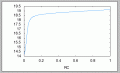
I felt like playing around with this a little more so here is a function for choosing the RC time constant.

V_DCavg=1.7*atan(60*RC-1.8)+RC/2+16 {RC :: 0.01 to 1.00}

That's at 50Hz and with the input AC voltage Vrms=14.5 volts as before.
For 60Hz the RC would have to be 60/50 times larger.

This is not exact, but it gives us an idea what kind of curve we are dealing with. It's similar to an arctan(x) function with an added linear part and offset.
The numbers come out somewhat close but not exact for RC between 0.01 and 1.
Between 0.1 and 1 it's almost a straight line but there is a knee around 0.1 and then it swoops down low for RC<0.1 or so.
 

Attachments

MrAl

Joined Jun 17, 2014
13,720
Hi,

Oh ok yes.

Here is a little bit better rendition. The red plot is the approximation, still not exact but getting closer now. I might do a full curve fit for this if i can. For now it's just done by eye really.

The blue however is based on actual calculations of the average over 100 RC points from 0.01 to 1.0 and so that should be pretty close.
The green is based on the same 100 points but that's the solution point, the point where the exponential meets the next half cycle wavefront, so to get the ripple peak to peak voltage just subtract the green from the blue at any point and that is the ripple peak to peak. As the RC time constant gets longer we see the ripple go way down because the blue minus the green at the end of the plot is a very small value.

Still based on a constant diode drop of 0.65 but as previously noted with a 1N4001 diode it's good for light loads but at say 5 amp peak (very narrow current peaks because of the low capacitive impendance) the drop for one diode is twice that.
Also, this is again with a 14.5vrms input voltage but values can be adjusted for other inputs proportionately.

If anybody else wants to try to get the red formula better, the 55 controls the sharpness of the knee mostly, the 0.02 controls the x offset, and the 8.2 controls the amplitude offset, and the RC/16 controls the upper slope. The 7 controls the straightness of the initial slope. When you adjust one you have to adjust others too, but little by little it gets closer and closer to the blue curve which is considered exact for this experiment.

The green plot is considered to be the exact solution point voltages as the 100 points for that plot were also calculated outright.
 

Attachments

Last edited:

MrChips

Joined Oct 2, 2009
34,882
Nothing beats empirical data.
Transformer: Hammond 167L12
AC Line: 120VAC 60Hz
AC Secondary = 14.5VAC rms
Rectifiers: 4 x 1N4001
R = 1kΩ

C μF| t = RC s| Vrms | Vavg | ΔV
10 | 0.01|15.6|15.4|8
100|0.1|17.8|17.8|2
470|0.5|18.5|18.5|0.4
1000|1.0|18.6|18.6|0.2
 

MrAl

Joined Jun 17, 2014
13,720
Nothing beats empirical data.
Transformer: Hammond 167L12
AC Line: 120VAC 60Hz
AC Secondary = 14.5VAC rms
Rectifiers: 4 x 1N4001
R = 1kΩ
I added the calculated values for the average enclosed in parentheses:
C μF| t = RC s| Vrms | Vavg | ΔV
10 | 0.01|15.6|15.4 (14.64)|8
100|0.1|17.8|17.8 (18.43)|2
470|0.5|18.5|18.5 (19.03)|0.4
1000|1.0|18.6|18.6 (19.12) |0.2

Perhaps the difference is due to the diode peak current with larger cap values and/or cap tolerance.
Also, transformer winding resistance adds to the apparent diode resistance and thus more voltage drop, and so does any small leakage inductance especially if the two coils are wound side by side instead of one on top of the other.
 
Last edited:

MrChips

Joined Oct 2, 2009
34,882
Here is more data I have added.
C μF| t = RC s| Vrms | Vavg | ΔV | Vdiode | Ipeak mA| ton ms
10 | 0.01|15.6|15.4|8|0.7|80|3.3
100|0.1|17.8|17.8|2|0.78|95|2.3
470|0.5|18.5|18.5|0.4|0.8|135|1.6
1000|1.0|18.6|18.6|0.2|0.8|135|1.6
 

MrAl

Joined Jun 17, 2014
13,720
Here is more data I have added.
C μF| t = RC s| Vrms | Vavg | ΔV | Vdiode | Ipeak mA| ton ms
10 | 0.01|15.6|15.4|8|0.7|80|3.3
100|0.1|17.8|17.8|2|0.78|95|2.3
470|0.5|18.5|18.5|0.4|0.8|135|1.6
1000|1.0|18.6|18.6|0.2|0.8|135|1.6
Hi again,

Thanks for the added data.

Now when i subtract the extra diode drop from 19.12 volts i get 18.82 and your data for that C is 18.6 so that's pretty close now, maybe if we knew the primary and secondary resistance that would take care of the extra 0.2 volts. Pretty close though huh.
So adding the diode model would be next, and with that i would see close to 0.8 too, and it actually comes out to 0.76 with the MicroCap model for the 1N4001 diode.
 

MrChips

Joined Oct 2, 2009
34,882
There are two interesting observations from this experiment.

1) Beyond a time-constant of 0.5s (ripple period is 8ms) the results remain the same.

2) For long time constant the peak diode current is 7 times the average load current.
 

MrAl

Joined Jun 17, 2014
13,720
There are two interesting observations from this experiment.

1) Beyond a time-constant of 0.5s (ripple period is 8ms) the results remain the same.

2) For long time constant the peak diode current is 7 times the average load current.
Hi,

Yeah and that peak diode current increase often goes unnoticed. As the cap gets larger the dynamic impedance gets lower so the peak current goes up.
Also for RC of 0.1 or greater the straight line approximation isnt that bad.
 

Thread Starter

Danlar81

Joined Apr 19, 2019
87
Hi MrAl,
That formula works pretty well.
Yes I agree this power supply is ordinary with regards to ripple voltages, however I believe this was the intention of the experiment to highlight the difference the cap alone has on the circuit.

Regards
Dan
 

MrAl

Joined Jun 17, 2014
13,720
Hi MrAl,
That formula works pretty well.
Yes I agree this power supply is ordinary with regards to ripple voltages, however I believe this was the intention of the experiment to highlight the difference the cap alone has on the circuit.

Regards
Dan
Hi,

So what did you get out of all of this with regard to the cap value?
 

MrAl

Joined Jun 17, 2014
13,720
Hi,

Just for the heck of it i went back and recalculated a few average values using the model for the 1N4001 diode.
The results are as follows.

RC=0.01, Vavg=14.59842737282718 (was 14.64 without diode model using constant 0.65 only)
RC=0.1, Vavg=18.36438720302801 (was 18.43 without diode model using constant 0.65 only)
RC=1.0, Vavg=19.04447464856828 (was 19.12 without diode model using constant 0.65 only)

This is where i used the average voltage value to determine the diode current which is also an approximation of the diode current and not as dynamic as it would be instantaneously. Doing it this way takes less iterations to get to a solution, about 10 or so.
 
Top