Facebook
 Google
 GitHub
 Linkedin

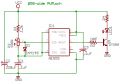
Yep - but Bill, try splitting that R1 into two resistors, and connect pin 7 to the junction of the two resistors, keeping 6 and 2 on the cap.OK, this will go down to 4.5VDC, and will substitute for the other oscillator. A negative is the square wave isn't anymore.

I found this in the AAC experiments, believe it or not. Substitute a current mirror for the resistor, it becomes linear!
Then connect a diode, anode towards pin 7, across the lower resistor.
This way, C1 charges via the upper resistor and the diode, and discharges via the lower resistor.
You can get just about any duty cycle you want from that circuit, although the upper resistor can't go lower than 100 Ohms per volt of Vcc. It also has the advantage that it is independent of the load on the output (pin 3). At low Vcc, the current source/sink capability of pin 3 is greatly reduced.