full bridge pwm controller

ebp

Joined Feb 8, 2018
2,332
The UC3825A may be worth considering. It can be used for peak current or voltage modes. The maximum duty cycle can be controlled by selection of the oscillator components, so you can have all the dead time you want (actually, 70% is rec'd min duty cycle). There may be a Tina-TI model for it.

It looks like average current mode has been largely abandoned by TI except for power factor correction controllers. At the last Unitrode/TI power supply design seminar I attended, at least 12 years ago, the general tone was "well, current mode seemed like a good thing for a time, but ...".
 

Thread Starter

kubeek

Joined Sep 20, 2005
5,796
I having issues with getting the peak current control to work properly with teh SG3825. The issue seems to be that when the pwm regulator starts limiting at the peak current, the capacitor in series with primary starts charging and on the next half-cycle the voltage applied across the coil is different, which causes a different di/dt for each cycle and the circuit starts acting chaotically. What am I missing here?
 

Attachments

ebp

Joined Feb 8, 2018
2,332
Got a schematic?
Peak current mode control can lead to some nasty problems with bridge-derived converters and definite action may be required to keep things from running amok. In a half bridge, for example, extra windings on the transformer can be used to keep the voltages on the two caps balanced.

How much inductance do you need?
 

ebp

Joined Feb 8, 2018
2,332
I don't have LTspice and am not to likely to ever bother installing it. I don't do electronics anymore.

What does D2 do for its living?
 

Thread Starter

kubeek

Joined Sep 20, 2005
5,796
that is a good question, I just copied it from somewhere and it take it that it clamps negative peaks coming from the CT and its leakage inductance, but the sensing seemed to work about the same with or without it.
 

ebp

Joined Feb 8, 2018
2,332
Because of where you have placed the CT it is subjected to unipolar primary current. You must have ample time for the transformer to reset during the OFF time of the bridge. As duty cycle increase, this may become a problem. Allowing as much voltage as possible across the CT secondary during the OFF time helps to assure complete reset. Even the RC across the secondary may impair reset. Often the capacitance of the secondary winding is enough to keep the voltage from getting high enough to cause the rectifier diode to break down.

If you put the CT in the transformer primary it will get bipolar drive. Putting it there also saves having to filter any shoot-through current in the switches. You would need a bridge rectifier.

Try monitoring the current in the CT secondary in your sim, with and without the diode.
 

Thread Starter

kubeek

Joined Sep 20, 2005
5,796
Coming back thinking about the CT, how do I determine how much time is enough for the CT to reset? Is it possible to speed it up by say a zener clamp or something?
Using it in bipolar way seems attractive as it has less issues, but on the other hand i would like to use the CT in the unipolar part of the circuit to detect shoot-through and stop everything. (even though the gate driver ICs should be able to detect that as well through sensing the voltage across the IGBT in conduction).
 

ebp

Joined Feb 8, 2018
2,332
Basically the reset time has to be calculated the same way you would for any inductor - using the volt-second product, in this case for the secondary.
For example if you are running at 90% duty cycle with 10 µs period and 1 volt for 9 µs you must allow at least 9 V for the 1 µs to assure reset. Don't forget to include the diode forward voltage in the ON time voltage.
Depending on the circuit, you can use a zener for the "rectifier", in forward for the sense part of the cycle and in reverse for the recovery. Of course this puts some current through the burden resistor during recovery, which you may not want.

Somewhere in Unitrode pubs there was a good discussion of current sense transformers, but I don't recall if it was an ap note on CTs as such, current sense in general or part of another ap note. It may have been a section in a seminar book. I'll see if I can find a ref for it.
 

ebp

Joined Feb 8, 2018
2,332
The doc I was thinking of was Unitrode Power Supply Design Seminar 1200, Topic 1, by Bob Mammano, Current Sensing Solutions for Power Supply Designers.

It is on the web, but I'm not sure any of the locations are "legitimate" so I won't post a link. The seminar book may be available at TI. It seems some are and some aren't.
 

eetech00

Joined Jun 8, 2013
4,709
OK....might take a few days..but I'll give it shot.....;)
Thank you that would be very much welcome.
the model is here http://ltwiki.org/files/LTspiceIV/Mixed Part List/Spice-Models-collection/swit_reg.lib as sg1846, and the missing DIGIFPWR that you are going to need is here http://ltwiki.org/files/LTspiceIV/Mixed Part List/Spice-Models-collection/dig_io.lib That is as far as I got, I just didn´t have t he nerve to go through all the definitions of logic gates, which seem to be the main culprit, as I don´t know how ltspice treats those and their connection back to analog.
hi
Don't know if your still interested....
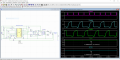
I believe I've finished a model for an SG1846 Current Mode PWM Controller. I was going to try to convert the pspice model but it would take more time than I wanted to take. Anyway...an image of the 20Khz Push Pull circuit simulation below.

20KhzPushPullConverter.png
 
Top