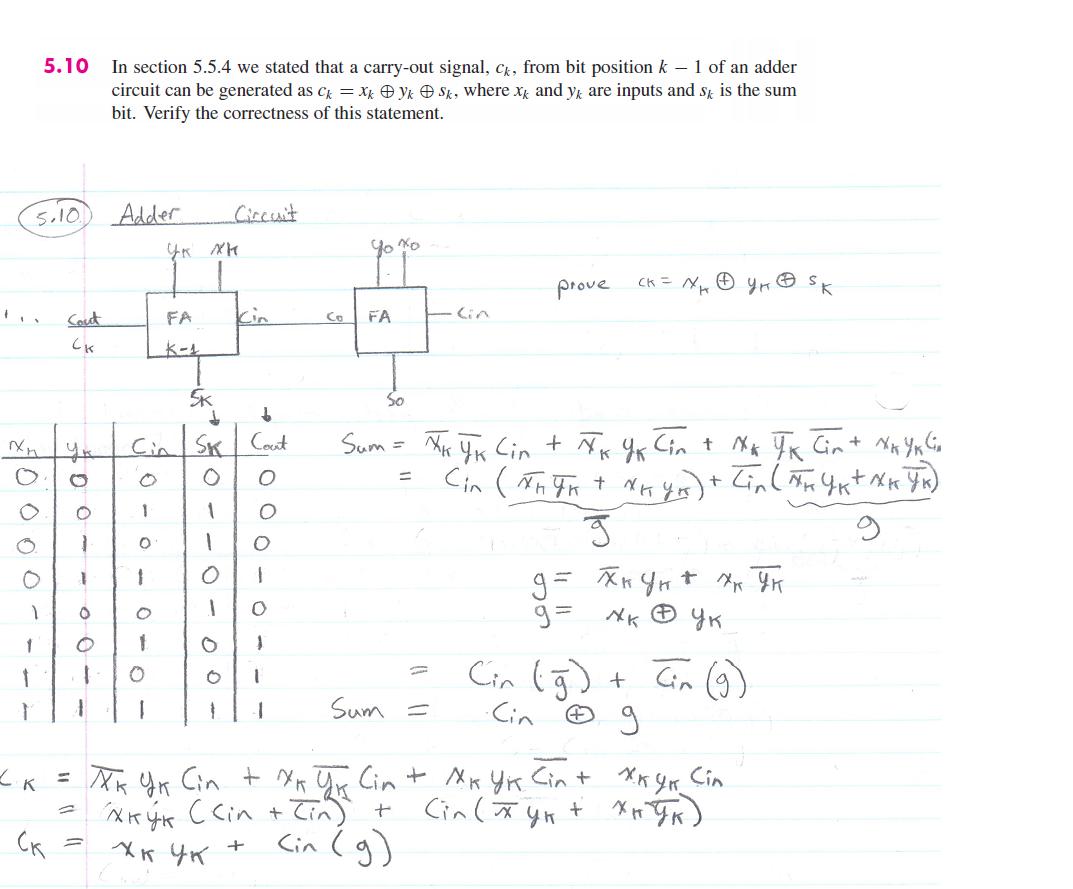
Clarify me this: \(c_k\) is \(c_{in}\) or \(c_{out}\)? If it is \(c_{in}\) I can agree, based only on your truth table. If it is \(c_{out}\) however I can't see how the question can be confirmed.
You can make your proof much easier if you keep in mind that multiple XOR gates will function as an Odd Function (will say if the numbers of ones is odd).
LIBRARY ieee ;
USE ieee.std logic 1164.all ;
USE ieee.std logic signed.all ;
ENTITY adder16 IS
PORT ( X, Y : IN STD LOGIC VECTOR(15 DOWNTO 0) ;
S : OUT STD LOGIC VECTOR(15 DOWNTO 0) ) ;
END adder16 ;
ARCHITECTURE Behavior OF adder16 IS
BEGIN
S < X+Y ;
END Behavior ;
Figure 5.27 VHDL code for a 16-bit adder.
The code in Figure 5.27 does not include carry-in or carry-out signals. Also, it does not provide the arithmetic overflow signal. One way in which these signals can be added is given in Figure 5.28. The 17-bit signal named Sum isdefined in the architecture. The extra bit, Sum(16), is used for the carry-out from bit-position 15 in the adder. The statement used
to assign the sum of X, Y, and the carry-in, Cin, to the Sum signal uses an unusual syntax.
The meaning of the term in parentheses, namely (0& X), is that a 0 is concatenated to the
16-bit signal X to create a 17-bit signal. In VHDL the & operator is called the concatenate
operator. The reader should not confuse this meaning with the more traditional meaning
of & in other hardware description languagesin which it isthe logical AND operator. The
reason that the concatenate operator isneeded in Figure 5.28 isthat VHDL requiresat least
one of the operands of an arithmetic expression to have the same number of bits as the
result. Because Sum isa 17-bit operand, then at least one of X or Y must be modified to
become a 17-bit number.
Another detail to observe from the figure is the statement
S <= Sum(15 DOWNTO 0) ;
This statement assigns the lower 16 bits of Sum to the output sum S. The next statement
assigns the carry-out from the addition, Sum(16), to the carry-out signal, Cout. The expression
for arithmetic overflow was defined in section 5.3.5 as cn−1 ⊕ cn. In our case, cn
corresponds to Sum(16), but there is no direct way of accessing cn−1, which isthe carry-out
from bit-position 14. The reader should verify that the expression X(15)⊕Y(15)⊕Sum(15)
corresponds to cn−1
Okay, as we said before, you can verify that
\(c_{in,k}=x_k\ XOR\ y_k\ XOR\ s_k\)
by looking at your truth table.
You can either do this visually by noticing that the XOR/odd function is confirmed, or by manipulating the minterms, in order to build the XOR function from scratch.
I got it now, thank you. the thing that strange about this questions is that Sk is dependant on the carry out signal from the previous bit. I understand what there asking and how to do the question, but I dont get the point of it.
The circuit at hand might not have the carry values available. If you need them, you must have a way to obtain them. This exercise displays exactly that.

 Facebook
 Google
 GitHub
 Linkedin