Facebook
 Google
 GitHub
 Linkedin

Standard disclaimer for these discussions: DOT-approved lighting units experience this same exact issue, this has nothing to do with street legality or lack thereof
With that out of the way, I have an old GM car that has a double function of the front corner lights (194 bulbs). One side goes to the turn signal circuit, one side to the parking light circuit. I've also seen some cars that have illuminated side lights that are grounded to the turn signal circuit to make a side blinker mod. The problem is usually the front parking light bulbs, which are dual filament (1157 in my case). With all the bulbs incandescent, everything works as expected. The problem comes in when you upgrade everything to LED's. Reason being, the front corner 194's ground through the parking light 1157's. With incandescent bulbs, the resistance is low enough where it doesn't matter much. With LED's in the front parking light 1157's, the resistance becomes so high that the circuits get really screwy with resistance and backfeed etc. to the point that depending on what you pick, you can even wind up having the bulbs try and ground through the instrument cluster turn signal indicators and disabling your turn signals entirely whenever the parking lights are on. Not good.
I decided to try some multimeter measurements with the LED's installed in the front parking light 1157's, but both front corner bulbs removed.
The problem?
With both circuits off, the parking light circuit is connected to GND. The turn signal circuit however is left floating. While I could get a turn signal (and Hazard for that matter) relay that has an actual ground, I want to rewire my car to use the 8-pin Subaru modules so I can throw an old TapTurn relay I have on there for the approach lighting feature, and it too leaves the outputs floating instead of grounded, so a more proper solution is needed.
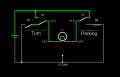
Here is, effectively, what I am dealing with.
[Link to Falsad]
Note that C1-* and C2-* will effectively be an extension cable with some circuitry in the middle to connect any floating grounds. C1 goes to the bulb itself, C2 comes from the bulb feed wires. S1 and S4 are purely to test and see if floating GND vs connected GND works as intended. S2 and S3 flip the turn and parking circuits on and off.
The goal is to connect any floating grounds when a circuit is otherwise off. So in the picture above, since S2 is OFF but S1 is OPEN, C2-T should ground through C1-GND. Current passes from C2-P to C2-T to illuminate L1 as a parking light. For full clarity, let me show other screenshots of the same circuit in different states.
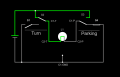
This one is working as intended. S2 is ON, so the turn signal circuit's floating ground should not be connected to C1-GND, and S3 is ON but S4 is CLOSED, so there is no floating ground on the parking light circuit. Current passes from C2-T to C2-P to illuminate L1 as a turn signal.
With both circuits energized, there is no ground through either side. This behavior needs to be preserved:
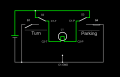
This one is also working as intended. S2 and S3 are both ON, so no ground to C1-GND should be added for either circuit.
My first thought was a couple N-channel MOSFET's in a criss-cross pattern, which fixes the floating grounds!
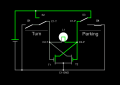
[Link to Falsad]
As intended, S2 is OFF, and S1 is OPEN, so C1-P opens the Gate of T2, passes through the Source of T1, goes across L1 from C2-P to C2-T, and grounds through the Source to Drain of T2, out to C1-GND. Perfect!
...until you try and have both S2 and S3 ON, that is
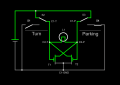
Now both circuits manage to turn on T1 and T2 and ground themselves, bypassing L1 entirely, creating a short circuit. Icky. Obviously an XOR or NAND is needed. So I gave that a go too, but kept getting a "Convergence Failed!" error, so I gave up on that.
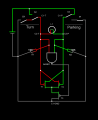
[Link to Falsad]
Thinking maybe this is a simulator quirk, I looked through the NAND examples and tried to use the RTL one:
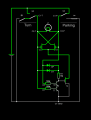
[Link to Falsad]
Unfortunately this doesn't work. Because current is flowing from C2-P to C2-T on L1, both sides of the NAND (DP, RP, and TP for Parking, DT, RT, and TT for Turn) are receiving power, turning on T3 through R1 and C1-GND, which makes the NAND effectively an OR, and bypasses L1 entirely
I've been at this for days throughout Google and such, I'm not an electronics engineer, just a hobbyist who still mostly doesn't understand what I'm looking at (but am trying from time to time). Ultimately my goal is to make a PCB that I can throw on GitHub for anyone else who wants to solve it with a circuitboard mounted by their own quirky blinking 194 bulbs wired the same way and is okay with some soldering and running a ground wire, but until I can figure out what's going on, I can't really do a whole lot of good with it.
I want to use this as a learning opportunity and avoid the overused gimmick of just throwing a relay on it Hopefully someone is able to help me figure out what I'm doing wrong. Or was I right with the last approach and a simulator quirk is misleading me? (Wishful thinking though I'm sure). Thank you!
With that out of the way, I have an old GM car that has a double function of the front corner lights (194 bulbs). One side goes to the turn signal circuit, one side to the parking light circuit. I've also seen some cars that have illuminated side lights that are grounded to the turn signal circuit to make a side blinker mod. The problem is usually the front parking light bulbs, which are dual filament (1157 in my case). With all the bulbs incandescent, everything works as expected. The problem comes in when you upgrade everything to LED's. Reason being, the front corner 194's ground through the parking light 1157's. With incandescent bulbs, the resistance is low enough where it doesn't matter much. With LED's in the front parking light 1157's, the resistance becomes so high that the circuits get really screwy with resistance and backfeed etc. to the point that depending on what you pick, you can even wind up having the bulbs try and ground through the instrument cluster turn signal indicators and disabling your turn signals entirely whenever the parking lights are on. Not good.
I decided to try some multimeter measurements with the LED's installed in the front parking light 1157's, but both front corner bulbs removed.
The problem?
With both circuits off, the parking light circuit is connected to GND. The turn signal circuit however is left floating. While I could get a turn signal (and Hazard for that matter) relay that has an actual ground, I want to rewire my car to use the 8-pin Subaru modules so I can throw an old TapTurn relay I have on there for the approach lighting feature, and it too leaves the outputs floating instead of grounded, so a more proper solution is needed.
Here is, effectively, what I am dealing with.
[Link to Falsad]
Note that C1-* and C2-* will effectively be an extension cable with some circuitry in the middle to connect any floating grounds. C1 goes to the bulb itself, C2 comes from the bulb feed wires. S1 and S4 are purely to test and see if floating GND vs connected GND works as intended. S2 and S3 flip the turn and parking circuits on and off.
The goal is to connect any floating grounds when a circuit is otherwise off. So in the picture above, since S2 is OFF but S1 is OPEN, C2-T should ground through C1-GND. Current passes from C2-P to C2-T to illuminate L1 as a parking light. For full clarity, let me show other screenshots of the same circuit in different states.
This one is working as intended. S2 is ON, so the turn signal circuit's floating ground should not be connected to C1-GND, and S3 is ON but S4 is CLOSED, so there is no floating ground on the parking light circuit. Current passes from C2-T to C2-P to illuminate L1 as a turn signal.
With both circuits energized, there is no ground through either side. This behavior needs to be preserved:
This one is also working as intended. S2 and S3 are both ON, so no ground to C1-GND should be added for either circuit.
My first thought was a couple N-channel MOSFET's in a criss-cross pattern, which fixes the floating grounds!
[Link to Falsad]
As intended, S2 is OFF, and S1 is OPEN, so C1-P opens the Gate of T2, passes through the Source of T1, goes across L1 from C2-P to C2-T, and grounds through the Source to Drain of T2, out to C1-GND. Perfect!
...until you try and have both S2 and S3 ON, that is
Now both circuits manage to turn on T1 and T2 and ground themselves, bypassing L1 entirely, creating a short circuit. Icky. Obviously an XOR or NAND is needed. So I gave that a go too, but kept getting a "Convergence Failed!" error, so I gave up on that.
[Link to Falsad]
Thinking maybe this is a simulator quirk, I looked through the NAND examples and tried to use the RTL one:
[Link to Falsad]
Unfortunately this doesn't work. Because current is flowing from C2-P to C2-T on L1, both sides of the NAND (DP, RP, and TP for Parking, DT, RT, and TT for Turn) are receiving power, turning on T3 through R1 and C1-GND, which makes the NAND effectively an OR, and bypasses L1 entirely
I've been at this for days throughout Google and such, I'm not an electronics engineer, just a hobbyist who still mostly doesn't understand what I'm looking at (but am trying from time to time). Ultimately my goal is to make a PCB that I can throw on GitHub for anyone else who wants to solve it with a circuitboard mounted by their own quirky blinking 194 bulbs wired the same way and is okay with some soldering and running a ground wire, but until I can figure out what's going on, I can't really do a whole lot of good with it.
I want to use this as a learning opportunity and avoid the overused gimmick of just throwing a relay on it
Hopefully someone is able to help me figure out what I'm doing wrong. Or was I right with the last approach and a simulator quirk is misleading me? (Wishful thinking though I'm sure). Thank you!